
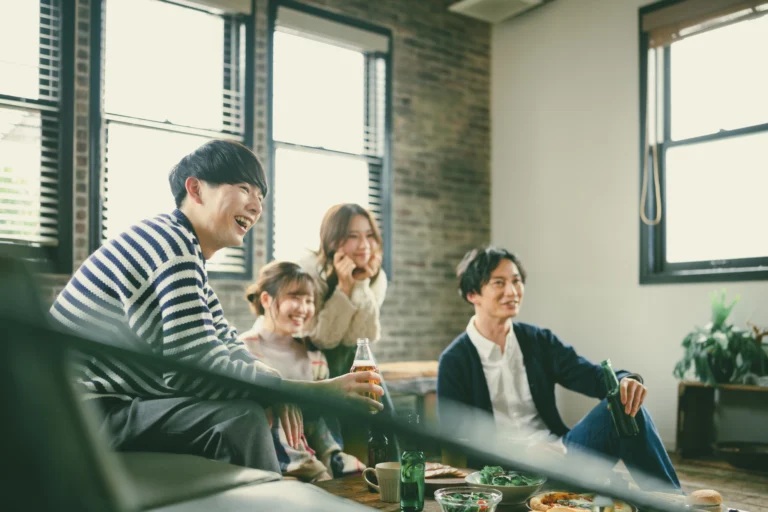
Rental housing is readily available for individuals, married couples, and families in Japan, but much harder to find for a group of friends.
While sharing a house or apartment may be common in other countries, Japanese rental listings tend to sort tenants into “single” and “family” categories. The machinery underneath that split (occupancy clauses, joint-contract requirements, guarantor rules and a screening culture that treats unrelated adults as a risk) quietly forecloses an arrangement that is unremarkable in much of the world.
That’s why Tokyo-based property company Livmo made headlines after it renovated an aging detached house in Setagaya and rented it in August to three people in their 20s from Hokkaido, Ishikawa, and Shizuoka who belong to the same theater troupe. While small, the move cut against the grain in a country where shared living is treated with suspicion.
In this article, we look at the rental machinery behind that exclusion, who it shuts out beyond the obvious, and why it’s increasingly out of step with how people in Japan actually live.
The product launch for friends as roommates
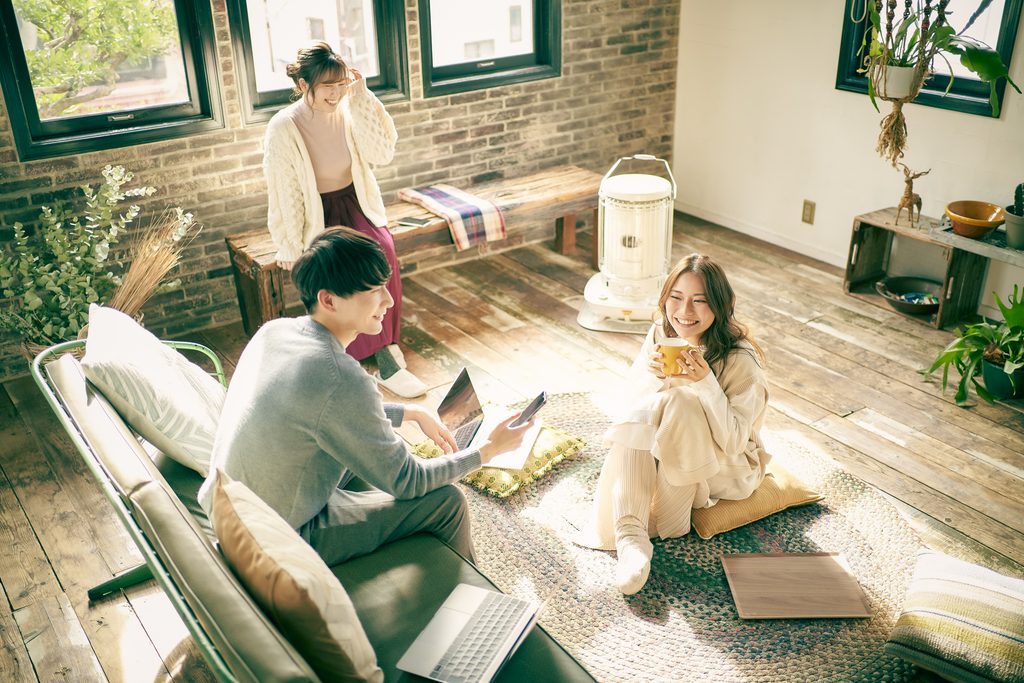
Livmo, founded in 2012, announced on Aug. 4 that it had completed the renovation of a rental house in Setagaya City, Tokyo, purpose-built for “three friends living together,” and that its first tenants had moved in. The company’s stated premise is that demand for multiple-person occupancy among friends is high, but that such arrangements are significantly restricted by family-only occupancy clauses and screening barriers.
The house Livmo rented to the trio is an 18-minute walk from the nearest station, ordinarily a weakness in a rental listing.
Founder Minamoto Yūki, who traces the idea to his experience living in a dormitory as a student, argues that the intangible benefits of living together can outweigh such specifications.
“More than the hard specifications, such as proximity to the station and the latest facilities, it’s the soft value created by the relationships that develop there and the atmosphere that flows under the same roof that enriches people’s lives and hearts,” Minamoto said.
One of the tenants said that without the project, they would’ve given up on sharing a home.
In its press release, Livmo gives three reasons why landlords and property managers may be reluctant to rent to friends. First, if one tenant moves out, the remaining tenants may no longer be able to cover the rent. Second, management companies and owners may associate groups of friends with nighttime noise and mismatched daily routines. Third, deciding who should be the representative contract holder doesn’t fit neatly into the standard lease framework.
The problem is part of a broader pattern: when institutions expect people to have family members available for practical roles, a market can emerge to fill the gap. Japan even has services that provide people to act as stand-in family members for situations where a relative would normally be expected.
These are landlord-side rationales relayed by a company selling a solution to the problem, rather than independent findings. Livmo says that, for these reasons, friends are sometimes rejected at the screening stage or even refused a viewing. In other words, the exclusion can happen before a landlord has assessed the applicants’ ability to pay, meaning it’s not necessarily a question of creditworthiness.
It is a familiar pattern in Japan’s rental market. Unseen Japan has previously documented landlords refusing housing to foreigners, elderly people, single mothers and other groups based on perceived risk or simply because they fall outside a landlord’s preferred tenant profile.
How thin the eligible pool is
Sharekari, a brokerage specializing in room-share placements, estimates that only about 3% of properties on the market are open to the possibility of being shared. Separately, Ace Real Estate, a screening-specialist agency in Takadanobaba, estimates that the proportion of properties available varies significantly by relationship: about 90% for siblings or couples, about 60% for work colleagues, and only 20% to 30% for friends.
Both figures are industry estimates from companies operating in the market created by this problem, and Sharekari’s page dates to 2019–2020. There’s no government dataset that measures how often friends are denied rental properties specifically because they’re friends. That absence is itself notable.
Spelling out the more candid reason, Sharekari’s own list of landlord objections ends with one that isn’t a risk calculation at all: some owners simply can’t understand the idea of unrelated people renting together and refuse on that basis.
The workaround that carries its own penalty

Ace Real Estate describes friends as the hardest category to screen. Such arrangements usually require a joint contract in which each tenant is separately screened by a guarantee company, potentially doubling the guarantee fees. Each tenant may also need to provide their own emergency contact, normally a parent.
The agency also notes that for engaged couples, it has seen landlords demand proof of engagement and later documentation of the marriage. That illustrates how literally the “family” category can be verified.
However, some brokers do not disclose the arrangement to the landlord or management company. Sharekari notes that intermediaries sometimes submit an application without saying that the property will be shared by friends, and warns that if the arrangement is discovered, tenants could face a penalty or an order to vacate.
Question: do you like UJ's independent coverage of Japan? Our writers are supported by our members. Join Unseen Japan Insider to get bonus content every week, an ad-free website, and access to our large and growing Insider archive.If you love what we do, help us pay our writers to do more of it by joining Insider. You'll get bonus content every week, an ad-free website, and access to our large and growing Insider archive.
The guarantor rule changed in 2020
Under the revised Civil Code, which has been in force since 2020, a continuing guarantee contract (根保証契約, nehoshō keiyaku) involving an individual guarantor is void unless a maximum liability amount (極度額, kyokudogaku) is specified in writing.
The Ministry of Justice’s own explainer uses a rental agreement as its first example: a parent guaranteeing their child’s rent to a landlord. In practice, this means a parent can no longer sign an open-ended guarantee. (For a practical overview of how guarantors fit into the Japanese rental process, see our piece on moving to Japan.)
Industry sources describe the rule as one reason guarantee companies have become the norm. That causal link is plausible and widely asserted, but it isn’t established by the Ministry of Justice document itself, which sets out the legal requirement rather than its market effects.
There’s also a simpler economic argument for sharing: it’s cheaper.
In an example from Ace Real Estate, a newer 1K apartment in central Tokyo costs close to ¥100,000 (~$650) a month, while a newer 2DK costing ¥150,000 (~$975) works out to ¥75,000 (~$490) each when two people share it. Move-in costs can be divided in the same way, with roughly ¥300,000 (~$1,950) for an individual falling to about ¥150,000 (~$975) per person when shared by two.
The pressure to share doesn’t exist in a vacuum. In March, Tokyo residents took to the streets to protest rising rents, with organizers pointing to the widening gap between housing costs and stagnant wages. The economic logic behind sharing is therefore straightforward: when a ¥150,000 (~$975) apartment becomes affordable at ¥50,000 (~$325) per person, the ability to live with friends can turn a better property from unattainable into realistic.
Livmo’s first tenants made essentially the same point.
“Plenty of places were out of reach alone, but three people can live somewhere better without having to be careful around each other,” one tenant said.
A category already exists, but it’s not the same thing
Share houses are already a real and growing market. The Japan Share House Organization counted 5,607 buildings nationwide in its 2022 survey, an increase of 550 from the previous year.
But a share house is a managed product: an individual typically enters as a stranger, while the operator manages the property and holds the relevant contract.
What Livmo has done is different. It has taken an ordinary house and rented it to a group of people who already know and have chosen each other.
That gap between a managed share house and an ordinary rental occupied by friends is the crack into which many young people fall.
A May 2025 survey of 665 real-estate professionals by the Housing Future Council found that only 30.2% of respondents with authority over tenant approval allowed same-sex couples in all properties. Another 24.5% allowed them only in properties that could accommodate room-sharing, 21.1% required partnership documentation, and 12.6% didn’t allow them in any properties.
That 24.5% figure provides an important connection to the broader rental system: the same limited pool of “share-friendly” properties that friends may have to compete for can also become the pool to which same-sex couples are directed.
The machinery that excludes friends can therefore impose even greater constraints on people whose relationships do not fit the conventional family model.
The demographic backdrop

The single/family binary is also increasingly at odds with Japan’s changing household structure.
The National Institute of Population and Social Security Research projects that single-person households will rise from 38.0% of all households in 2020 to 44.3% by 2050. In Tokyo, they already accounted for 50.2% of households in 2020.
But that trend is driven overwhelmingly by older people living alone. The institute projects 10.84 million one-person households headed by people aged 65 or older by 2050, including 7.04 million headed by people aged 75 or older.
The data show that Japanese households are shrinking and diversifying. They don’t, by themselves, show that young people increasingly want to live with friends.
There’s a parallel supply-side problem. Japan’s 2023 Housing and Land Survey recorded a record 9 million vacant homes, resulting in a vacancy rate of 13.8% of 65.02 million total dwellings.
Livmo’s project is itself a renovated older house, making the country’s akiya (vacant-house) glut thematically relevant. But the idea that Japan’s empty houses represent a ready-made supply of urban homes for groups of friends does not hold up neatly: the surplus is concentrated in properties that are difficult to reuse and in areas where demand is weaker, rather than in places such as Setagaya.
Livmo’s project is less a solution to Japan’s vacant-house problem than an example of a different mismatch: a housing market with plenty of physical space, but rules and assumptions that can make it surprisingly difficult for certain groups of people to use it together.
Keep reading




Sources
「友人同士の3人暮らし」はなぜ日本の賃貸市場で断られるのか。「ユーザーが欲しいくらし」から逆算したルームシェア物件をプロデュース・入居開始。 PR TIMES(株式会社Livmo)
友人と「3人」で住む家。家族でもシェアハウスでもない、新しいくらしのかたちを作る理由。【2話:お家の完成編】 note(株式会社Livmo)
同性カップル入居を全部断る賃貸業者がなんと1割超 偏見、無理解いまだ残る パートナーシップ制度10年 東京新聞
不動産業界の新たな課題が明らかに ―LGBTQ+当事者への対応実態調査結果― 一般社団法人住宅みらい会議
2020年4月1日から保証に関する民法のルールが大きく変わります 法務省
何でルームシェア可能物件が少ないの?大家さんや管理会社が嫌がる理由とは シェアカリマガジン
ルームシェアの審査は厳しい?同居人や人数の違いで審査基準は変わります。 エース不動産
団塊ジュニアが独居老人となる未来 : 高齢単身世帯が全世帯の2割超に―2050年推計 nippon.com
日本の世帯数の将来推計(全国推計)令和6(2024)年推計 国立社会保障・人口問題研究所
令和5年住宅・土地統計調査 住宅数概数集計(速報集計)結果 総務省統計局
(一社)日本シェアハウス連盟、22年シェアハウス市場調査 全国賃貸住宅新聞
貸しルーム入居者の実態調査の集計結果について 国土交通省