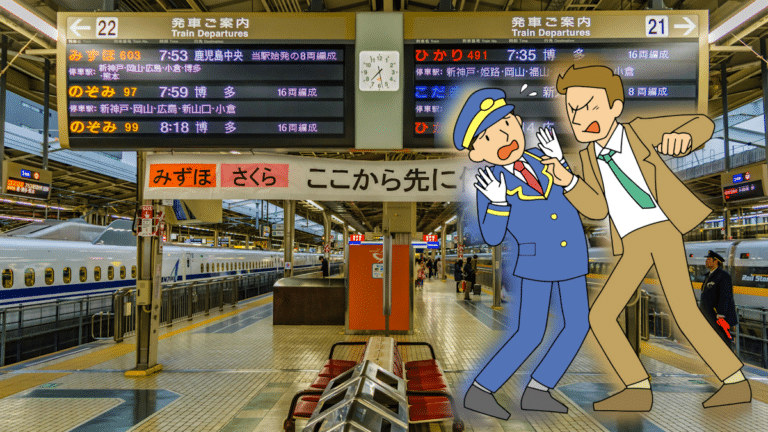

Overall verdictBroad support, with a sharp edge. When tech news site Impress Watch reported that Odakyu Electric Railway would deploy wearable body cameras across all 70 of its stations, the response on X was largely positive but not uniformly so. The top comment by far (509 likes) bypassed the policy altogether and called for police officers to wear body cameras too. The second most-liked comment (250 likes) argued that recording alone is not enough and that footage of offenders should be posted publicly with faces visible. The thread reveals a public that broadly supports these cameras as a protection for frontline workers, but is skeptical that recording alone will deter determined harassers. Several comments also raised pointed questions about accountability in the other direction: if station staff are being filmed, will that footage also be used to check their own conduct?
Note: Comments on X (formerly Twitter) in Japan tend to skew toward the political right, though individual threads may lean left depending on the original poster and topic. These comments are not necessarily representative of the Japanese population as a whole.
What the tweet was about
On April 6, 2026, tech news outlet Impress Watch reported that Odakyu Electric Railway would begin equipping station staff with chest-mounted wearable cameras across all 70 stations on the Odakyu Line starting April 16. The railway plans to deploy 90 units in total, with one to three cameras assigned per station. The model chosen is the LINKFLOW P3000. Staff will also carry an ALSOK emergency pendant capable of instantly alerting security services. Footage will be retained for approximately 50 hours before older recordings are overwritten, and will be managed by station supervisors under strict use-limitation rules.
Odakyu cited a documented rise in kasuhara (customer harassment) and other disruptive incidents as the primary reason for the rollout. The company had already conducted trial deployments at Setagaya-Daita Station in August 2025 and again in March 2026, evaluating several devices before selecting the LINKFLOW unit for its quick activation, stable fit, and instant playback. The cameras are intended to deter bad behavior through visible recording, to provide factual evidence during disputes, and to help staff document equipment faults or safety hazards during routine patrols.
The policy places strict limits on when the cameras can be used: only during incident response, routine patrol documentation, or when a station supervisor judges it necessary. Footage will not be shared with outside parties or used for any purpose beyond those defined. Camera use will be clearly indicated to those being filmed.
Odakyu is not the first railway company in Japan to take a firm stance on customer harassment. JR East announced a zero-tolerance customer harassment policy in 2024, becoming one of the highest-profile companies to publicly refuse service to repeat offenders. The broader trend reflects what Unseen Japan has documented across multiple industries: as kasuhara incidents increase, Japanese companies are shifting from passive tolerance to active countermeasures, including changes to employee name tags, refusal of service, and now physical recording technology.
Sentiment distribution (engagement-weighted)
comment
being discussed
Highest-engagement comments
Activity timeline (JST, April 6, 2026)
Key themes in detail
🔵 Why not police too? · 34.2% of engagement
The single comment that dominated the thread had nothing to do with Odakyu or railway stations. The user simply wrote that, since this is now possible, police officers should be given body cameras as well. The comment received 509 likes, far ahead of any other. Several other comments in the thread echoed the same sentiment, with some adding that police in particular should be subject to the same accountability standard that wearable cameras create. One commenter put it pointedly: “If a private company can do this, why can’t the police?” A few others extended the logic further, calling for body cameras to be standard in schools, convenience stores, and other frontline service settings. The thread revealed a latent public appetite for bodycam accountability that extends well beyond railway platforms.
🟠 Recording alone is not enough · 24.7% of engagement
The second most-liked comment (250 likes) argued that simply recording incidents serves no purpose unless consequences follow. The commenter called for footage of harassers to be uploaded to Odakyu’s official website with faces clearly visible. This was not a fringe view: multiple comments across the thread suggested that publication, public shaming, or formal legal action are what would actually change behavior. One commenter said that determined harassers do not care about cameras and will continue regardless. Another compared it favorably to recording phone calls for “service quality,” suggesting that recording alone, without teeth behind it, has a limited deterrent effect. This reflects a thread-wide skepticism about whether documentation, on its own, is sufficient to address what respondents see as a deeper social problem.
🟢 Broad but quiet support · 18.4% of engagement
Many comments were simply supportive: “great idea,” “go for it,” “this is good.” These attracted fewer likes than the more pointed comments above, but they were numerous. Several commenters expressed sympathy for frontline railway staff, with one noting that the demeanor of Tokyo station workers has visibly changed over the years and attributing it to cumulative exhaustion. Another wished staff could be equipped with a self-defense option as well. The support in this segment was genuine, but largely passive. People are broadly in favor of the measure; they are simply not especially exercised about it one way or another.
⚫ The device itself is too bulky · 11.5% of engagement
A recurring secondary note was skepticism about the physical design of the LINKFLOW P3000. Several commenters described the device as looking like a household intercom, a radio antenna, or a “防護無線” (protective radio) used in railway operations. One commenter worried it looked heavy and would interfere with staff mobility during actual incidents. Another suggested Saitama Kanagawa prefectural police could use it too, given the size. These comments did not oppose the cameras in principle but suggested the implementation was not yet refined enough to feel natural as a workplace tool. Whether this reflects genuine ergonomic concern or simply the jarring novelty of seeing the device in photos shared in the thread is hard to separate.
🟣 Accountability cuts both ways · 8.0% of engagement
A cluster of comments noted, with varying levels of warmth, that if station staff are filming passengers, passengers can film staff back. One commenter framed it generously: “filming each other, no hard feelings.” Another was sharper, arguing that Odakyu may actually be trying to suppress legitimate complaints by making any confrontation feel like it is being recorded for evidence against the customer. A third suggested that recording will also capture any unprofessional behavior by staff themselves, calling it a “double-edged sword.” The most detailed version of this concern pointed out that Suntory, in a similar situation, managed to succeed only with brands it licensed or developed carefully, implying that institutions can fail even with good tools. The concern about staff accountability was not dominant, but it was consistent.