

“Silence is complicity” is a phrase you may have heard before, often used to critique quiet bystanders who witness a crime or injustice. Some argue that quiet bystanders are just as guilty as those who commit the crime for allowing the act to continue.
As it turns out, this reasoning is exactly what a large insurance company argued in Tokyo District Court in a lawsuit brought by a male employee. It defended taking disciplinary actions against the employee who failed to intervene on behalf of a female colleague who was being sexually harassed by a different male colleague.
The court, however, sided against the company.
Lack of evidence

So, what exactly happened for all of this to end up in a lawsuit against one’s employer?
Back in spring 2024, during an after-work drinking session (飲み会; nomikai) with several employees, the plaintiff allegedly failed to take action and intervene on behalf of a female colleague who was the target of repeated sexual harassment remarks by another male colleague.
Due to this, the plaintiff’s employer took disciplinary actions against him for not doing anything to intervene and “indirectly supporting” verbal sexual harassment. The company claimed it was justified on the grounds that they “have thoroughly instructed all employees not to tolerate harassment by others and to speak up.”
Unfortunately, we are not privy to the exact comments or content that were made towards the female colleague. We do know that the court acknowledged only one remark given in the company’s written report on the disciplinary matter, “your bra strap is showing.”
However, the report also mentioned that the circumstances under which the comment was made, as well as the intent behind it, were unclear. This led to the court’s decision to rule the disciplinary action by the company against the plaintiff as unjustified.
The ruling was handed down by Judge Matsushita Emi. “By this remark alone, it is difficult to say that it was indeed sexual harassment, and it cannot be said that the plaintiff had a duty to stop it.”
At the trial, the company did not request examination of the witness, the female employee who was the target of sexual harassment. It also didn’t submit a written statement from her.
Questions linger
This case and the ruling may seem a bit jarring, especially in the wake of the #MeToo movement. Let’s start with perhaps the biggest question: Did the employee who committed the actual harassment face disciplinary action as well from the company?
Regrettably, we don’t know based on the limited information provided in this court case. But if the plaintiff in the case faced discipline for not intervening, it would be reasonable to think that the actual harasser faced much harsher discipline, given the company’s policy against harassment.
Second, why didn’t the plaintiff or any of the other possible attending colleagues intervene when the harassment happened multiple times? Japanese shyness or collectivism may be cited as reasons here. But failure of people to intervene in sexual harassment – or even assault – is a global problem.
Japan’s no different. Many women here have reported feeling that, even if they do speak up, authorities won’t have their backs.
If you see something, say something

In recent years, more and more Japanese people are speaking out against sexual harassment and taking it more seriously. Ito Shiori’s high-profile rape case and her follow-up movie, Black Box Diaries, have done a lot to bring the #MeToo movement to Japan. In fact, the company in the lawsuit telling their employees that it won’t tolerate sexual harassment – and will hold them responsible for it – is fairly progressive for a Japanese company.
Despite this, change can be slow. People are still hesitant to raise their voices and disturb the perceived harmony and peace, even if witnessing a colleague being repeatedly sexually harassed.
While Japanese netizens argue on the definition of sexual harassment and the circumstances of the incident in the court case, many agree that sexual harassment is an issue and needs to be stopped.
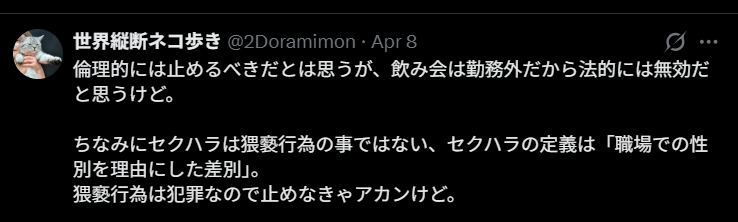
Given that it was a work party, the company’s responsibility is legally murky. Nomikai are a staple of Japanese worklife but aren’t technically company events. It’s also unclear whether the court would have ruled differently if the evidence were stronger.
One thing’s clear: Japan – and every society – should be encouraging more people to speak out against sexual harassment. And supporting those who do.
Keep reading




Sources
飲み会でセクハラ発言を止めず懲戒処分 「制止義務なく無効」と判決. Asahi Shimbun