


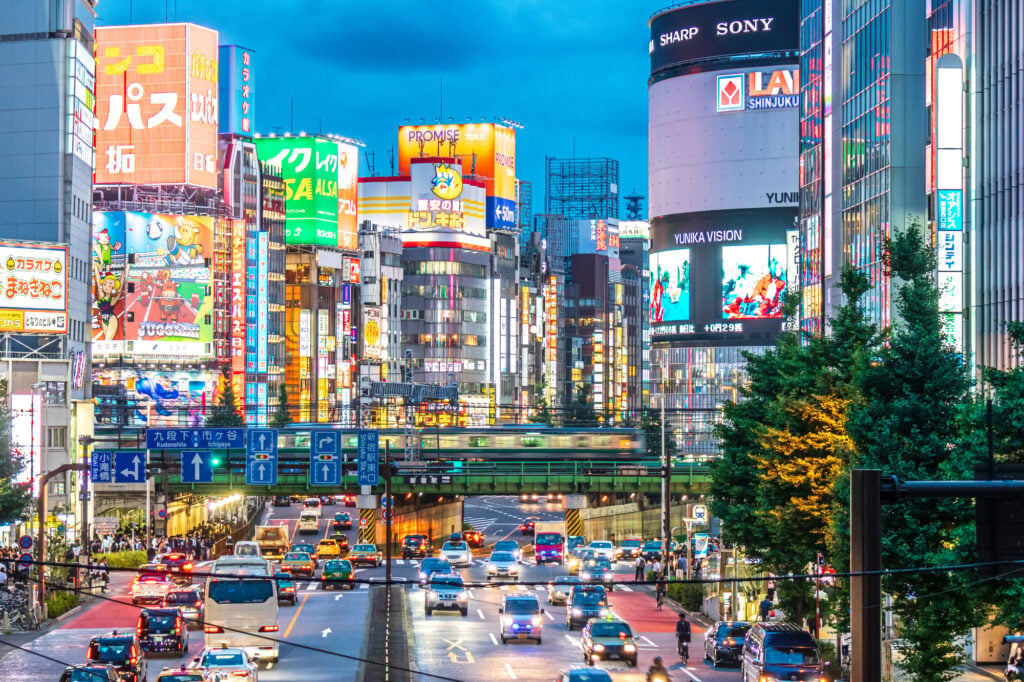
If Tokyo is the modern core of Japan, then Shinjuku, the famed and infamous ward in the capital’s western districts, is Tokyo’s beating heart. Home to more than 350,000, vastly more people – locals and visitors – will make their way through Shinjuku on any given day. Shinjuku Station, the expansive and often confounding transit node in the ward’s center, is the world’s single busiest train station. It sees approximately 3.6 million people pass through it on the daily.
The station houses 35 train platforms (52, if directly accessible sub-stations are counted) connecting Shinjuku with a web of transit lines heading into, out of, and across Tokyo and the surrounding region – the world’s most populated urban area. It’s perhaps the most significant non-Shinkansen station on the loop line, sometimes called “the world’s most important train line,” the Yamanote. To the station’s west is the Tokyo Metropolitan Government Building, home to Tokyo Prefecture’s vast bureaucracy, which moved to Shinjuku from Tokyo’s old core to the east in the 1990s.
But it’s not just the massive station, governmental agencies, and business district of towering skyscrapers that draw people to Shinjuku. Those three elements have created the basis for what Shinjuku may be best known for: its status as a massive nightlife and entertainment district. Yasukuni Avenue, lined with multi-use Zakkyo buildings, where each floor hosts a different establishment, presents what is likely the single-most-identifiable image of Tokyo. (Perhaps rivaled only by the Shibuya Scramble.)
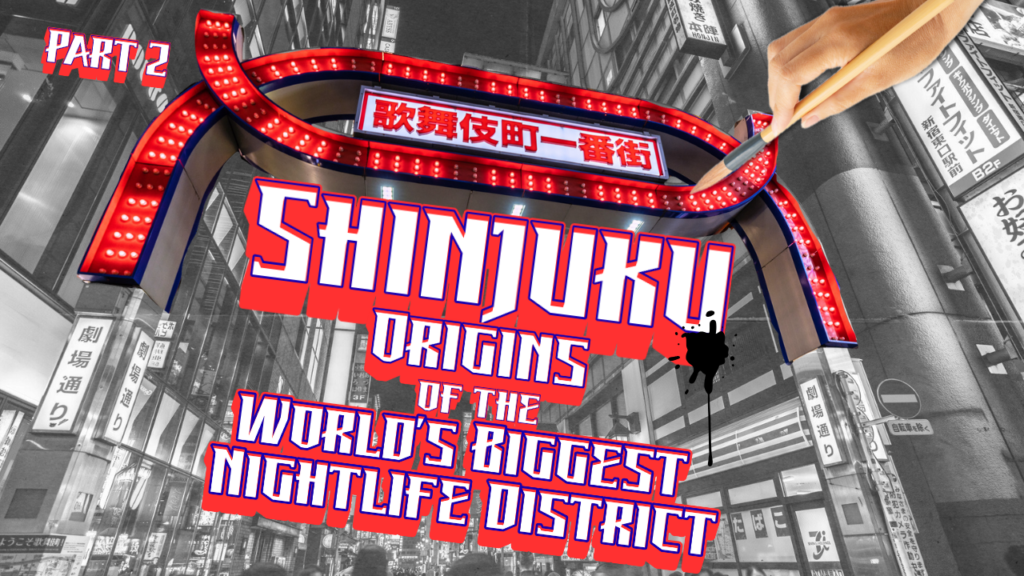
Behind those buildings lies Kabukichō, Japan’s largest red light district, currently undergoing a patchwork whitewashing for the sake of the thousands of international tourists who unwittingly visit the area each day. Dozens of girls bars and host and hostess clubs, innumerable drinking establishments (including nearly 300 tiny bars in the narrow alleyways of Golden Gai alone), restaurants overhead and underground; and, in the seedier alleyways and mid-rises near the love hotels, establishments offering paid companionship that blurs the lines of Japanese legality — it’s all here in Kabukichō. Indeed, “by the early 2000s, [Kabukichō] boasted some eight thousand sex shops, bars, pachinko parlors, karaoke clubs, game centers, and restaurants and two hundred yakuza offices.” [8]
Shinjuku is so vast and dense with establishments that it can be difficult to conceive of just how much activity is happening here at any time. And as with so many places in Tokyo, it can be hard to perceive what lies beneath the warrens of concrete: to look back in time, and grasp what might have been here before the endless entertainment district.
In fact, not 160 years ago, there was very little here at all. And yet, the original Shinjuku, with its origins in the samurai past, offers a fascinating picture of urban change, and a surprisingly direct connection between the seedy entertainment of the feudal age and that of our modern day.
Join us on a journey back into a not-too-distant Shinjuku past, and learn how one of the world’s biggest entertainment and red light districts came into existence.
Just Where, and What, is Shinjuku?
It’s safe to say that anyone who knows Tokyo at all knows Shinjuku. Even if shopping, drinking, and cavorting at host clubs isn’t your style, the massive station’s transit opportunities inexorably draw all towards it. But if you were asked to draw the borders of “Shinjuku” on a map, things might get a bit murkier. In an urban space with as incredible a train system as Tokyo, people tend to create mental maps based on the landscape that radiates out from stations. Since we travel while watching the city slip by from train windows or in the dark of subway tunnels, we can miss the exact linkages and demarcations between different areas of a city. So, for most, “Shinjuku” feels like the massive entertainment complex around the vast Shinjuku Station.
You’d think looking at a map would make things clearer. In its broadest sense, “Shinjuku” is Shinjuku-ku (新宿区): Shinjuku Ward. (Or Shinjuku City, as the municipality prefers to self-designate in English.) One of the 23 “Special Wards” that make up the former Tokyo City, itself disestablished in 1943, Shinjuku Ward is a local governance of 18.2 km2, home to well over 300,000 people, whose borders stretch into neighborhoods that few immediately think of as “Shinjuku.” In the ward’s northeast, this includes the old geisha district of Kagurazaka; in its north, there’s the university party town of Takadanoba and the residential blocks of Ochiai. Other areas within the ward possesed of strong identities separate from “Shinjuku” include Yotsuya, Totsuka, Toyama, Ichigaya, and more.
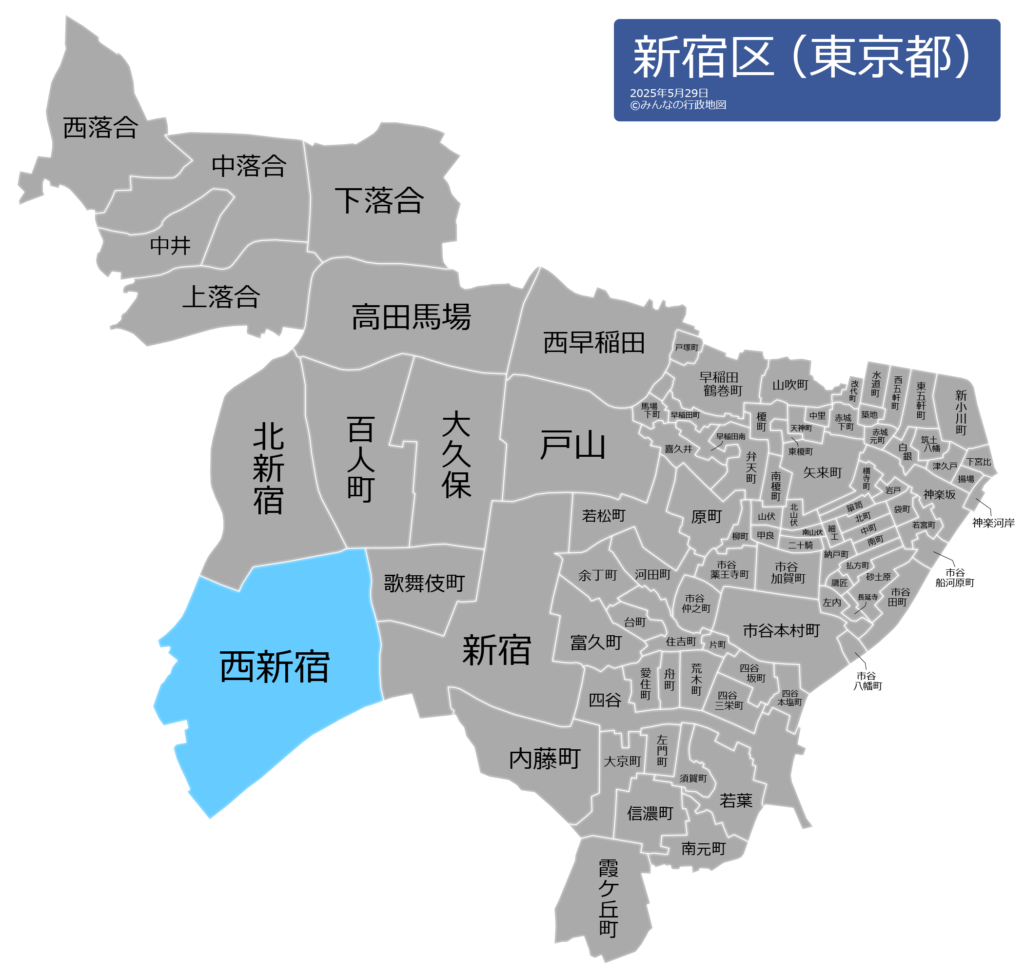
So, what’s the true heart of Shinjuku within the ward of Shinjuku? A map of the ward’s districts – its machi, the next organizational step down from wards – shows three locations with that designation. These are “Shinjuku,” the massive entertainment area east of the station, “West Shinjuku” (the skyscraper district where the ward government building is located), and “North Shinjuku,” home to high rises and some residential buildings. But if machi naming conventions define Shinjuku, then Kabukicho – a machi in its own right – and the famed Shinjuku Gyoen park, found within Naito Machi, wouldn’t count. And that can’t be right, can it?
To make this definition even more complex, some areas certainly feel like Shinjuku that actually aren’t in the borders of the ward at all. Take the north part of the Yoyogi Station area, so close to Shinjuku Station; or, not far away from there, Minami (South) Shinjuku Station on the Odakyu Line. Not only are these not in Shinjuku, but rather in Shibuya Ward; parts of Shinjuku Station itself are in Shibuya Ward! So, as with many issues of geography, sense of place, and municipal borders, lines on the map don’t tell the whole story. Sometimes, if something feels like Shinjuku, in a sense, it is Shinjuku.
But where did Shinjuku come from?
Shinjuku: On the Road to Somewhere Else
The first clue to Shinjuku’s origins lies in its name. For those who can read kanji (Japanese ideographs) and know a bit about Japanese history, the general gist is easy enough to guess: 新宿 (Shinjuku) literally means “new post town.” What exactly a “post town” was, and understanding Shinjuku’s former status as one, requires a little more explanation.
In 1590, the powerful warlord Tokugawa Ieyasu took control of the small castle town of Edo in the Musashino Plain. Tokugawa began the work of transforming this marshy expanse into an urban center, reclaiming land from nearby Edo Bay and creating a system of roads. When Tokugawa emerged as the undisputed ruler of all Japan in the early 1600s, taking the title of Shogun, his stronghold of Edo evolved from a frontier backwater to the de facto capital of the entire archipelago.
The Tokugawa also instituted a system known as sankin kotai, or “alternate attendance,” which necessitated that all samurai lords live every other year in the city. When the year was up, a given lord would return to his own domain in the countryside, leaving his wife and firstborn son behind. This system, essentially one of hostage taking, meant to prevent any potential uprising, had the secondary effect of assuring that Edo would also have a major samurai population. Each lord would need a massive retinue to help run and guard his residence in the city. Commoners also flocked to Edo to create an economy based on serving this massive warrior population. By 1721, the city had over one million people and had become the biggest city in the world. Within 150 years, Edo would take on a new name: Tokyo.
Shinjuku, however, was not part of this feudal metropolis. It sat outside the western gates of Edo, where a road ran towards the city. This road was the Koshu Kaido, one of the five strictly controlled highways that directed movement across the archipelago into the samurai capital. Each road had its system of official shukuba (宿場), post towns where samurai in lordly retinues or weary travelers could rest, take on supplies, and covort at chaya – “tea houses” which also provided alcohol and other indulgences.

The New Post Town: Naito Shinjuku
For the first hundred years during which the Tokugawa shoguns ruled Japan from their capital of Edo, the area that is now Shinjuku was known as Naito-machi — a mere collection of villages and farmland along the final stretches of the Koshu Kaido road. The area was so called as it was home to a secondary mansion for the Naito clan, mostly used in case the Naito lord needed to flee his primary residence in the city proper.
The Tamagawa Aqueduct, a major civil engineering milestone and one of the most important sources of drinking water for Edo, ran next to the road. The closest designated shukuba post town was further to the west; this was the joint lower and upper Takaido-shuku towns located a distant 10 kilometers from the entrance to the city. This posed a major inconvenience to the increasing number of commoners, samurai, and lords traveling on the Koshu Kaido as Edo’s population and importance expanded during that first century of Tokugawa rule.
In 1697, a group of merchants from Edo’s northeastern temple district of Asakusa, knowing a good business opportunity when they saw one, petitioned the Shogunate for the right to open a new shukuba on the Koshu Kaido. This one was to be closer to the city itself. The Shogunate, seeing the sense in the petition, allowed this initial group of ten to begin the work necessary for a new post town.
The chosen spot was the fork in Naito-machi where the Koshu Kaido split into a branch route known as the Ome Kaido. The merchants began a process of road widening and leveling, and by 1699, the new post town was ready for business. It took the name Naito Shinjuku (内藤新宿), the “New Naito Post Town.” Soon, it even had twenty-four surrounding hamlets that were officially obliged to supply labor and horses for the new post town. One of these was known as Tsunohazu Village – the area we now know as Kabukicho.
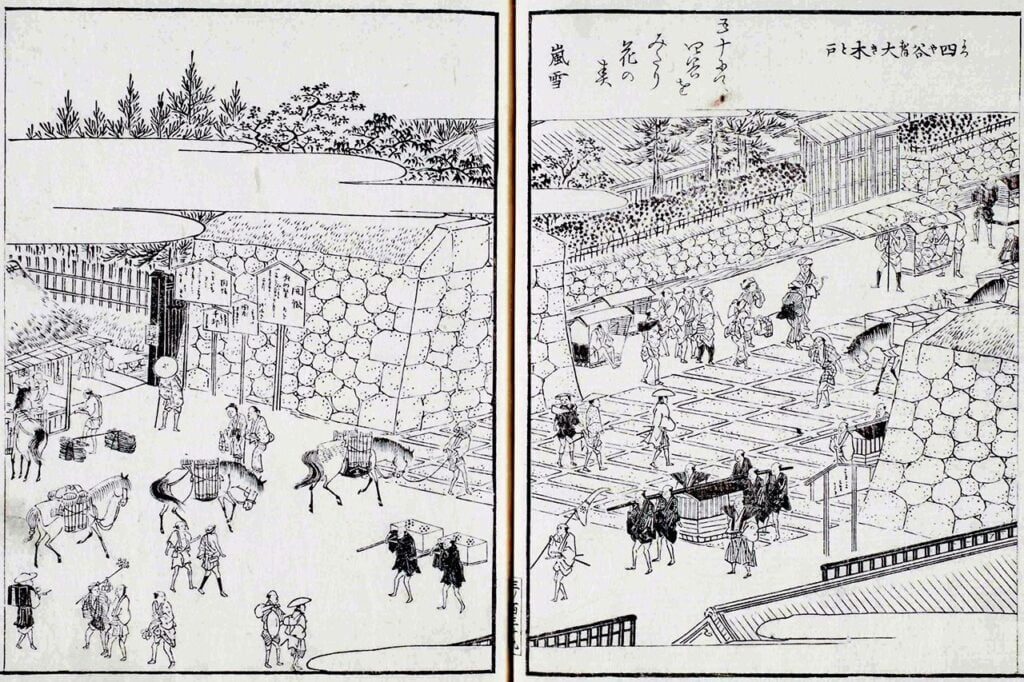
The Naito Shinjuku post town was not located directly next to the area now mostly associated with Shinjuku – the region directly surrounding the modern train station. Rather, it was a bit further east. There, it stretched for about 1 kilometer from what is now Shinjuku 3-chome to the western reaches of Yotsuya. Its endpoint was the Yotsuya Okido, the great gate that barred entry into Edo proper.
Boom and Bust on the Road to Edo
The Naito Shinjuku post town consisted of a road running for about 1 kilometer (3330 feet) at a width of about ten meters (33 feet), with low wooden buildings on either side. Many of these were hatago (旅籠), general lodging for travelers. Others were chaya teahouses, with a wide variety of stores, stables, and the occasional Shinto shrine and Buddhist temple. Daimyo, samurai lords, would usually only deign to stay at great Honjin houses reserved for their services – but Naito Shinjuku, which saw a relatively small amount of lordly traffic, only occasionally had a designated Honjin building. In fact, only three samurai domains regularly used the Koshu Kaido road for their annual processions into or out of Edo.
Things weren’t immediately all roses and mitarashi dango for Naito Shinjuku, however. The post town was hit by two major fires within its first decade and a half; one in 1702 and one in 1716. These necessitated major rebuilding efforts and put the Asakusa merchants group into arrears on money owed to the Shogunate. Worse news was awaiting the post town, however. In 1718, the samurai government ordered that Naito Shinjuku be struck from the list of official shukuba after only 19 years of operation.
The exact reasoning for the shutdown order has been subject to rumor and legend, but the official word from the Shogunate related to the small number of travelers on the Koshu Kaido — and an issue that fits more within the modern conception of Shinjuku: moral panic over the presence of women of loose virtue.
Three Centuries Ago, Already a Den of Iniquity
One peculiar type of serviceperson to be found at the shukuba was meshimori-onna (飯盛女), literally “meal serving women.” While these women did provide food at restaurants and inns, they also offered other, more intimate services. Meshimori-onna were part of the milieu at Naito Shinjuku from its earliest days, and were a major attraction that brought visitors to the post town. In fact, the appeal of the drinking and partying establishments was a significant basis for the shukuba economy, since the official purpose of the post towns – relaying people and packages and providing lodging – had to be done at designated prices that made things difficult for the town’s bottom line.

Want more news and views from Japan? Donate $5/month ($60 one-time donation) to the Unseen Japan Journalism Fund to join Unseen Japan Insider. You'll get our Insider newsletter with more news and deep dives, a chance to get your burning Japan questions answered, and a voice in our future editorial direction.
All four of the great post towns at the gates of Edo (Naito Shinjuku, Itabashi, Senju, and Shinagawa) steadily evolved into party towns, even attracting denizens within Edo to make day trips beyond the city’s gates for drinks and debauchery.
Unfortunately for Naito Shinjuku, the Shogunate looked askance at their officially designated post towns becoming dens of iniquity. The samurai government went through regular periods of moral panic, and as early as 1617, the Tokugawa had ordered that only a single place in Edo be allowed for prostitution: the great pleasure quarters of Yoshiwara, north of Asakusa’s Sensoji Temple. As Naito Shinjuku began drawing more and more visitors hoping to acquaint themselves with meshimori-onna, the town also drew the ire of the larger pleasure quarter; the official licensed quarter issued a complaint regarding the unlicensed brothels in the post towns.

A Scandal for the Samurai
The story also goes that the lordly Naito family became embroiled in the scandals of the post town that bore their name. A younger brother of Lord Naito Shingozaemon had become a regular at the brothels of Naito Shinjuku. One day, the brother had drunkenly tried to force a meishimori-onna from a certain inn to leave with him; the staff ganged up on him and beat him to a pulp.
When he showed his bloodied face at the family mansion, Lord Shingozaemon felt a burning shame. The Naito clan had already been made to give up much of their land in the area for the construction of the official post town; now, the lord’s own brother was cavorting about the local alleys like a licentious fool. Shingozaemon ordered his brother to commit ritual suicide and brought his head to the local Shogunate officials, begging them to shut the post town down.
Whether the story of samurai fratricide is historically true or not has been debated; either way, the Shogunate was moving into an era of financial and moral reform upon the ascension of the 8th Tokugawa Shogun, Yoshimune. Naito Shinjuku had gained a reputation as one great brothel, and with only a few samurai lords using the Koshu Kaido for their annual travels to Edo, it seemed the new post town was more trouble than it was worth. Naito Shinjuku was struck from the official list of shukuba, and quickly fell into decline. Despite repeated requests that it be reinstated, it would take more than half a century for it to regain its former status.
Naito Shinjuku was finally reborn in 1772. During the intervening 54 years, agricultural development of the western plains near Edo had continued afoot, and the Koshu Kaido gradually grew in importance. At the same time, the major shukuba had continued to face financial difficulties, with official prices simply too low. At long last, the Shogunate retracted its policy limiting prostitution in the post towns; it was the dawn of a new age of commercialism over moral policing. The same activities that had caused the downfall of Naito Shinjuku were now a main impetus for its revival; opened again for business, the post town quickly blossomed into a feudal-era transit and entertainment hub very similar in spirit to the iniquitous Shinjuku we know today.

End of an Epoch; Beginning of an Era
The heyday of the reborn Naito Shinjuku post town would last for less than a century. Meanwhile, Edo continued to grow, and the surrounding Musashi plain became a more important site of agricultural production for feeding the hungry metropolis. The post town, which saw little foot traffic in its original late 17th-century iteration, grew in significance and size. Its entertainment and housing facilities spilled out from its original kilometer perimeter, reaching further down the Koshu and Ome roads to the town of Tsunohazu (now Kabukicho) and the Yodobashi Bridge. (Now on the border of Shinjuku and Nakano Wards, and the namesake of the major Yodobashi Camera brand.)
With the dawn of the 1850s, however, the post town was about to be rocked by a seismic event; one that signaled a sea change for all feudal-era Japan. In July of 1853, four American warships, bristling with cannon, sailed through the entrance of Edo (now Tokyo) Bay. The squadron was led by Commodore Matthew Perry, with strict orders to finally open Japan to Western trade after two centuries of self-imposed isolation. Japan would never be the same.
What followed the so-called “Opening of Japan” was fifteen years of deep unrest and social change, as the weakened samurai government tried and failed to resist challenges to its authority. In 1862, the Shogunate relaxed most of the Alternative Attendance regulations, making the required stays in Edo less frequent, and allowing wives and firstborn sons of lords to return to their home provinces. The Shogunate intended this relaxation to allow samurai lords to focus on national defense; instead, it emptied out Edo. The raison d’etre for the city – and the post towns that led to it – had been greatly diminished. By 1867, when the Meiji Restoration toppled the Tokugawa dynasty and restored the emperor to political control, Edo had lost half its population. Inevitably, Naito Shinjuku was reduced to a near wasteland as well.
And yet, this was far from the end for the defunct post town.

Modernity Comes for Shinjuku
On September 3rd, 1868, the new Imperial government of Japan renamed the old samurai capital of Edo to “Tokyo.” This “Eastern Capital” was reborn as the new seat of the Emperor, and a series of modernizing measures was put into effect. The new City of Tokyo mostly existed within the borders of old Edo, with Naito Shinjuku just outside of its municipal territory. The population of the surrounding region slowly rebounded.
Though diminished by the end of the Shukuba system, the area directly around the old post town persisted. In 1872, the imperial government issued a proclamation of liberation for all women in the pleasure quarters; this had the effect of weakening the old Yoshiwara, while allowing Naito Shinjuku to flourish under a new system of prostitution. The old hatagoya inns of the post town were converted into karizashiki, “rooms for rent,” out of which now personally-licensed women could work their trade.
This was an era of great change, with new technologies, modes of transport, fashion, and mores. The men visiting Naito Shinjuku, who only years before had worn kimono and straw sandals, were shortly venturing into the district in suits and bowler hats. For Shinjuku, however, the greatest change of all would come via a newfangled technology of mass transit: trains.
Shinjuku Station: A Modest Birth for the World’s Biggest
When Japan’s first private railway company, Nippon Tetsudo, opened Shinjuku Station in 1885, the samurai government was only 17 years in the rear view. The station was built to the lightly populated west of Naito Shinjuku; despite bypassing the old shukuba, the station was still close enough to allow visitors to reach its entertainment district on foot.
A small suburban station on the line between eastern Shinagawa and even more distant Akabane, two-car steam engines would depart Shinjuku every hour and a half. The average daily passenger statistics showed only 50 people, and there were even days when not a single passenger embarked or alighted from the trains. [1] A far cry from the heyday of the nearby shukuba or the nightlife district to come, the only entertainment directly next to the station was a small grouping of tea houses. Much of the surrounding area to the west, north, and south was still farmland. Even two decades later, foxes were known to live in the weed-strewn plots around the station.

By 1900, however, the city of Tokyo was growing, and this suburban station was gaining significance as a hub; new lines were added, and the station building was rebuilt and enlarged. In 1920, the borders of Tokyo City expanded, and the eastern parts of Shinjuku finally joined Tokyo proper. It was 1923, however, that was perhaps the most important year in Shinjuku’s history since Naito Shinjuku closed down.
On Saturday, September 1st, a massive earthquake struck the Kanto Plain, with resulting firestorms raging across almost the entirety of the old eastern part of the city. As many as 140,000 people died, and 2.5 million people were left homeless.
With the merchant quarters of the old Shitamachi left in ruins, an exodus towards the relatively untouched areas of western Tokyo began. The Shinjuku area, lying on the very edge of Tokyo proper, and with good access via its various train lines, suddenly became a desirable neighborhood. Major department store brands, like Mitsukoshi and Isetan, relocated to the area. The westward exodus was so extreme that, by 1927, this once-insignificant train station was already the busiest in all Japan.

The “Anus of Tokyo”
The mass expansion of Shinjuku, now a modern transit, residential, and shopping hub, made some of the bawdier aspects of old Naito Shinjuku feel untoward. The main street of this red-light district was slowly cleaned up, with the “rooms for rent” moving into the back streets. Nonetheless, these legacy businesses from the feudal era remained all the way until the full illegalization of prostitution in the decades after World War II. Even thereafter, Shinjuku has remained Japan’s biggest red light district, in both a legal and illegal sense.
Shinjuku also took on a less-than-appealing appellation: “The Anus of Tokyo” (東京の肛門).
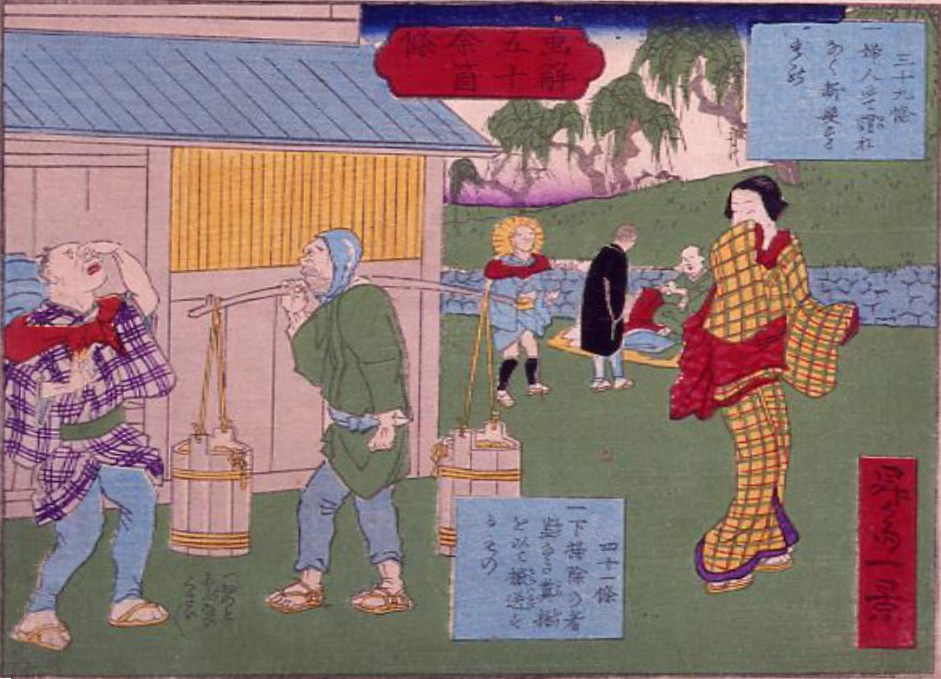
Indoor plumbing was one of the last advances in modern living to fully penetrate the city. Instead, night soil vendors continued to walk the city at night, purchasing bodily waste from residents to resell to the farming villages just outside of Tokyo.
As the urban sprawl of the capital began to swallow up farmland, however, the effort of hauling waste to from the center of the city to an ever-more-distant countryside increased in difficulty. Shinjuku, still on the comparative edge between city and country, was often clogged with hundreds of night soil carts heading to the farmland. Add to that the horse dung from carriages (in the brief decades before gas and electric conveyance fully took over), and you can see why this city gateway took on such a dubious bodily honorific. [12]
Interwar Flourishing
But not all aspects of Shinjuku were of such ill repute. In the mid-1920s, as trolley lines began connecting Shinjuku to the Tokyo interior, and buses radiated out from a new, enlarged Shinjuku Station to the ever-growing western suburbs, Shinjuku became a prime destination for filmgoing and theater. The Musashino-kan cinema opened in 1920 and was soon among the best-loved theaters in Tokyo. It specialized in foreign cinema and featured top-level benshi, skilled narrators for silent films. Meanwhile, the legendary Moulin Rouge Shinjuku-za opened in 1931, offering both titillating and edifying review-style performances.
In 1927, a new bookstore, Kinokuniya, appeared to fulfill the reading interests of local students, housewives, and a new type of worker – the salaryman, a group whose numbers swelled in the metropolis each year. The company had originally been a dealer of lumber and charcoal in Yotsuya, due east of Shinjuku. The 1923 earthquake forced the storefront to Shinjuku, where the founder reimagined the company as a book seller. Their original location included a 2nd-floor art gallery, perfect for the modern bohemian aspirations of the up-and-coming district.
See a side of Tokyo that other tourists can't. Book a tour with Unseen Japan Tours - we'll tailor your trip to your interests and guide you through experiences usually closed off to non-Japanese speakers.

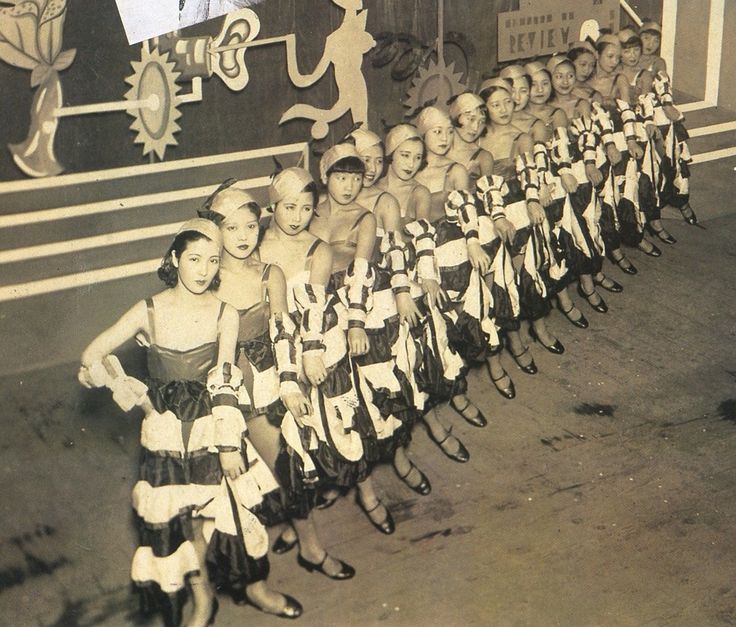
Restaurants and cafes helped wet Tokyoites’ appetites for new foreign foods. As but a single example, in 1909, the Nakamuraya bakery moved into Shinjuku. The shop was run by a husband-wife duo of philanthropist, pan-Asianist restaurateurs named Sōma Aizō and Kokkō. Aizō invented and popularized the Japanese cream puff, and the pair used their funds to open a salon next to the shop that served as a meeting point for artists and political thinkers of the day. The two also provided a hideaway for the exiled Indian revolutionary Rash Behari Bose, who married their daughter; upon Bose’s urging, in 1927, Nakamuraya introduced the first authentic Indian curry to the Japanese market. Nakamuraya’s curry remains legendary.

Emergent Shinjuku, once a comparative backwater post town, was on the ascent. As an entertainment district, it was slowly eclipsing the two great neighborhoods of the era: Asakusa and Ginza. As a site for vaudeville and theater, it had much in common with the much older Asakusa, and a more modern — if less classy — feel than the rarified air of Ginza, with its high-class geisha. To its south, another new town, Shibuya, was growing up as a secondary western transit and entertainment hub, but was not yet at the same level.
The west of Shinjuku Station was still comparatively subdued. Following the legacy of the Tamagawa canal that ran to its above-ground terminus at the Great Yotsuya Gate, a vast water purification plant had been established in the area in the early post-Restoration decades. The aging samurai-era water infrastructure had become a source of disease for the vast city, with cholera breaking out in the 1880s; in 1899, the Yodobashi Purification Plant officially opened, providing all of Tokyo with clean, reliable water. The plant, a vast open-air aquifer, occupied much of Shinjuku west of the station.

War Comes for Shinjuku
Interwar Shinjuku was a raucous, cosmopolitan town. Yet, by the 1930s, elements of what attracted Tokyoites to the district – flashiness, westernized drinking and eating, foreign films, plays, and books – also set local businesses up for conflict with an increasingly controlling and xenophobic government. On the business end, rationing and product bans starting with the onset of the 2nd Sino-Japanese War (1937-45) had a major cooling effect. The sale of food, clothing, and luxury items was all tightly curtailed. Worse still, many of the men working in the nightlife and entertainment districts were being drafted to the front. The wartime government banned most dance and beer halls; revelry came to a standstill. Much of Shinjuku emptied out. [7]
Things only got worse as the Pacific War began in the early 1940s. The famed Shinjuku Moulin Rouge was subject to a clear example of kotobagari – the hunt for foreign words. The French name, based on the legendary Parisian cabaret, disappeared; in its place, the theater took on the quotidian Japanese name of Sakubunkan (作文館, Hall of Composition). The house’s scripts, known for their colorful satire, were subject to censorship. Military police – the dreaded Kempeitai – watched over performances, ready to stop unpatriotic departures by performers or outbursts by the audience (many of whom were now young men in uniform). On the streets outside, parades for departing soldiers and fire preparedness drills overtook the former crowds of merrymakers.
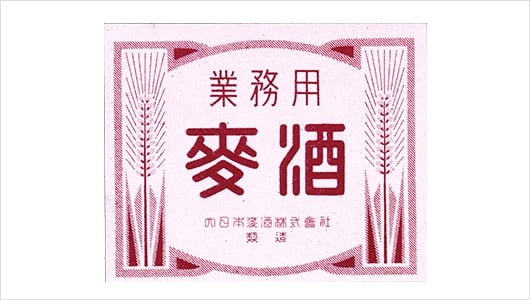
Even alcohol, the lifeblood of the party scene of Tokyo, was hit with censorship. Amidst rationing of base materials, with precedence given to feeding the military, each year from 1937 saw taxes on booze raised to help provision the war effort. In 1943, the government went a step further, unifying the various beer brands and eliminating trademarks and individual labeling. For years, illuminated signs for Ebisu Beer had guided Shinjuku patrons to establishments where they could drink that mildly fancy brew. Now, “Ebisu Beer” was no more. In its place, and in the place of the foreign word “beer” (ビール) itself, was a unified label for bakushu. Beer itself was now merely literal “barley alcohol.” [8]
The culture of Shinjuku was gravely shaken by wartime deprivations. Soon, the district’s environs themselves would face physical oblivion.
The story of Shinjuku continues in part 2 – read on!
Tokugawa Ieyasu: Japan’s Most Cutthroat Health Nut?
Japan’s most ruthless and efficient ruler believed a good diet was the key to success. Here’s how he kept his edge, according to historians.
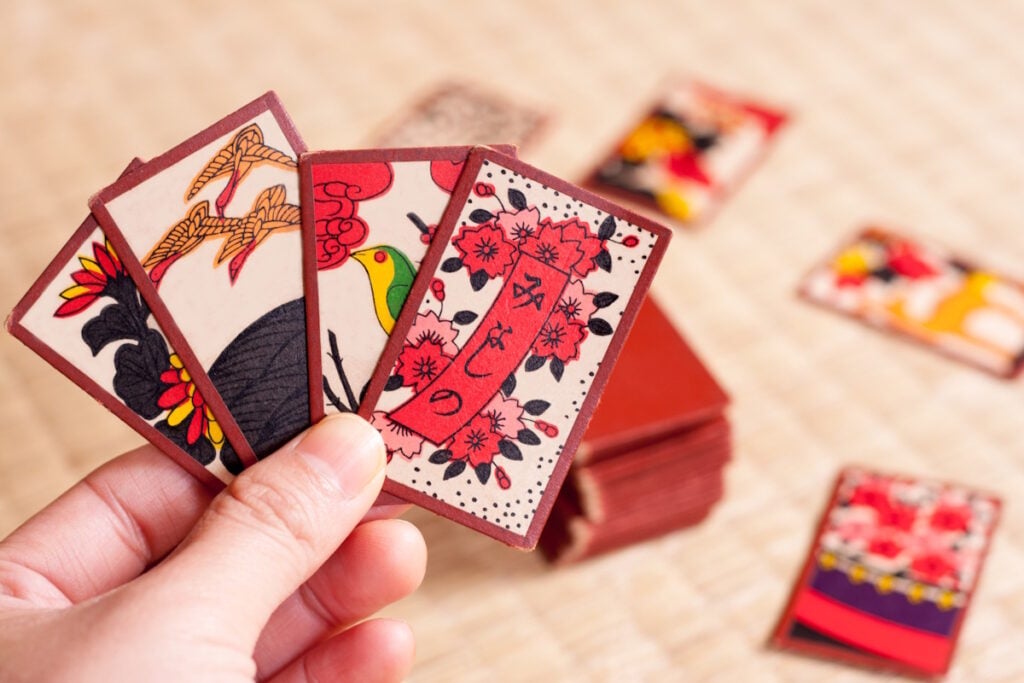
Hanafuda: How a Banned Card Game Defined the Pre-Pokémon Era
Before Mario, Nintendo sold hanafuda cards to the yakuza. Read the 400-year forbidden history of the flower cards that tricked the Shogun.
Shinjuku: The Birth of Kabukicho
How Kabukicho, Japan’s biggest red light district, arose from the ashes of post-war Japan.
Sources
[1] 新潮社. (1994). 「江戸東京物語 山の手篇 」. 新潮社.
[2] 小林明. (2025). 「山手線「駅名」の謎」. 株式会社鉄人社.
[3] 鈴木理生. (1999).「読む・知る・愉しむ:東京の地理がわかる事典」.日本実業出版社.
[4] “このまちアーカイブス | 東京都 新宿 3:鉄道の発達と繁華街の賑わい”. 三井住友トラスト不動産.
[5] 常設展示開設シート, 1-11. 新宿歴史博物館.
[6] (2017.07.18). 新宿街史/The History of Shinjuku. 歌舞伎町文化新聞.
[7] 新宿西口 思い出横丁の歴史. Shinjuku-omoide.com.
[8] (2025). 太平洋戦争から戦後へ. SHINJUKU OHDOORI SYOUTENGAI SHINKOU KUMIAI.
[9] 戦時下および統制下におけるビール. 酒・飲料の歴史. Kirin Museum and History.
[10] Vaporis, C. N. (1986). Post Station and Assisting Villages. Corvέe Labor and Peasant Contention. Monumenta Nipponica, 41(4), 377–414.
[11] Yun Hui Tsu, Timothy. (2011). “Black Market, Chinatown, and Kabukicho: Postwar Japanese Constructs of ‘Overseas Chinese'”. Duke University Press.
[12] Seidensticker, Edward. (1983). Low city, high city: Tokyo from Edo to the earthquake. New York: Knopf
[13] Dower, John W. Embracing Defeat: Japan in the Aftermath of World War II. Penguin Books, 1999. Print.
[14] Almazán, Jorge, et al., authors. Emergent Tokyo: Designing the Spontaneous City. ORO Editions, 2022.
[15] Takeoka, Toru. (08/2015.) Sexworkers, Regulation, and “Right to the City”: The Streets in a Red Light District of Tokyo. Conference At: Urbino.
[16] (2021.01.22). 歌舞伎町の入り口で人々を迎える街のシンボル「歌舞伎町一番街アーチ」. 歌舞伎町文化新聞.
