
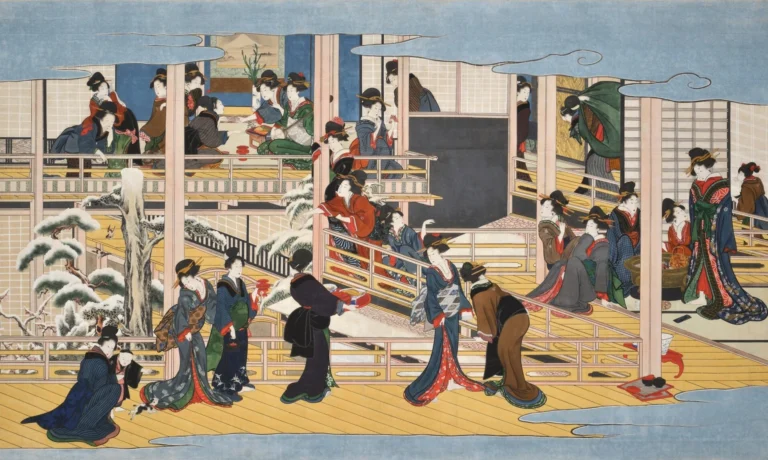
When I wrote earlier this week about visiting Kiyosumi-Shirakawa, I dug into a side of the neighborhood with which our Tours Director, Noah Oskow, turns out to be quite familiar: its deep geisha history.
As the Fukagawa region in which modern-day Kiyosumi-Shirakawa sits boomed, an unauthorized pleasure quarter boomed along with it. Then, in the 18th century, thanks to one woman, it morphed into something quite different: a contingent of women who prided themselves on selling, not their bodies, but the arts of entertainment and attention.
These were the Tatsumi Geisha (辰巳芸者) – the first female geisha of Japan. And they owe their origins to one woman who moved to Fukagawa after being driven out of her former workplace by jealous men.
Fukagawa booms thanks to timber
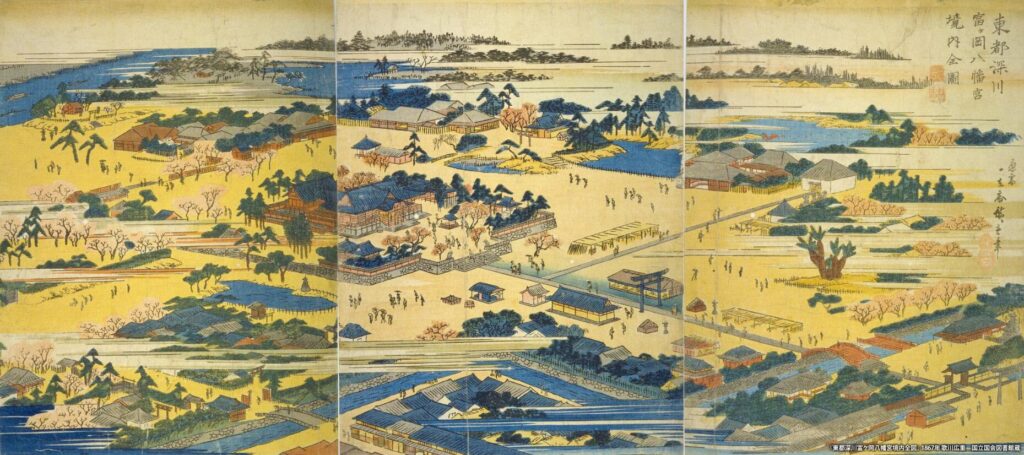
Fukagawa was mostly marshland until 1590. It was then that a 47-year-old Tokugawa Ieyasu, then a daimyō who had been reassigned to the area, set up his base of operations in Edo. Ieyasu saw Fukagawa as a critical junction for supplying salt to his military. He dug the 5km east-west Onagi Canal for just this purpose. It helped make Edo into Ieyasu’s base of operations from which he would be shogun and ruler of all Japan 13 years later.
The area was further developed by a settler from Osaka, one Fukagawa Hachirōzaemon. Fukagawa and his crew became so skilled at reclaiming wetland that Ieyasu consulted with him on other projects. Legend has it that, when Ieyasu learned the area had no proper name, he named it after Fukagawa.
After the Great Meireki Fire of 1657 leveled central Edo, the shogunate under the fourth shogun, Tokugawa Ietsuna, pushed development east across the river. This helped build Fukagawa into Edo’s busiest shitamachi: a canal-laced district of warehouses, fish markets, and, most importantly, the timber yards that made the area rich and prosperous.
Give a bunch of men money and, sure enough, more than a few will use it for female “entertainment.” That happened in Fukagawa, which saw a booming prostitution business in the 1700s.
It was a risky business. Legally, there was only one licensed female prostitution district in Japan: the Yoshiwara district, a walled-off enclave in what today is Asakusa. There were other prostitution districts, but they were considered okabasho (岡場所) – off-books, unlicensed.
The shogunate and daimyō lords went through cycles of tolerating them, then engaging in periodic purges. Many of the purges were instigated by Yoshiwara, which was hellbent on retaining its monopoly over licensed prostitution.
Kikuya: Inventing the female geisha
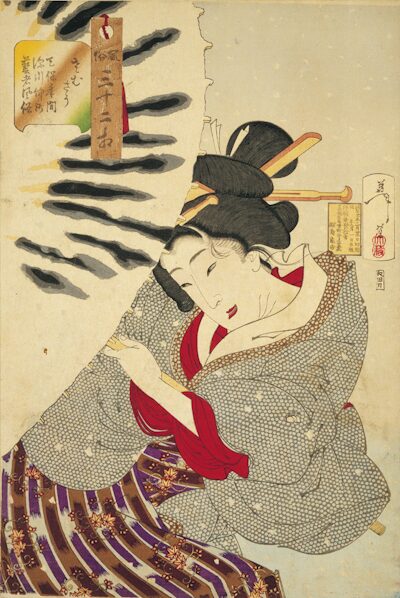
The Fukagawa okabasho changed dramatically in the mid-1700s thanks to the influence of one woman, Kikuya (菊弥). She came to Fukagawa, not just because she saw an opportunity, but because she was chased out of her old neighborhood by spiteful men.
We don’t know exactly when Kikuya arrived in Fukagawa. Some reports peg her as arriving around 1700; others put her arrival at around 1730.
No matter who tells the story, however, the other details remain the same. Kikuya had previously worked in Yoshichō in Nihonbashi (present-day Ningyōchō), next to the area’s kabuki theaters. At that time, the only “geisha” who existed were men; Yoshichō was one of the city’s kagema (陰間) districts of male geisha attached to the kabuki world.
Kikuya was an entertainer and odoriko (dancing girl), a tradition that started at Japanese teahouses. She got so good at what she did, though, that the male performers got jealous and drove her out. So, she took her talents to Fukagawa.
Sources say the term 女芸者 (onna-geisha; female geisha) first appeared around the Hōreki era (1751–64). Under the slogan 芸は売っても色は売らない (“we sell art, not lust”), Kikuya trained women to focus on hospitality, dance, and arts such as shamisen playing.
This move was driven as much by necessity as by high-mindedness. By labeling what they did as art, geisha in Fukagawa could more easily evade pressure from authorities. Historical records make it clear that, slogans notwithstanding, Fukagawa geisha also sold sex.
Thus were born the Tatsumi Geisha, “tatsumi” meaning “southeast” (a reference to Fukagawa’s location in Edo). The geisha district boomed at the end of the 18th century as the Kansei Reforms (1787-93) cracked down on unlicensed prostitution across Edo. (Fun fact: the Reforms were led by Matsudaira Sadanobu of the Shirakawa clan – where Kiyosumi-Shirakawa gets its name.) Because the crackdown targeted unlicensed prostitution and not art, the Tatsumi Geisha, who (at least on the surface) emphasized art over sex, thrived even as the sex trade around them was suppressed.
The unique, “masculine” look of the Tatsumi Geisha
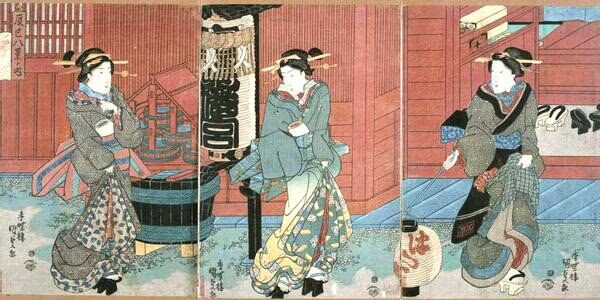
Kikuya’s invention was so successful that, by the Meiji era, the word “geisha” would come to be fully associated with women. However, the art manifested very differently in Fukagawa than it did in other areas of the country.
Today, geisha are considered a refined form of high-minded Japanese culture worldwide. Kyoto geisha are particularly known for their elegance (hence the 花, flower, in 花柳界 [karyūkai], “flower-and-willow world,” a euphemism for the world of the geisha).
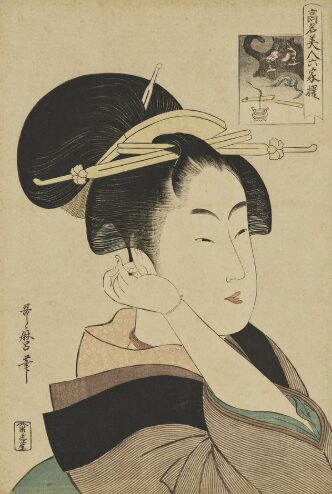
Kikuya’s shitamachi geisha, however, reflected the geisha’s humble origins as a lower-class form of entertainment. The Tatsumi Geisha’s style was more in line with the iki (chic) style that defined Edo. They were most famous for wearing, not fancy kimono, but grey haori (羽織), or formal coats. They wore light makeup, were known for walking barefoot even in winter, and tended to guests, not with courtly airs, but with big-hearted and warm personalities.
Like the male geisha that came before them, the Tatsumi Geisha tended to take on masculine professional names, such as Otokichi (音吉), Tsutakichi (蔦吉), Ponta (ぽん太), or Mameyakko (豆奴). This helped them pose as male entertainers and further evade the scrutiny of authorities. Eventually, they would also take on the male speech patterns that were the trademark of the Tatsumi area, though the dating of this practice is lost to time.
Their muted appearance was a deliberate contrast to the licensed female prostitution of Yoshiwara, where women were known for their flashy dress and courtesan airs. This was also a survival mechanism, as it was another signal that the Tatsumi Geisha weren’t trying to invade Yoshiwara’s turf (even if they totally were). But it was also an authentic expression of the timber town in which they worked and thrived.
Question: do you like UJ's independent coverage of Japan? Our writers are supported by our members. Join Unseen Japan Insider to get bonus content every week, an ad-free website, and access to our large and growing Insider archive.We manage to keep most of our content free thanks to the generosity of our members. Join Unseen Japan Insider and you'll get access to new, exclusive UJ member content weekly, an ad-free website, and access to our large and growing Insider archive.
Dispersing (then returning) after the crackdown
It didn’t last.
The 1800s were a tumultuous time for the shogunate. The Tenpō Famine (1833-1839) brought crop failures followed by peasant uprisings and urban riots. Tensions came to a head when a former shogunal officer launched the Ōshio Heihachirō Rebellion (大塩平八郎の乱) in 1837, a direct assault on bakufu authority.
Meanwhile, the licensed Yoshiwara prostitution district was frequently petitioning the magistrate to crack down on the city’s okabasho – which the magistrate did in regular roundups. Yoshiwara had been bleeding business to these districts for decades; services outside Yoshiwara were cheaper and less formal, and thus more accessible.
When shogun Tokugawa Ieyoshi came to power in 1837, he had something to prove. One of his rōjū (Council of Elders), Mizuno Tadakuni, launched a four-pronged campaign: fiscal rehabilitation, austerity, moral purification (風紀粛正; fūkishukusei), and reasserting shogunal control.
By the Tenpō era in the 1830s and 1840s, Fukagawa was Edo’s largest unlicensed quarter of prostitution, with over 260 geisha (including men) and over 470 unlicensed prostitutes (私娼; shishō). That made it the largest visible target for Mizuno’s crackdown. Unlicensed prostitutes were forced to work at Yoshiwara as a punishment for plying their trade outside of its walls.
But the Tatsumi Geisha weren’t spared, either. While their art saved them from being sent to Yoshiwara, they still had to flee to other licensed entertainment quarters, such as Nihonbashi and Yanagibashi, where they rebuilt their practices. The crackdown also targeted male prostitution. In one fell swoop, the booming nightlife quarters of Fukagawa were effectively erased.
Tatsumi Geisha through the modern era
There was a double irony to the Yoshiwara-inspired crackdowns. The first is that they didn’t help Yoshiwara. People still steered clear of the expensive district; meanwhile, the influx of untrained workers lowered service quality, tarnishing its reputation.
The second is that this didn’t end Fukagawa’s geisha district. At least not yet. The quarter revived around 1860 and had another boom in the Meiji era thanks to the arrival of Shingon temple Fudō-dō and a rice market. By the early Shōwa era (1926-1989), the district was up to 149 geisha. Even after the area was extensively firebombed in 1945 during World War II, it rebuilt quickly. Throughout it all, the Tatsumi Geisha continued to don the dress and mannerisms that made them famous.
Things ground to a halt, however, as Fukagawa’s economy slowly wound down. The 1956 Anti-Prostitution Law, fully enacted in 1958, shut down the nearby Susaki red-line district. Meanwhile, high-growth cabaret clubs pulled away clients.
The final straw came in 1970, when the area’s timber yards were moved to Shin-Kiba (新木場; literally “new lumber yard”). Fukagawa’s three-trade guild (三業組合; sangyō kumiai) – a structure created in Meiji to manage teahouses, restaurants, and geisha houses – closed in 1982, by which time only around 20 geisha remained.
The district saw a short-lived revival from an unlikely source. Australian Fiona Graham, an Oxford-trained anthropologist, became the first foreigner to work as a geisha in Japan in 2007, working under the name Sayuki. Graham took up residency in Fukagawa in 2021 with three apprentices in an attempt to revive the area’s centuries-old traditions. However, she passed away in 2023 before she could fulfill those ambitions.
The heyday of the Tatsumi Geisha may be over. But the art launched by Kikuya continues to flourish throughout Japan to this day, and continues to serve as a lasting symbol of Japanese culture worldwide.
Want to experience the art of geisha for yourself? Unseen Japan Tours uses its connections to the geisha world to introduce our customers to this Edo-era tradition. Arrange your visit today→
Keep reading


Sources
辰巳芸者 Wikipedia (JP)
深川 (花街) Wikipedia (JP)
岡場所 Wikipedia (JP)
菊弥(きくや) — デジタル版 日本人名大辞典+Plus コトバンク (Kotobank)
辰巳芸者(たつみげいしゃ) コトバンク (Kotobank)
深川芸者(ふかがわげいしゃ) — 世界大百科事典 コトバンク (Kotobank)
江戸最大の深川岡場所の花街に生きた「辰巳芸者」という”いき”のいい女たち【前編】 Japaaan
羽織の起源。辰巳芸者はなぜ男装の羽織を着たか? note(じざいやさくらこ)
白拍子 Wikipedia (JP)
寛政の改革 Wikipedia (JP)
第三十回「深川の花街・巽芸者の街」 其角せんべい(門前仲町)
深川から世界へ発信! オーストラリア出身の深川芸者 イエノミスタイル (ienomistyle)
江戸最大の岡場所があった深川とはどんな街だったのか. JBPress
Fiona Graham. Wikipedia
吉原遊廓 Wikipedia (JP)
陰間茶屋 Wikipedia (JP)
天保の改革 Wikipedia (JP)
天保の飢饉 Wikipedia (JP)
【吉原遊廓】大衆化と衰退のはじまり THE YOSHIWARA (kansensho.com)
江戸最大の深川岡場所の花街に生きた「辰巳芸者」という”いき”のいい女たち【後編】 Japaaan
高名美人六家撰・辰巳路考(喜多川歌麿) 文化遺産オンライン(文化庁)
風俗三十二相 さむさう 天保年間深川仲町芸者風俗(月岡芳年・1888) 城西大学(Josai University)