
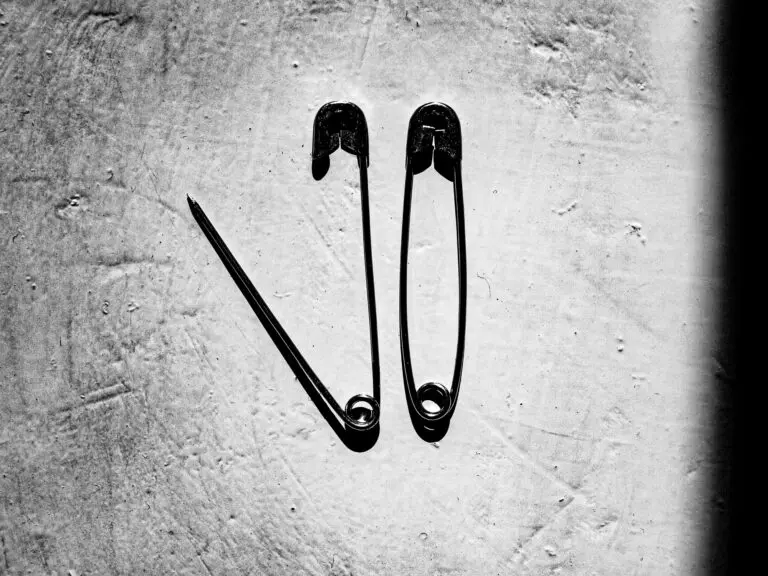
While Japan is relatively safe, groping on trains remains an invisible crime. Some private estimates say 80% of assaults might go unreported.
This year, as the new school year started in April, multiple municipalities held awareness campaigns aimed at reducing 痴漢 (chikan, molestation). At least one resourceful woman, however, reportedly took matters into her own hands. Japanese social media is saying she was right to do it.
Con cafe employee takes matters into her own hands
The post comes from Ayaka, a concept cafe (con cafe) staff member at the store Alice x Alice in Akihabara. In her now-viral post, Ayaka writes, “I was groped on the train, and it put me in a bad mood so I stabbed tf outta his hand with a safety pin!”
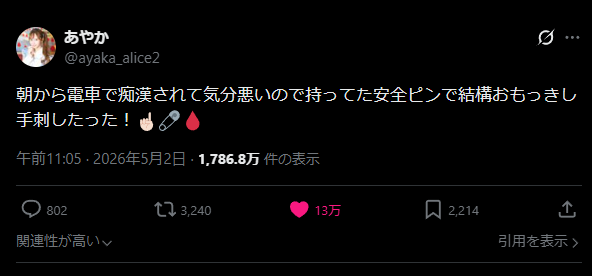
Ayaka later elaborated that she had the safety pin on her because her mother taught her to keep one on her for exactly that reason. I’ve written before how older Japanese women have long used safety pins as their own personal anti-molestation devices.
Ayaka’s post earned her 130,000 likes. (It also netted some good advertisement for her con cafe. Get that bag, girl.) I analyzed over 350 comments on the post and found that the sentiment was near-universal support for the act of self-defense.
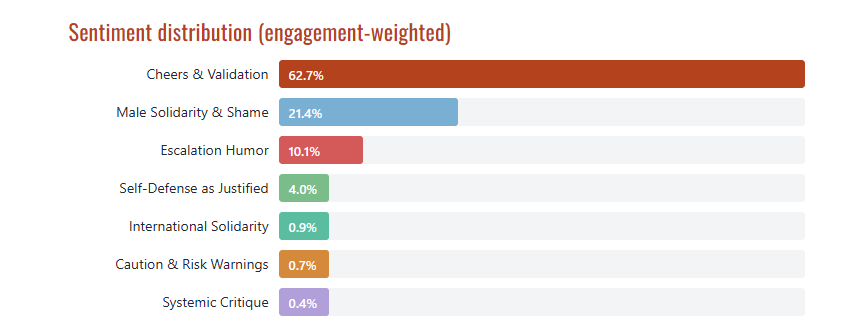
“Nothing but admiration for your fighting spirit,” one user wrote in a comment that netted over 6,000 likes.
“The only people criticizing this are the gropers and the wannabe gropers,” another wrote.
“You’ve probably saved future victims, too,” said another. “You’re a hero.”
Men also joined in on the chorus to express both their anger and shame at their gender. “As a man myself I’m appalled. May misfortune befall the perpetrator.”
Question: do you like UJ's independent coverage of Japan? Our writers are supported by our members. Join Unseen Japan Insider to get bonus content every week, an ad-free website, and access to our large and growing Insider archive.If you love UJ's independent coverage of Japan, join Unseen Japan Insider to get content every week, an ad-free website, and access to our large and growing Insider archive.
It may legally be self-defense
A few people questioned whether Ayaka’s self-defense was morally justifiable.
“This isn’t okay,” one wrote. “He may have groped you but you also hurt him.”
That commenter, however, was largely shouted down by others. “Don’t molest people,” one shot back. “Don’t support molesters. If you’re a man, tell other men, ‘stop molesting women.'”
Others questioned whether stabbing a molester with a safety pin is legally acceptable. In other words, would a court consider it self-defense?
As I noted, the safety pin strategy has been around for years. So this subject has come up for debate before. In 2019, writing for Bengo4.com, lawyer Itō Satoshi weighed in with his verdict. While there was no legal precedent when Itō wrote his article, he concluded that pricking someone “enough to draw blood” would very likely be considered self-defense under Article 36 of Japan’s Penal Code if done to ward off a molestation attack.
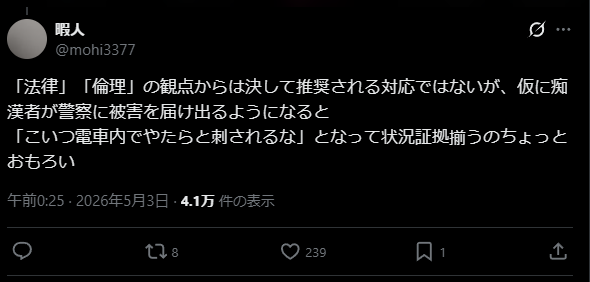
Even commenters who thought Ayaka’s defense was legally dubious found the strategy entertaining. “If gropers started reporting their puncture wounds, the pattern of ‘huh, this dude keeps getting stabbed on trains’ would become its own sort of circumstantial evidence,” one concluded. “Kinda funny.”
Anti-groping campaigns vs. the lived reality
Ayaka’s story comes after another one we wrote about from two weeks ago in which police arrested 27-year-old Nakamura Yū after he groped a 17-year-old schoolgirl. Nakamura reportedly victimized the child three times before she grabbed him by the wrist and escorted him to station personnel, who then called the cops.

These incidents stand in stark contrast to official efforts during the month of April to stamp out groping nationwide.
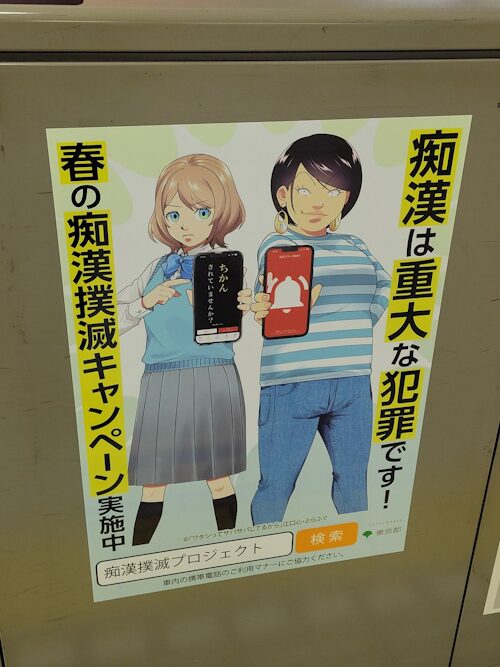
April is when the new fiscal and school year starts. Along with examination time, it’s a time of year when train molestation cases skyrocket. In response, municipalities across Japan held anti-groping awareness campaigns. Tokyo’s Spring Groping Eradication Campaign used the phrase “Groping is a serious crime” and ran a poster campaign in conjunction with the popular manga Watashittte Sabasaba Shiteru Kara (ワタシってサバサバしてるから; I’m the Easygoing Type) by Eguchi Kokoro.
The Japanese government has also taken measures to eliminate barriers to reporting molestation assaults. Several years ago, for example, it instructed schools in Japan not to count students as late if they had to go to the police station to report an assault.
Other, private efforts have also garnered social media attention and raised awareness around the seriousness of chikan. One high school girl who said she’d been groped daily went viral after she posted about wearing a badge distributed by Matsunaga Yayoi’s Osaka Chikan Prevention Action Center. The badge designates that the person wearing it has been a groping victim. Once she started wearing it, the girl said she went four months without a single incident.
Not all anti-groping campaigns, however, are appreciated. Social media users roundly criticized Osaka Prefecture’s Tenma police for a “beware of gropers” latte art campaign. Critics say that the campaign put the onus on victims to be careful, instead of putting the onus on men to stop assaulting women.
Internet users also criticized the Chikan Prevention Action Center’s Matsunaga earlier this year for issuing advice to women on how to stand on elevators to avoid gropers. Some have criticized the badges for the same reason.
Maybe the Center should start handing out safety pins instead.
Keep reading




Sources
新しい生活様式を守る!「春の痴漢撲滅キャンペーン」を実施します 東京都 / Tokyo Metropolitan Government
毎日痴漢されていた女子高生→4か月ゼロに。バッグに付けるアレ。バッジ開発者の願いとは Yahoo!ニュース / 女子SPA!
通勤・通学時の痴漢被害防止を 名古屋駅で高校生らが呼びかけ 名古屋テレビ / Nagoya TV (メ〜テレ)
ayaka_alice2’s tweet: ‘Was groped on the morning train, stabbed his hand with a safety pin’ X (Twitter) / @ayaka_alice2
痴漢されたら「安全ピンで刺す」は正当防衛か傷害罪か? Twitterで大論争 Bengo4.com