
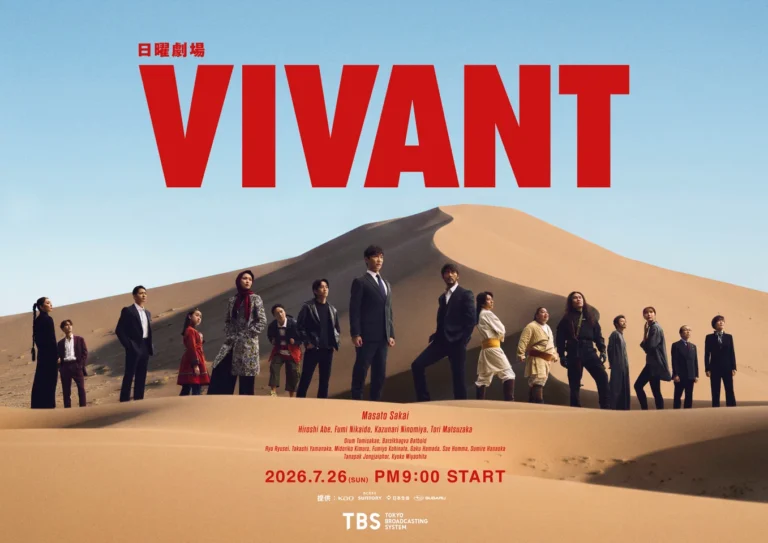
Japan’s biggest television drama of 2026 has become the center of a debate over LGBTQ representation. TBS’s spy thriller VIVANT introduced its first gay characters in its second season, and audiences quickly warmed to them. But a veteran of Japan’s gay-rights movement says the show’s portrayal of gay men is stuck 10 or 20 years in the past.
The disagreement highlights a divide in how Japanese audiences see LGBTQ characters in entertainment. For some viewers, VIVANT offered fun, memorable characters. For others, it recycled stereotypes that Japanese television should have left behind.
Meet Chokki and Liu, VIVANT’s first gay characters

The show VIVANT follows a secret Japanese military intelligence unit known as Beppan and features an impressive cast led by Sakai Masato and Abe Hiroshi. The season finale earlier this month attracted a 21.8% household rating in the Kantō region, making it the highest-rated Japanese drama of 2026. (Though not quite as highly rated as Hanzawa Naoki from the 2010s.)
The second season also introduced two gay characters. The first, Chokki, is a wealthy Thai businessman and former informant for the terrorist organization Tent. He’s in love with the character Shinjō Kōtarō, a former police agent who defected during the first season.
Thai actor and musician Ohm depicts Chokki as enthusiastic and somewhat feminine, despite being masculine himself. His call of “Shin-chaaan!” (新ちゃ~ん!) has become one of the show’s catchphrases and even appears on merchandise.
From episode 18, voice actor Kitō Akari, best known for playing Nezuko in Demon Slayer, replaced the character’s Japanese voice. Some fans weren’t particularly happy about losing Ohm’s original voice.
The second character is Liu Mingxuan, a Chinese agent born and raised in Japan. Played by Sakai Masato, Liu is a double agent who previously worked alongside detective Nozaki Mamoru. He’s in love with Nozaki, who makes it clear that the feelings aren’t mutual.
A gay-rights veteran says the show went backward
However, not everyone is celebrating the characters. In an interview with Asahi’s withnews two weeks after the finale, sociologist Kazama Takashi criticized the show’s portrayal of gay men.
For reference, Kazama has long advocated gay rights. As a university student, he was part of a Japanese lesbian and gay rights organization called OCCUR. At one point, the Tokyo government refused to allow the group to use the Fuchū Youth Lodge because its members were gay, and the group filed a lawsuit.
Kazama’s main criticism of VIVANT is Chokki’s exaggerated femininity. The character speaks using feminine sentence endings, has a female voice actor, and becomes the subject of a gag involving a close-up of his backside during an infiltration scene. He said these things turned the character into a caricature and used his sexual orientation as a source of comedy.
He also questioned the decision to make Chokki Thai, implying that it downplayed discrimination that sexual minorities in Thailand faced. Although Thailand became the first country in Southeast Asia to legalize same-sex marriage, it only did so in January 2025, so it’s hardly an LGBTQ sanctuary.
Kazama also questioned a scene in which the leader of Liu’s organization mutters “gross” after seeing Liu embrace Nozaki and promise to protect him. He said it encouraged disgust toward intimacy between two men. Other viewers interpreted the remark differently, arguing that the woman was reacting to Liu’s manipulative behavior, not his orientation.
Question: do you like UJ's independent coverage of Japan? Our writers are supported by our members. Join Unseen Japan Insider to get bonus content every week, an ad-free website, and access to our large and growing Insider archive.If you love what we do, help us pay our writers to do more of it by joining Insider. You'll get bonus content every week, an ad-free website, and access to our large and growing Insider archive.
The problem with the old onē stereotype

One important part of this debate is the Japanese television tradition of portraying gay men through the onē (オネエ) persona: a feminine, often flamboyant male stereotype who uses a feminine style of speech known as onē kotoba. Shows typically reserve these characters for comedy only, as objects of mockery.
Kazama clarified that he wasn’t arguing that gay men shouldn’t be feminine, or that there was anything wrong with feminine guys. Rather, he said it’s important to ask the show’s producers why they chose to make Chokki feminine.
Recent productions have actually gotten better about this, with NHK’s Tora ni Tsubasa and Tokyo Salad Bowl treating sexuality as just one aspect of a three-dimensional character, not their whole personality. So, especially with how popular VIVANT is, Kazama said that it felt like the show has a bit of a backward portrayal.
The LGBTQ publication NOISE raised similar concerns even before the Asahi interview. In an October 22 article, writer Jitian criticized both characters as outdated representations of gay men. It said Liu’s representation was especially regressive, similar to how older TV often portrayed gay men and transgender women as criminals or psychologically disturbed villains.
NOISE also pointed out that neither character gets a happy romantic storyline. Both men’s feelings are unrequited, unlike the heterosexual romance featured in the first season.
Online opinion doesn’t agree with the criticism

Interestingly, the reaction online was overwhelmingly different. In one Yahoo! News story on the topic, the most popular comment, which received 14,071 empathy votes, said the drama had never made them uncomfortable.
Another commenter accused the critic of being the stereotypical one for questioning the inclusion of characters who were simply part of the show’s story.
One former Japanese teacher who had worked in Thailand also pushed back against the idea that Chokki somehow misrepresented the country. They recalled having students like him 25 years ago who lived happily without attracting particular attention.
Users over on the site Hatena Bookmark, however, were more divided. Some agreed with Kazama, while others argued that feminine gay men are hardly fictional inventions and that characters like Chokki exist in real life.
When asked why it created the two characters and emphasized Chokki’s feminine speech, TBS offered a very corporate response. It takes people’s opinions seriously and will incorporate them into future productions, but declined to discuss its creative process.
VIVANT is getting a feature film on December 4, although it’s not yet clear whether Chokki or Liu will appear. Either way, the debate surrounding them raises a bigger question for Japanese television: is simply including gay characters enough, or does mainstream representation also need to consider how those characters are presented?
Keep reading

Sources
「VIVANT」ゲイ描写に疑問 “笑いのスパイス”にしていないか 朝日新聞
「VIVANT」に登場したゲイ2人 研究者「時代に逆行した描写」 キャラ設定の意図をTBSに聞くと… Yahoo!ニュース/withnews
大人気ドラマ『VIVANT』。ゲイのキャラ設定や描写に引っかかる NOISE
VIVANT最終回視聴率21・8% 「半沢直樹」に次ぐ令和の連ドラ2位 堺雅人×福澤克雄氏タッグで圧倒 デイリースポーツ
VIVANTチョッキー役、素はオネエキャラと正反対だった 語った撮影の裏側 デイリースポーツ
『VIVANT』人気キャラ・チョッキーの声“吹き替え”に「シンチャーン!」絶叫待つ視聴者からの大ブーイング Yahoo!ニュース/SmartFLASH
『VIVANT』豪華声優陣の起用になぜ賛否? “吹き替え”が変えたキャラクターの印象 Yahoo!ニュース/リアルサウンド
同性婚認めるタイの法律、23日に施行 数百組が挙式へ CNN.co.jp
東京都青年の家事件 Wikipedia
「VIVANT」に登場したゲイ2人 研究者「時代に逆行した描写」 キャラ設定の意図をTBSに聞くと…(withnews by 朝日新聞) はてなブックマーク