

As prices rise in Japan, people are looking for value wherever they can find it. Yen for yen, ramen continues to deliver. While some fancier ramen places are crossing the 1,000 yen wall, many ramen shops continue to provide heaping bowls for less than $7.
Not to be outdone, popular konbini chain 7-Eleven released a new product this month modeled on a famous (infamous?) genre of ramen that provides 2/3rds of your daily calories and several days’ worth of your max salt intake. At a mere 862 yen ($5.40) after tax, it’s a huge value. But the real question is: How does it taste?
I don’t often eat ramen these days. But when I do, I eat it like I’ve just been told I have three weeks to live. So naturally, I decided to turn myself into an experiment and see what eating 1,595 calories in a single sitting does to the human body.
G-kei Ramen: A famous brand ramen without the lawsuit
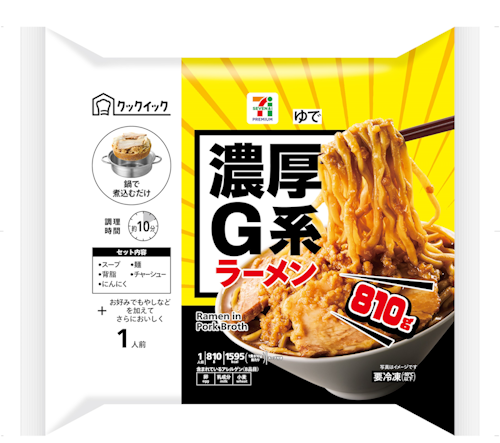
The product from 7-Eleven, released earlier this month, dubs itself as “Rich G-kei ramen.” It’s a clever nod and a wink towards an extremely popular and almost cult-like ramen chain here.
Despite its popularity, ramen has long had its detractors who point out that eating 1,000+ calories of pure carbs loaded with salt and fat in a single meal might not be the best thing for your body. (Killjoys.) Way back in 1962, before the Tokyo Olympics, a book entitled The Book of Building Stamina (スタミナのつく本) came out slamming ramen as “all carbs, no nutrition” (炭水化物ばかりで栄養がない).
Ironically, today in Japan, you can find multiple shops that serve so-called “stamina ramen,” hearty bowls that are supposed to give you energy to tackle the rest of the day. Some say this development, which dates back to around 1970, was in deliberate response to the book to shake ramen’s unhealthy image.
In 1968, the heavyweight champion of the big bowl appeared on Japan’s ramen scene. Yamada Takumi started Ramen Jirō in Mita, Tokyo making bowls with thick ramen noodles, an extremely fatty pork soup base, and mountains of bean sprouts and (optionally) garlic.
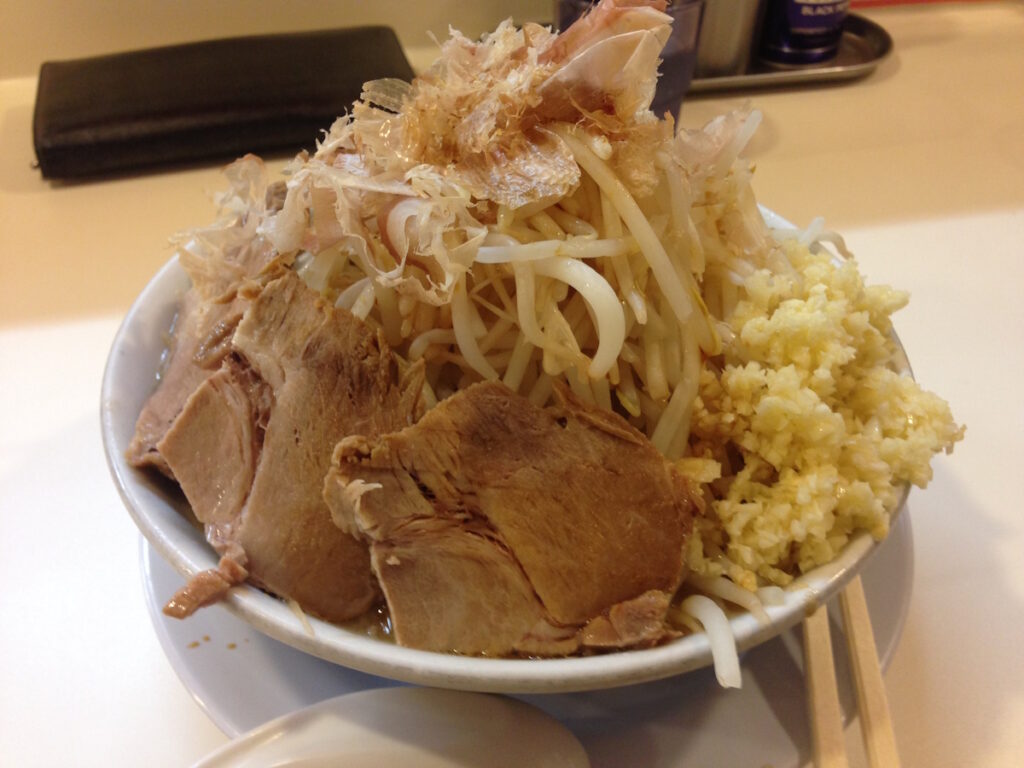
The restaurants took off. Many flock to Jirō, not just for the bowls themselves, but for the store’s culture: a unique ordering style encased in unspoken rules, such as time limits on eating. Diehard fans call themselves “Jirorians” (ジロリアン) and visit the stores regularly (even if it does make them slightly less attractive to the opposite sex).
7-Eleven’s “G-kei” naming (系 means “style” or “type”) is a nod to Jirō. It’s their way of letting fans know they can enjoy a Jirō-like experience at home, all the while avoiding a lawsuit from Ramen Jirō for violating its trademark.
This isn’t the first time 7-Eleven’s thrown its hat into the Jirō-style ring. It previously had a collaboration with ramen maker Tomita in 2019. FamilyMart and Lawson followed suit in 2020 with their own variations.
This dish is one salty bitch
Before digging in, I looked at the nutritional stats. This was a mistake, but what’s seen cannot be unseen.
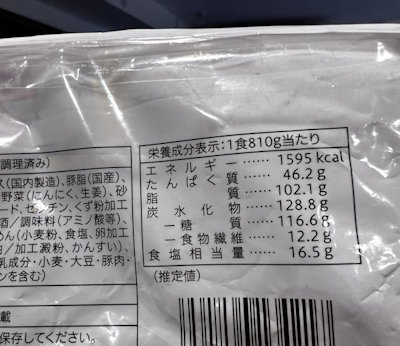
No surprise, it’s a carbohydrate-heavy helping. The whole thing clocks in at 116 grams of digestible carbohydrate. But hey, it also comes out to 46.2g of protein! Given the calories, I don’t think we can categorize this as one of 7-Eleven’s high protein dishes. But if you need an excuse to eat a 1,600 calorie bowl of ramen, this is a handy lie to tell yourself.
What’s more alarming is the 16.5 grams of 食塩相当量 (shokuen sōtōryō), or salt-equivalent. As an American, this metric doesn’t mean much to me. US food labels don’t measure the amount of salt, but the amount of sodium (salt is around 40% sodium).
I did some quick calculations to find that this comes out to around 6,500mg of sodium.
To put that in perspective, the US Food & Drug Administration’s recommended daily value of sodium is 2,300mg. This one dish has 2.83 days of your daily sodium intake. If you follow the American Heart Association’s recommendation of max 1,500mg per day, this is four days worth of sodium.
FWIW, Japan’s recommendations are equivalent to the US. The Ministry of Health, Labour & Welfare recommends men get no more than 7.5g of salt-equivalent per day and women eat less than 6.5g. Health experts here recommend keeping daily intake below 6g, which is about equivalent to the FDA’s guidelines.
But how does it taste?
After bellyaching over the salt, I decided to give myself a real bellyache and eat the damn thing.
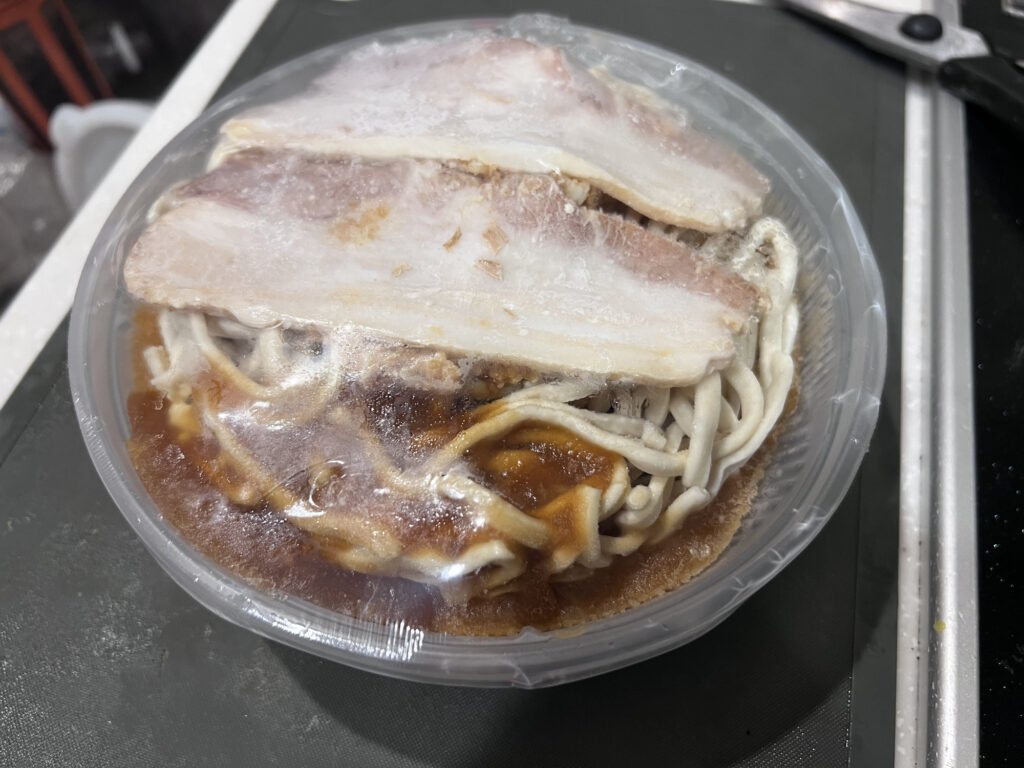
7-Eleven’s G-Kei ramen is unique for a konbini food item. Most konbini food is quick eat; at most you have to warm it up in the microwave for a few minutes. The G-Kei ramen frozen brick requires around 10 minutes of heating on the stove top. (Tourists: Do NOT try microwaving this in your hotel unless you’re staying somewhere with a full kitchen, like the MIMARU or an Airbnb.)
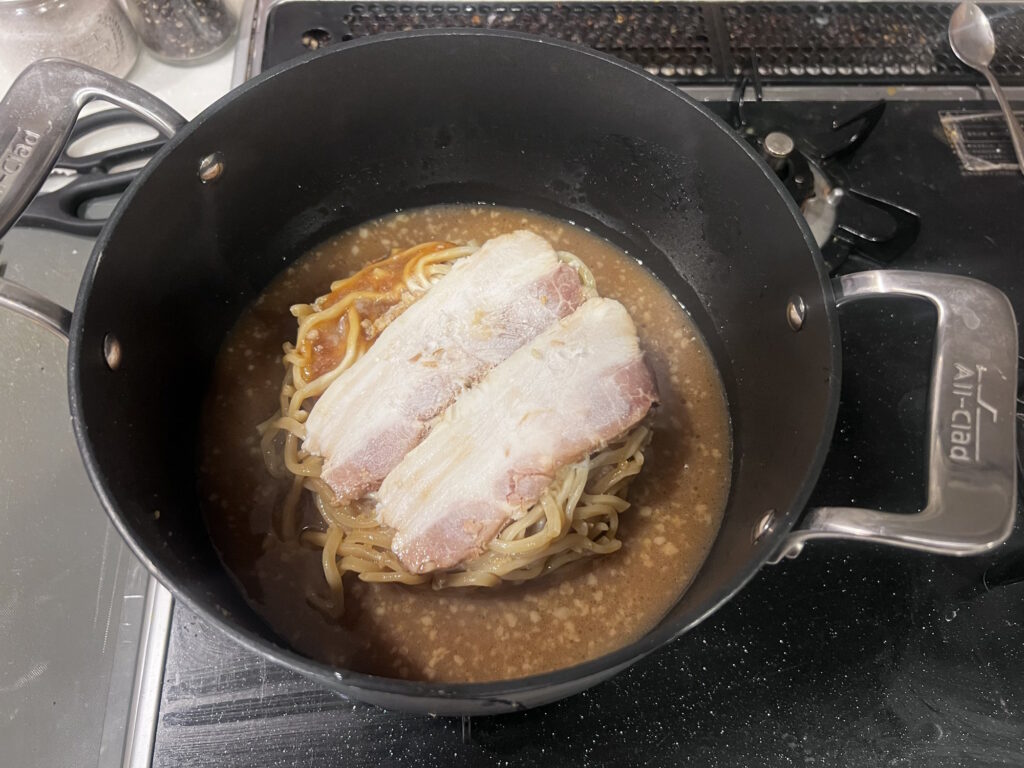
The package says it takes around 10 minutes to cook. Perhaps I kept the heat too low because it took around 15 minutes for it to melt completely and reach boiling point.
For some reason, I neglected to purchase bean sprouts. I did, however, top mine off with a delightful local garlic seven-spice (七味; shichimi) that I bought at a service area in Yamanashi Prefecture.
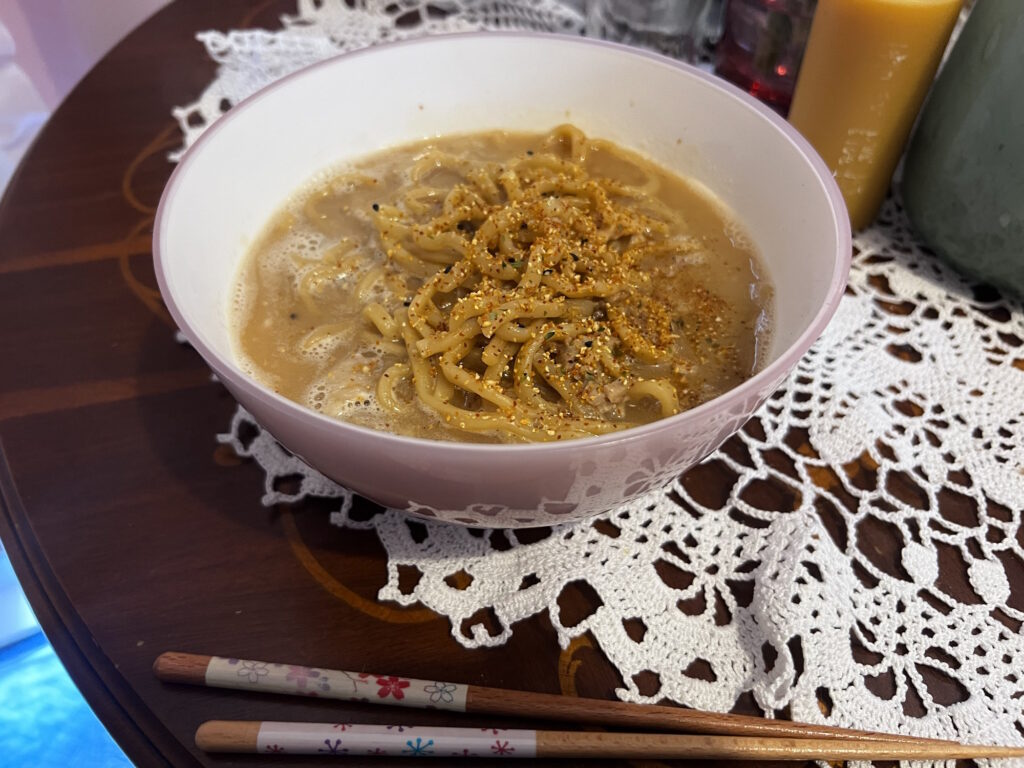
Before eating, I told myself that I was not going to eat the whole thing. Well…I f!$*ed up, chat. As I dug in, the salty, fatty broth proved too good to quit. I shoved 1,595 calories of ramen down my gullet before lunch was over.

So how was it? Pretty damn good, actually.
I wouldn’t say this beats Jirō, of course. But I’ve had frozen ramen before; it became popular during the pandemic as a dish you could buy from vending machines (you can still find such machines here and there).
I was never impressed with any of the vending machine frozen ramens I tried. This, however, was hearty, flavorful, and reminiscent of a store-bought bowl.
However, as you’d expect, the dish is salty as hell. A part of my soul shriveled up and died like a salted leech as I neared the home stretch. Notably, the building sodium backlash on my palate wasn’t bad enough to make me stop eating.

Before I ate this dish, I figured it would be something I might have the stomach to eat once but never again. Oddly, I don’t feel that way after tackling it. In fact, I might have it again this week. After all, at a mere $5.40 a serving, it’s a hard-to-beat value.
Keep reading



Sources
セブン‐イレブンの冷凍食品史上”最大級”のボリューム!「セブンプレミアム 濃厚G系ラーメン」 5月12日(火)より順次発売 セブン‐イレブン・ジャパン
7プレミアム 濃厚G系ラーメン(商品情報・栄養成分) セブン‐イレブン
セブンが大胆な「自己否定」 “二郎系キット”反タイパ売れの舞台裏 日経クロストレンド
重量810g、1595kcal! セブンの冷凍史上最大級ボリューム「濃厚G系」 ラーメンWalker
「セブンプレミアム 濃厚G系ラーメン」を発売初日に食べてみた! 総重量約810g、熱量1595kcalの実力は!? マイナビニュース
ラーメン二郎 ウィキペディア
ナトリウム(生活習慣病などの情報・e-ヘルスネット) 厚生労働省
スタミナラーメンの歴史の秘密 note(if → itself)
【用語集(371)】「インスパイア系」とは Cookpit