
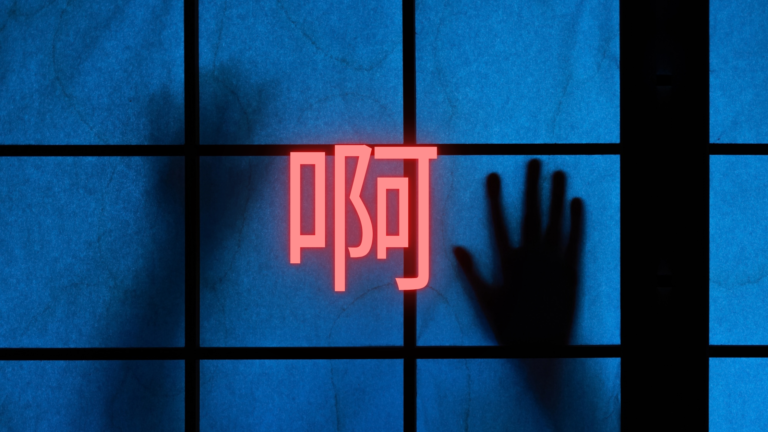
You might expect a Japanese person saying that Chinese sounds “scary” to spark an unfriendly debate, given the long history of tensions between the two countries.
Instead, Japanese and Chinese social media users recently had a surprisingly calm, matter-of-fact conversation about why the languages can sound so different – and even a little funny – to each other.
The particle of anger?
The discussion began after a Japanese X user posted on September 13: “I think 95% of the reason Japanese people say ‘the way Chinese people speak is kind of scary’ is because of the particle 啊.”
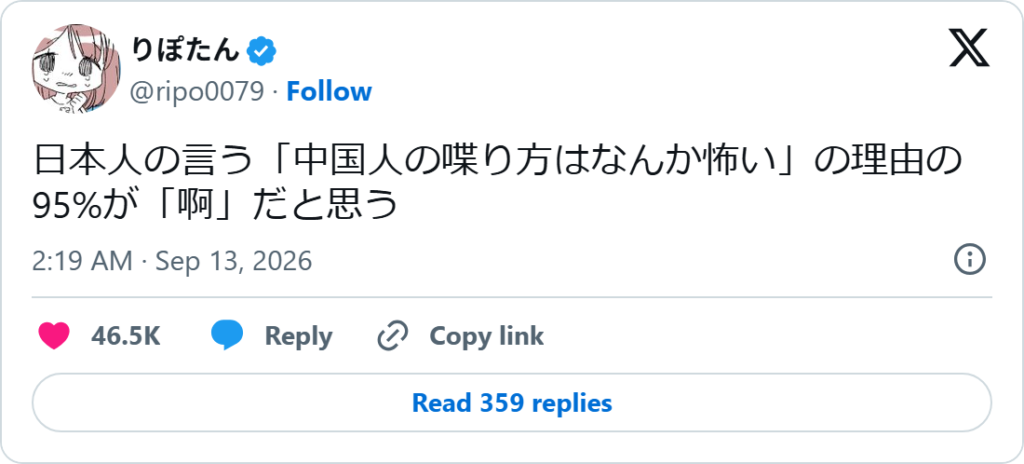
The claim isn’t based on any empirical data, but thousands of users appeared to recognize the phenomenon. The post had garnered more than 10 million views and 46,500 likes as of September 15.
Their focus was a single Chinese particle, 啊 (a), which some Japanese users say helps explain why Chinese speech can sound “scary” to Japanese ears. Its rising intonation can sound remarkably similar to the Japanese あ? (a?), an abrupt expression that can signal hostility or confrontation.
In Mandarin, 啊 is commonly used when someone hasn’t heard or understood what was said, roughly equivalent to “Sorry, what?” in English. But to Japanese ears, the sound can evoke the very different あ?, which is sometimes used in an aggressive or confrontational way. The exchange of あ? usually happens before a fistfight breaks out, for example.
What made the observation resonate was its specificity. Japanese users recognized the sound, and the uneasy reaction it can sometimes produce. But Chinese-speaking users were surprised to learn that such an ordinary part of everyday speech could sound so different.
What could have turned into an us-against-them debate instead became something much more ordinary and, in its own small way, wholesome: a conversation about how the same sound can carry completely different meanings depending on whose ears are hearing it.
What 啊 actually means

The Chinese particle 啊 has four tonal readings, including the rising intonation á, which is used when pressing someone for an answer or asking them to repeat what they have said. In Japanese, however, that would be え? (e?), ええっ? (ē?) and なに? (nani?), not あ?.
So when a Chinese speaker says “Sorry, what?”, the Japanese listener may hear it as an abrupt expression that can signal hostility or confrontation.
The mismatch is especially striking because Japanese and Chinese share a written-character heritage, even though the two languages can sound radically different when spoken.
A 2019 blog post by an instructor at Hitotsubu Chinese Language School (一粒中国語教室) in Kobe offers a more detailed explanation. Drawing on a graduate-school report, the instructor identified three uses of the rising 啊.
The first is asking someone to repeat what they said. The second is confirming that an instruction has been understood, such as when a parent speaks to a child or a superior gives an order. The third is responding when someone calls your name.
That distinction matters because the viral explanation reduces several uses of 啊 to the one that Japanese listeners find startling.
In a Mandarin request for repetition, 啊 is an ordinary response. But that doesn’t mean every use is emotionally neutral. When it follows an instruction from a superior, for example, the expression can have a different interpersonal force.
When the same sound means something different
Japanese speakers responding to the discussion repeatedly described 啊 in terms of confrontation.
But this thread wasn’t the first to point out 啊 getting lost in translation.
A 2019 Kobe language-school post had already documented similar reactions from Japanese interviewees. They described the sound as hostile, rough, rude or adversarial. Interviewees also said Japanese women basically don’t use the sound.
The issue was also picked up by a bilingual speaker on X. Kohei Kawaguchi-Sunada, an associate professor of economics at the Hong Kong University of Science and Technology, wrote that the fact that 啊? can sound roughly like an English “What the fuck?” in Japanese is not widely known among Chinese speakers.
Another commenter argued that the problem is not simply that the sound resembles a Japanese expression. It also occurs in the same situation: Someone says something, the listener responds with a short, rising sound asking them to repeat it. In Japanese, however, that sound can resemble an aggressive “What did you just say to me?”
One Chinese-speaking commenter framed the difference as one of politeness standards.
One user compared the Chinese 啊? to the Japanese 何? (nani?), arguing that they perform essentially the same conversational function. Others said they were surprised to learn that their habitual response could make Japanese listeners flinch.
For some Japanese users, knowing the explanation did not completely eliminate the reaction. One commenter said they had studied abroad with many Chinese classmates and understood intellectually that 啊? was not necessarily angry, but still instinctively flinched when hearing it unexpectedly.
Question: do you like UJ's independent coverage of Japan? Our writers are supported by our members. Join Unseen Japan Insider to get bonus content every week, an ad-free website, and access to our large and growing Insider archive.We manage to keep most of our content free thanks to the generosity of our members. Join Unseen Japan Insider and you'll get access to new, exclusive UJ member content weekly, an ad-free website, and access to our large and growing Insider archive.
It’s not just 啊

The viral explanation may be useful precisely because it identifies something concrete, but it doesn’t explain every reason why Japanese listeners may perceive Chinese as forceful or angry.
One factor is the fundamental difference in how Mandarin and Japanese organize sounds. Mandarin is a tonal language, meaning that changes in pitch can distinguish words and carry linguistic information. Japanese, meanwhile, does not use the same four-tone system.
That makes advice such as “just say it more gently” difficult to apply. As one X user pointed out, changing the pitch of a Mandarin syllable can change its meaning rather than simply making the speaker sound more polite.
There’s also evidence that speakers of different languages can express and interpret vocal attitudes differently.
A 2021 study published in the Journal of the Acoustical Society of Japan compared Japanese native speakers with Chinese-native learners of Japanese across attitudes including friendliness and hostility, politeness and rudeness, seriousness and joking, and praise and blame. The researchers found differences in how the two groups expressed these attitudes, including differences in vocal-fold tension among the Chinese learners when producing Japanese.
The study does not demonstrate that Japanese people perceive Mandarin as angrier, however. Its participants were Chinese speakers producing Japanese, rather than Japanese listeners hearing Mandarin.
More broadly, research suggests that people are generally better at recognizing emotions expressed by people from their own cultural background. A 2021 meta-analysis covering 37 cross-cultural studies found that emotions could still be recognized across cultural boundaries, but that listeners had an “in-group advantage,” with accuracy tending to decline as cultural distance increased.
The joke’s older than the viral post
A 2021 essay by the Chinese manga artist and interpreter かいし in FRaU included messages from Japanese readers saying that Chinese speech sounded angry or frightening.
She specifically described the ア?? that Japanese listeners hear when speaking with Chinese people, explaining that it’s often closer in function to the Japanese んー? (an ordinary conversational response) than to an aggressive あ?.
She also cautioned against treating Chinese speech as a single uniform sound. Regional differences are significant, she noted, and speech in southern China is often described as slower and gentler than speech in the north.
The viral post works because it turns a complicated cross-cultural phenomenon into one instantly recognizable sound. But “Chinese sounds angry” is itself an enormous generalization that surprisingly didn’t escalate into an argument.
The X discussion contained reminders of this from Japanese users, too. Some pointed out that あ? can itself be an ordinary request for repetition in certain Japanese regional varieties. One commenter recalled once mistaking such a regional Japanese expression for anger.
Ah! Why the explanation clicked with so many

The popularity of the 啊 theory may ultimately have less to do with proving why Chinese sounds “scary” than with giving people a name for a fleeting experience.
A Japanese traveler in the thread recalled asking for a toilet in China and being startled when people repeatedly responded with what sounded like あ゛?, complete with a strong voice. Yet the same people then helpfully gave directions, revealing that the response had been perfectly ordinary.
That moment, hearing apparent aggression followed immediately by helpful behavior, captures the delta between the two languages. The sound itself hasn’t changed. Neither has the speaker’s intention. What changes is the listener’s interpretation.
For Japanese listeners, 啊? can trigger an emotional reaction before the brain has time to translate it. And for Chinese speakers, the surprise may work in the opposite direction: discovering that something they have said casually for years can sound, to another country’s ears, like baiting someone into a fistfight.
Keep reading



Sources
『日本人の言う「中国人の喋り方はなんか怖い」の理由の95%が「啊」ではないか?』こんな風に聞こえている、という例えに双方から納得の声 Togetter
感嘆詞の「あ~!”啊↑(a、第2声)”」について 一粒中国語教室
啊(中国語)の日本語訳、読み方は コトバンク(小学館 中日辞典)
中国人の声はなぜ大きいの? 日本育ちの中国人が「中国人あるある」を分析してみた FRaU
日本語・中国語態度音声の音響分析及び声質分析――日本語母語話者及び中国語を母語とする日本語学習者を対象に―― 日本音響学会誌
Cross-Cultural Emotion Recognition and In-Group Advantage in Vocal Expression: A Meta-Analysis Emotion Review