
As I’ve discussed in the past, not everyone agrees on what constitutes good etiquette even within their own culture. That’s true, for example, when it comes to the proper way to eat certain foods in Japan.
Apparently, this also extends to when certain foods should be eaten. That’s the conundrum that one school district found itself in recently when its attempt to celebrate graduation collided with a terrible day in Japan’s modern history. That led to the school board throwing out 2,100 meals – a decision that some are now calling rash and wasteful.
Two phone calls scuttle 2,100 meals
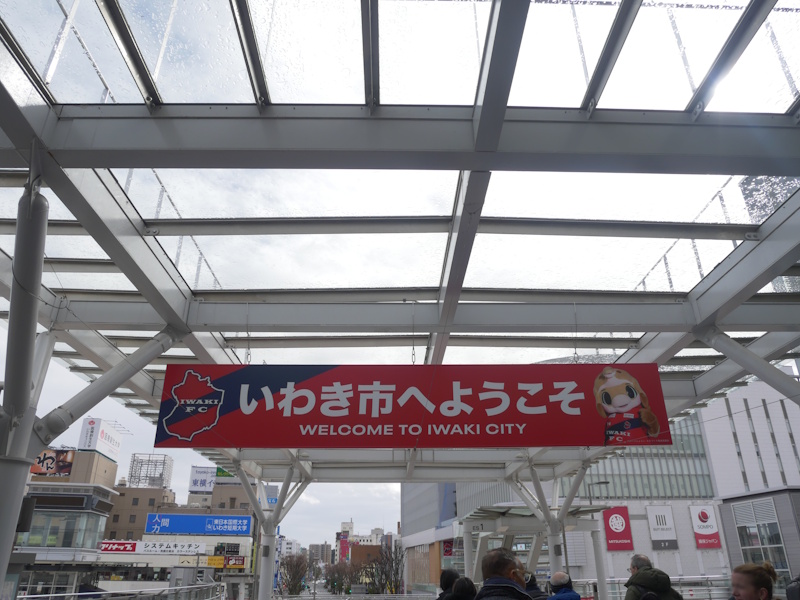
The incident happened in Iwaki, Fukushima Prefecture, an area heavily impacted by the devastating earthquake and tsunami that struck the region on March 11th, 2011.
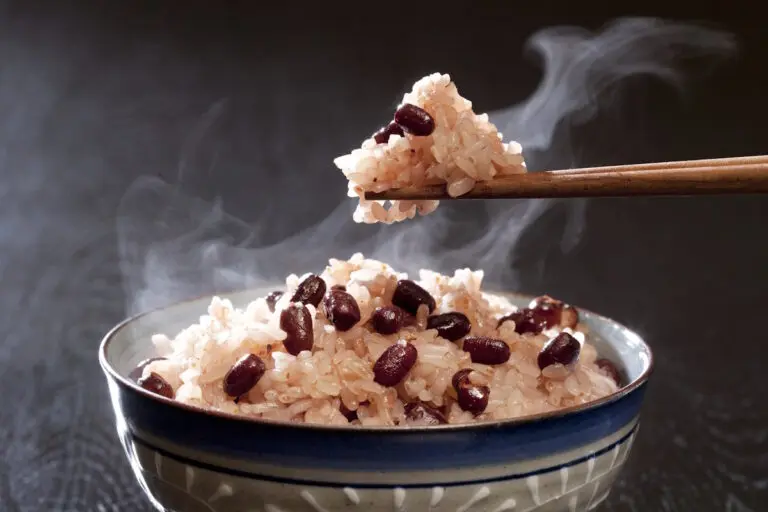
One of Iwaki’s seven shared school kitchen facilities had prepared sekihan, or sticky rice with red beans, as part of a graduation celebration lunch. Sekihan is traditionally served in Japan to mark auspicious occasions.
On the morning of March 11th, someone claiming to be a parent of a student at one of the schools called in to say that serving celebratory red rice on the disaster anniversary was in poor taste. A second call came in to the kitchen facility itself. According to the board of education, they haven’t been able to confirm whether it was the same person or a different caller.
Based on those two calls alone, plus the fact that Iwaki holds a memorial ceremony on March 11th every year, the board made a judgment call to pull the sekihan from all five schools.
As a substitute, students got canned emergency bread. Happy graduation.
Balancing sensitivity versus food waste
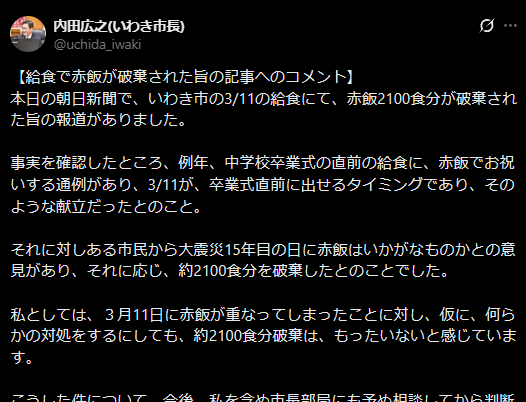
The decision led to a backlash on social media, where users charged that it was wasteful to throw out so much food on the basis of two complaints.
The concept of mottainai (wastefulness) being a pinnacle principle of Japanese culture is something of a stereotype. On the other hand, Japan has also increasingly focused on reducing the country’s food waste over the past 10 years. For example, the government announced last year that it was revising how retailers should calculate food expiration dates to extend shelf life.
The backlash led Iwaki’s mayor, Ichida Hiroyuki, to speak out. Posting on his official X account, he said, “Even if we should have done something about the sekihan serving coinciding with 3/11, I feel throwing out around 2,100 meals was a waste.” He said he’s instructed the school board to only make such decisions going forward after consulting the mayor’s office.
This incident highlights how customs can change radically over time. In the Edo Era, for example, it was customary to serve sticky rice and red beans on calamitous days as opposed to auspicious ones. One theory holds that this is because the split red beans evoke thoughts of seppuku, the form of ritualistic suicide samurai (and famous authors) would commit to retain their honor.
In other words, the school made the correct decision; it was just a couple hundred years too late.
Keep reading
Sources
約2100食の赤飯廃棄に批判相次ぐ…「誰」が電話した? 「圧力的なものは全くない」と市教委の担当者. J-CAST News
赤飯. Wikipedia JP