

A viral thread on X this past week sparked a rather odd rumor: are Japanese schools thinking of abolishing the pre- and post-meal greetings of “itadakimasu” and “gochisōsama?”
The short answer is no. There’s no documented case of a school banning them, or even talk of a school thinking about it.
However, you’d never know that based on how viral the post has gotten. With more than 100,000 likes, 2,000 replies, and 22,000 reposts, this relatively small classroom custom has sparked a heated debate. And it’s not the first time it’s surfaced. How did this rumor, despite its lack of foundation in reality, spread so quickly?
A heated deluge of responses to a simple tweet
It started when X user @maimai_ahaha made a tweet on May 20, 2026. The user said they’d heard news that schools might ban “itadakimasu” and “gochisōsama,” and specifically asked “those born in the Showa era” what they thought.
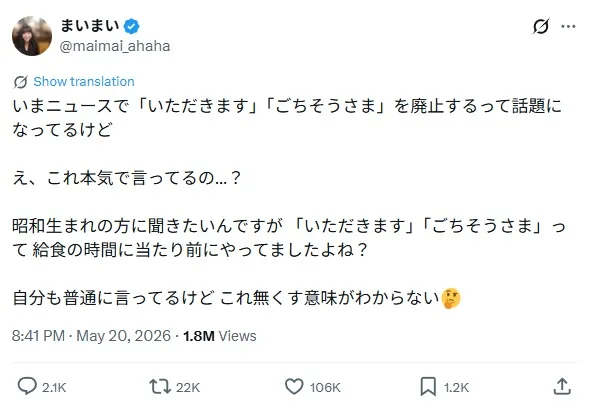
That simple tweet triggered a flood of responses. Without any actual evidence, many already took it as fact that mealtime greetings had been removed or were under threat.
Almost all of the people replying defended the custom. At the time of this writing, the largest share (roughly 24.7% of replies, though 59.2% of likes) said that the greetings are about offering gratitude. User @y____e____s’s reply, which has nearly 4,300 likes, said, “‘Itadakimasu’ and ‘gochisōsama’ are words of gratitude, aren’t they?? I think these are words we must never lose.”
The next most common reply (39.6%) revolved around disbelief that such a thing could happen. Some 20.1% of replies (receiving 14.9% of likes) said it was because of forced multiculturalism, with some suggesting that the ban is a conspiracy to destroy Japan from the inside out.
The sentiment is very similar to how, in 2025, a false rumor spread that Kitakyushu, in Fukuoka Prefecture, was going to introduce Muslim-friendly school lunches, and the city received around 1,000 complaints.
Only 4.9% of replies asked for a source or pointed out that there seems to be no actual basis for the rumor. The most-liked response of this sort (receiving over 1,500 likes) came from @c0outa: “I worked at a public junior high for 45 years and retired last year. This topic never once came up; we never once skipped the mealtime greeting. Is this a fear-mongering clickbait article?”
And wouldn’t you know it, that teacher was right.
The rumor is just that: a rumor
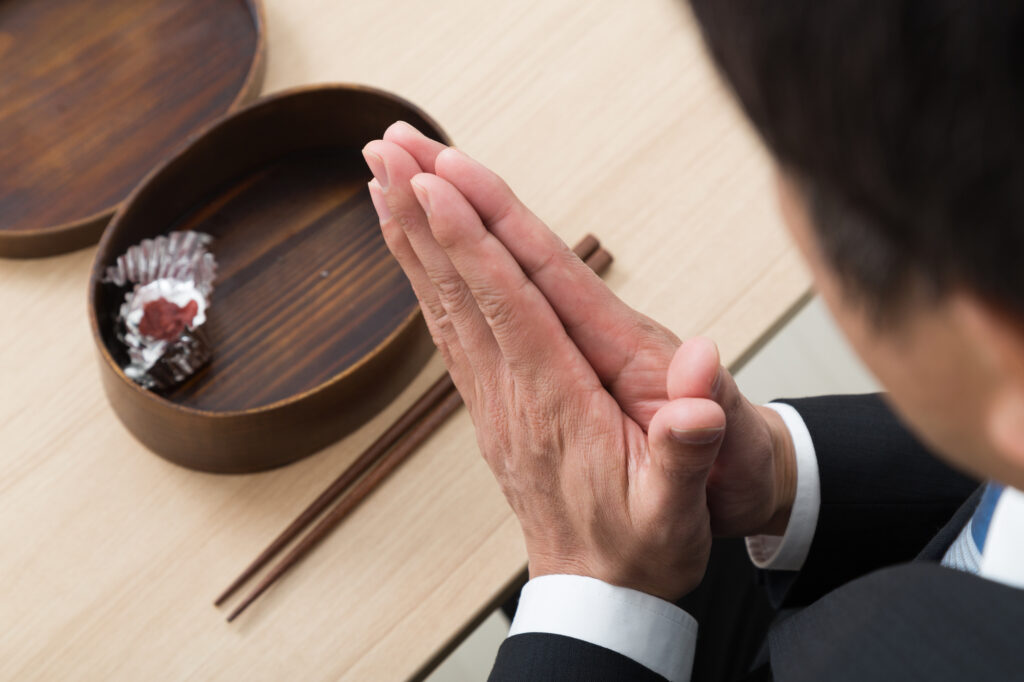
That’s right: there isn’t a single real-life example of anyone banning these mealtime greetings or even thinking about banning them.
Some people claimed such a thing had happened in Chiba City in 2023. However, when Shueisha Online checked with education boards in both the city and the prefecture, they found no record of any sort of ban.
More broadly, Japan’s Ministry of Education (MEXT for short) still lists “itadakimasu” in its school lunch guidance as a recommended practice. There is zero evidence suggesting an official move to abolish those greetings. It seems like yet another school lunch conspiracy.
So, where does this idea come from?
Getting the facts straight: rumors born from a 25-year-old incident

As it turns out, this rumor is at least 25 years old. The blog Dennō Chiriakuta (電脳塵芥, which translates to “Cyber Dust”) did a detailed fact-check and traced the rumor’s origins back to a real but fairly contained case in Toyama around 1996-1997.
In that instance, a school stopped requiring students to perform gasshō (合掌), which is the act of putting one’s hands together. At the time, officials cited concerns about religious neutrality because gasshō has its origins in Buddhist prayer. But more importantly, no one said anything about the spoken “itadakimasu” itself.
From there, the story mutated like a game of Telephone. In the late 1990s and early 2000s, a version of the rumor emerged where parents were objecting to “itadakimasu” because they paid for school lunches and didn’t want their children “forced” to express gratitude.
Naturally, politicians didn’t help stem the flow of rumors. (Some things never change.) Conservative figures like Sugihara Seishiro repeated similar claims over the years, and it’s not the first time this kind of thing has happened.
Interestingly, the current prime minister, Takaichi Sanae, seems to be responsible for popularizing the “paid lunch fees” anecdote in 2000. However, as with the tweet that resurrected this story, the claims rely heavily on secondhand accounts and lack verifiable evidence.
There’s also a rumor saying that 38% of elementary schools received complaints about saying “itadakimasu.” However, there’s seemingly no source for these percentages. Supposedly, they came from a 2024 MEXT school-lunch survey and a 2025 Japan Education Association survey, but in reality, neither discusses itadakimasu complaints. It seems to have been purely invented.
Question: do you like UJ's independent coverage of Japan? Our writers are supported by our members. Join Unseen Japan Insider to get bonus content every week, an ad-free website, and access to our large and growing Insider archive.We manage to keep most of our content free thanks to the generosity of our members. Join Unseen Japan Insider and you'll get access to new, exclusive UJ member content weekly, an ad-free website, and access to our large and growing Insider archive.
Do “Itadakimasu” and “Gochisōsama” stem from militarization?
Part of the outrage comes from a misconception about these mealtime greetings being ancient, deep-seated Japanese traditions. After all, people do them every day, before and after every meal. Thus, when someone suggests getting rid of them, the gut reaction many have is to say that their culture is being silenced or erased.
The popular belief is that “itadakimasu” and “gochisōsama” come from a Buddhist custom of offering gratitude for the food. In particular, articles say that “itadakimasu” means “I receive this life” (i.e., the life of the animal if meat is being served).
But is that true? An analysis published by the National Museum of Ethnology found no evidence of this. Not only that, sources suggest that this mealtime custom might be less than 100 years old. A 1980s survey found that those 70 years and older didn’t say these greetings at mealtime when they were kids. Instead, the custom likely began during Japan’s militarization period in the 20th century.
Of course, being a relatively recent custom doesn’t mean it has no value, or that people can’t be attached to it. Even if it isn’t a longstanding tradition, the gratitude expressed can certainly be real. But it goes to show how easily people’s perceptions can be warped when emotion overtakes reason.
Mealtime greetings are safe for the foreseeable future
As it stands, some schools have made the mealtime greetings optional rather than compulsory. This allows students to opt out for religious reasons or to reduce stress for those struggling with school lunch. The debate stirred up by this rumor says less about school policy than it does about the current social tensions surrounding tradition, national identity, and immigration.
Keep reading


Sources
「宗教上の配慮」で給食の“いただきます”を廃止? 福岡市で誤発注により2万食を廃棄? 給食をめぐる炎上案件の真相を調査 集英社オンライン
学校給食時の「いただきます」が廃止されたという都市伝説に関する検証 電脳塵芥
給食で「いただきます」は廃止? 日高新報
いただきます ウィキペディア(日本語)
ごちそうさま ウィキペディア(日本語)
食卓生活史の調査と分析 : 食卓生活史の質的分析(その2) ―食べものと食べかた― みんぱくリポジトリ
語源・由来|「いただきます」「ごちそうさま」 食べることにまつわる語源 世田谷自然食品
ルーツは仏教「いただきます」の深くて大切な意味とは 1万年堂ライフ
日本の挨拶「いただきます」はどんな意味?子どもに教えたい由来や語源 macaroni
給食「いただきます」廃止の噂は事実なのか Note