
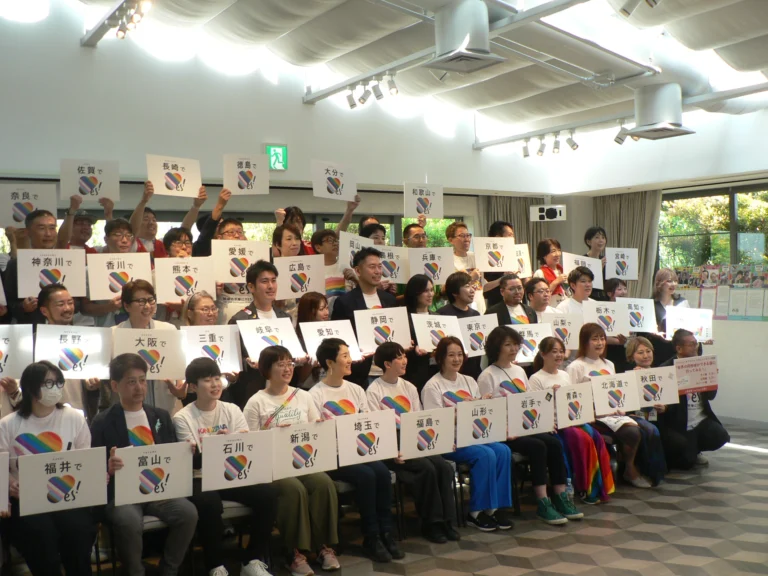
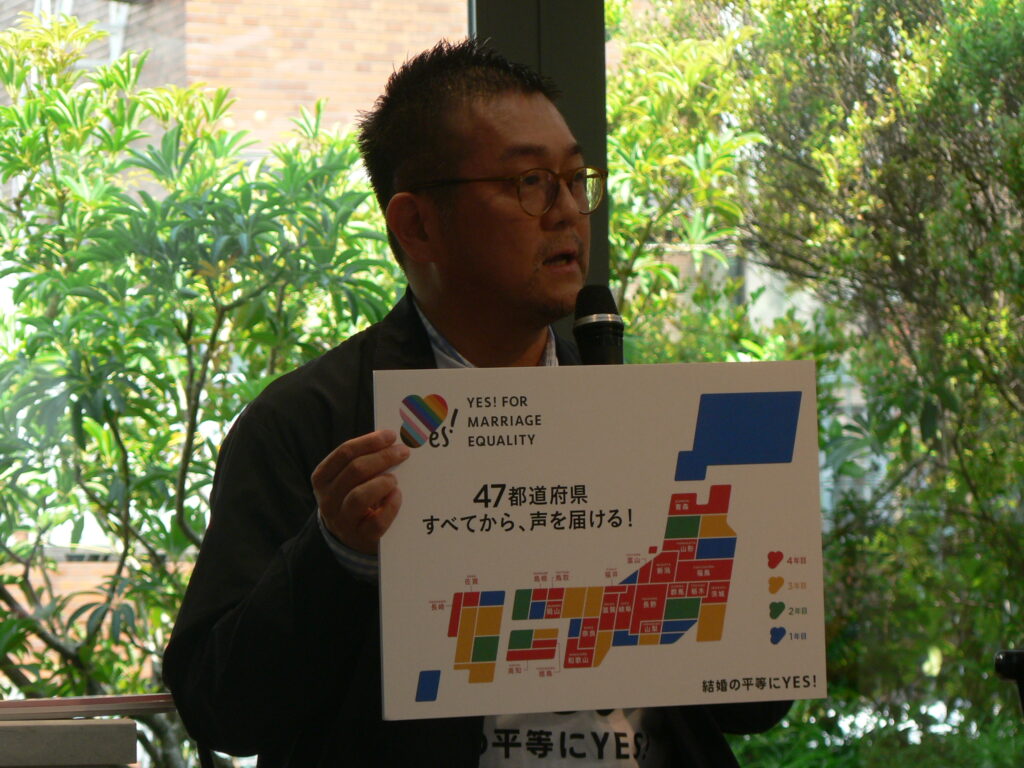
Marriage for All Japan director Matsunaka Gon opened a press conference on May 18 in Tokyo by announcing the expansion of his organization’s 結婚の平等にYES! (YES! FOR MARRIAGE EQUALITY) campaign.
Marriage for All Japan originally launched the campaign, which seeks to unite local voices and groups from all over Japan to spread messages of support for same-sex marriage, in 10 prefectures in 2023. It has since transformed into a fully nationwide campaign that now covers all of Japan’s 47 prefectures.
Stakes high ahead of ruling
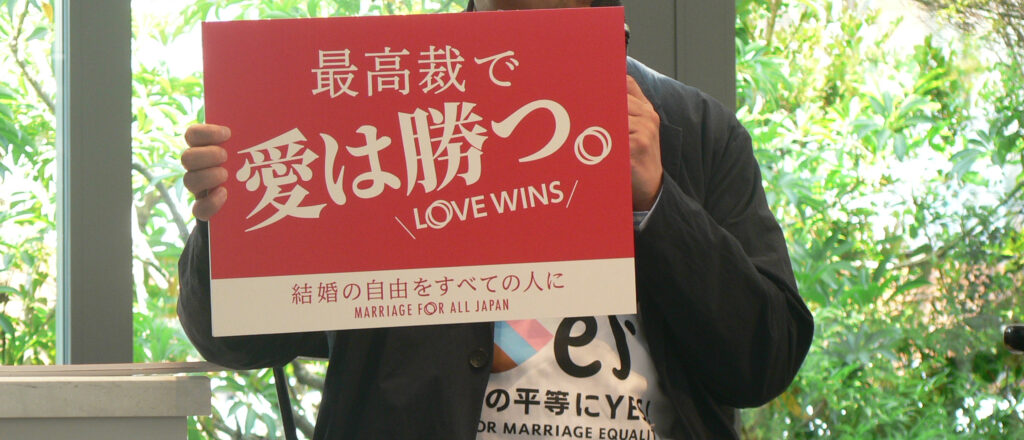
Addressing the gathered press, Matsunaka declared “愛は勝つ” (Love Wins) as the theme for 2026. The Supreme Court is expected to rule this year in the Marriage for All Japan lawsuits, which seek recognition of marriage equality. Out of the six court cases, five resulted in rulings at the high court level that recognize the present state of affairs as unconstitutional in one way or another. Only the most recent high court ruling, delivered last year in Tokyo, saw no issue with the current lack of equal recognition for couples of the same legal gender.
Stakes and expectations are high for the upcoming Supreme Court ruling. The Supreme Court has referred the case to its “Grand Bench”, composed of all fifteen Supreme Court justices. The Court reserves the Grand Bench for particularly important cases, especially those involving constitutional interpretation. In other words, the Supreme Court is expected to deliver its very first verdict on whether Japan’s lacking legal recognition for same-sex relationships violates the country’s constitution.
Whether love will indeed win in the courtroom may depend on more than just the legal arguments from the Marriage for All Japan team. Courts in Japan are known to take societal changes and consensus into consideration.
In a 2024 ruling in favor of marriage equality, the Tokyo High Court, for instance, made reference to the spread of local government’s “partnership systems” recognizing LGBTQ+ couples’ relationships. It used this as evidence of “a growing awareness that same-sex couples should be protected by the institution of marriage in the same manner as opposite-sex couples.” If the Supreme Court justices are convinced that societal consensus is supportive of marriage equality, they are likely to let this count in the plaintiffs’ favor.
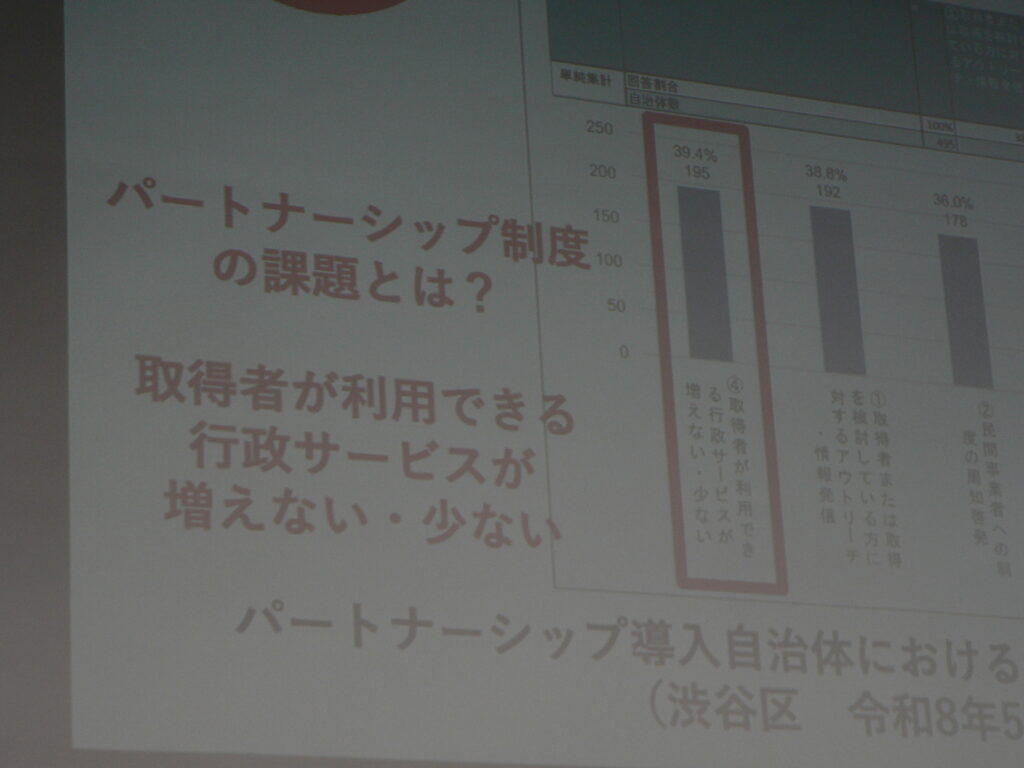
39.4% of municipalities consider partnership systems “too limited”
How deeply the lack of recognition affects the plaintiffs and other LGBTQ+ people is also likely to factor into the Supreme Court’s decision.
As mentioned earlier, a second Tokyo High Court judgement, made in 2025, was unfavorable towards marriage equality. Part of the ruling’s argumentation was that even without marriage couples can still enjoy some degree of recognition and benefits through alternative means, including partnership systems, legal contracts between partners, and policies from private companies.
This ruling was the odd one out among the six Marriage for All Japan high court rulings. It illustrates the importance of stressing to the court that these alternatives still leave couples severely disadvantaged in their daily lives.
The press conference highlighted findings from a recent research survey conducted by Tokyo’s Shibuya Ward. The municipality sent out a survey in 2025 to all local governments with the policy. 495 local governments responded. 195 (39.4%) of the responding municipalities and prefectures considered the public services provided by their own partnership systems to be too limited.
Petition for the Supreme Court
Seeking to demonstrate to the Supreme Court that there are many people who desire the legalization of marriage equality, Marriage for All Japan announced an online petition. The petition runs until June 7, and at the time of this article’s publication has surpassed 27,000 signatures. The petition will be delivered to the Supreme Court on June 8, alongside handwritten messages collected by various LGBTQ+ organizations across Japan.
On the petition’s webpage, Marriage for All Japan writes:
Now, more than ever, your voice matters. Let’s deliver the voices of many people to the Supreme Court, to realize a society where people can freely choose to get married, regardless of whether they’re of differing legal genders or the same legal gender.
In addition to the petition, Marriage for All Japan also announced the launch of a two-part panel exhibition as part of the Yes! To Marriage Equality campaign. The first part centers on the display of messages written to one another by LGBTQ+ couples who are, from the perspective of the law, of the same sex, as well as messages between LGBTQ+ people and their family members.
Each panel displays the handwritten letters alongside photographs of the people in question. At the time of the press conference, organizers had created panels with messages from 36 prefectures, with the ultimate goal being to represent all 47 prefectures. The other part of the exhibition will focus on spreading information about same-sex marriage in a simple, and accessible way.
Question: do you like UJ's independent coverage of Japan? Our writers are supported by our members. Join Unseen Japan Insider to get bonus content every week, an ad-free website, and access to our large and growing Insider archive.If you love what we do, help us pay our writers to do more of it by joining Insider. You'll get bonus content every week, an ad-free website, and access to our large and growing Insider archive.
A new documentary on marriage equality in Asia
Last but not least, Marriage for All Japan announced an original documentary series called 『世界の同性婚ができる国に行ってみた!』(We Went To Countries Where Same-sex Marriage Is Possible!). The series, published on the organization’s YouTube channel and produced with support from Grindr’s Grindr For Equality initiative, consists mainly of street interviews in three other Asian countries.
The series’ first and second episodes are already available on YouTube at the time of this writing. The first episode focuses on Thailand; the second focuses on Taiwan. In May 2019, Taiwan became the first Asian country to legalize same-sex marriage. Thailand followed in January 2025.
The series’ third installment, currently slated for June 1, will focus on Nepal. While Nepal’s government recognized a marriage between two Nepalis of the same legal gender in November 2023, and other couples have followed since, the situation there is not as straightforward. Queer couples in Nepal continue to face high hurdles to register their marriages. Their “provisionally recognized” marriages don’t grant them the same rights as other married couples.
Messages from all over Japan
Following the above announcements, people from 36 different prefectures take the stage at the press conference. They are members of local LGBTQ+-related organizations, or branches of the Yes! For Marriage Equality campaign. One by one, they deliver a brief statement in support of marriage equality.
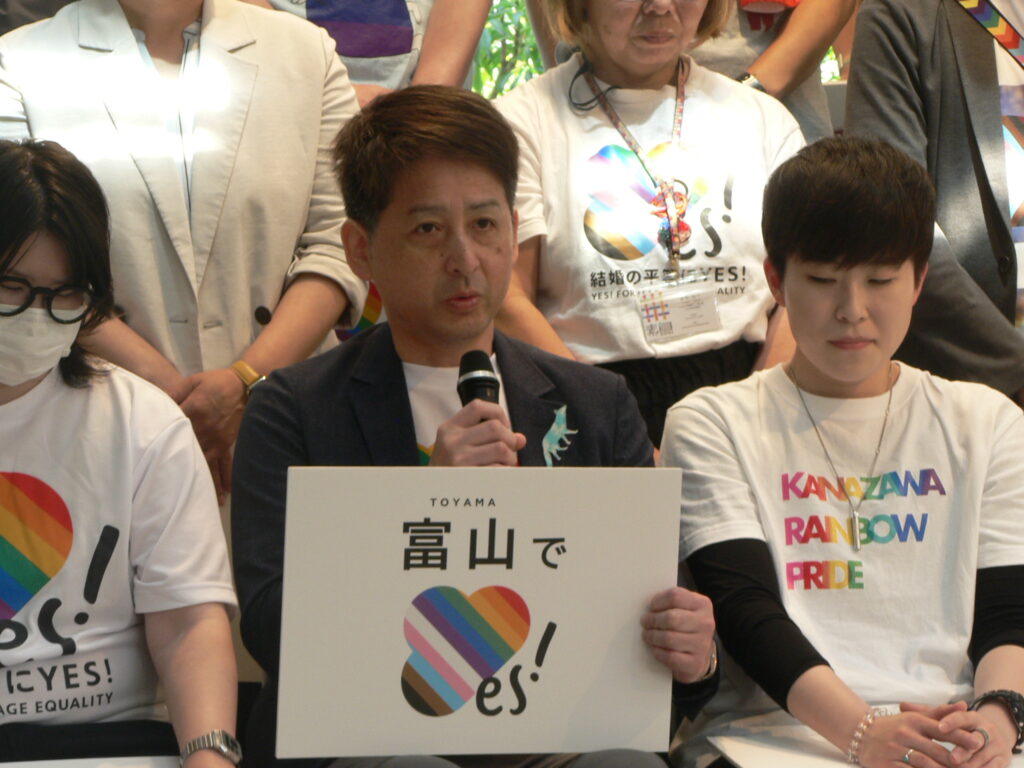
Kawashima Nobuka, from Hokkaido, starts: “Regardless of how the Supreme Court rules, the ruling by itself will not change society. Ultimately, nothing for us will change unless action is taken at the level of national politics.
“The issue is not only a major problem for couples of the same gender, but also for transgender people such as myself. I hope that as many people as possible will take interest, consider it as something that concerns them personally, too, and pay attention.”
Roughly twenty minutes later, Tsumura Masatoshi, from Wakayama, delivers the last statement. Tsumura asks people to question why some people are denied the choice to get married, before ending with the words: “Love wins.”
Making their rainbow more brilliant
After the press conference comes to an end, there is a moment to walk around the room, where panels belonging to the Yes! To Marriage Equality exhibition are already on display. The heartfelt messages brim with a bittersweet mix of affection, frustration, and hope.
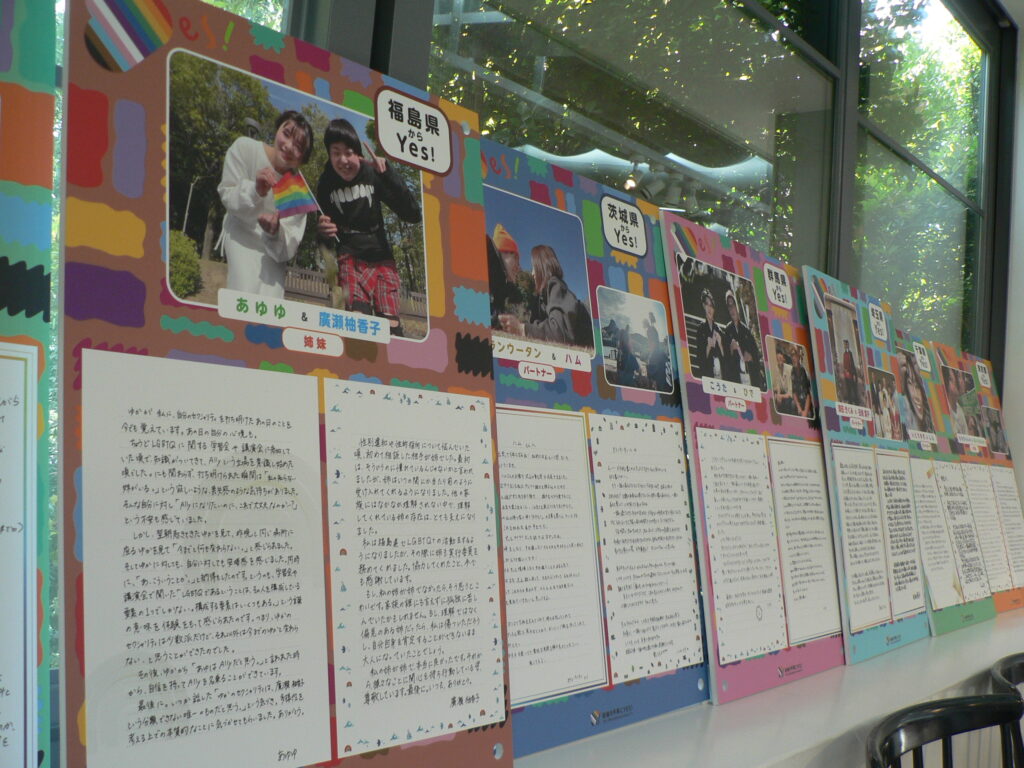
Among the panels, one from Aomori stands out. It lists the names of two partners, Okada Miho and Usami Shōko, along with the text “1968-2021.”
It’s been almost five years since Usami passed away from illness. In 2014 she founded the Aomori Rainbow Parade, the Tohoku region’s very first pride parade. That same year, she and Okada attempted to register their relationship as a marriage at the city hall. The city denied their request, but Usami’s activism for marriage equality and other causes continued until her death.
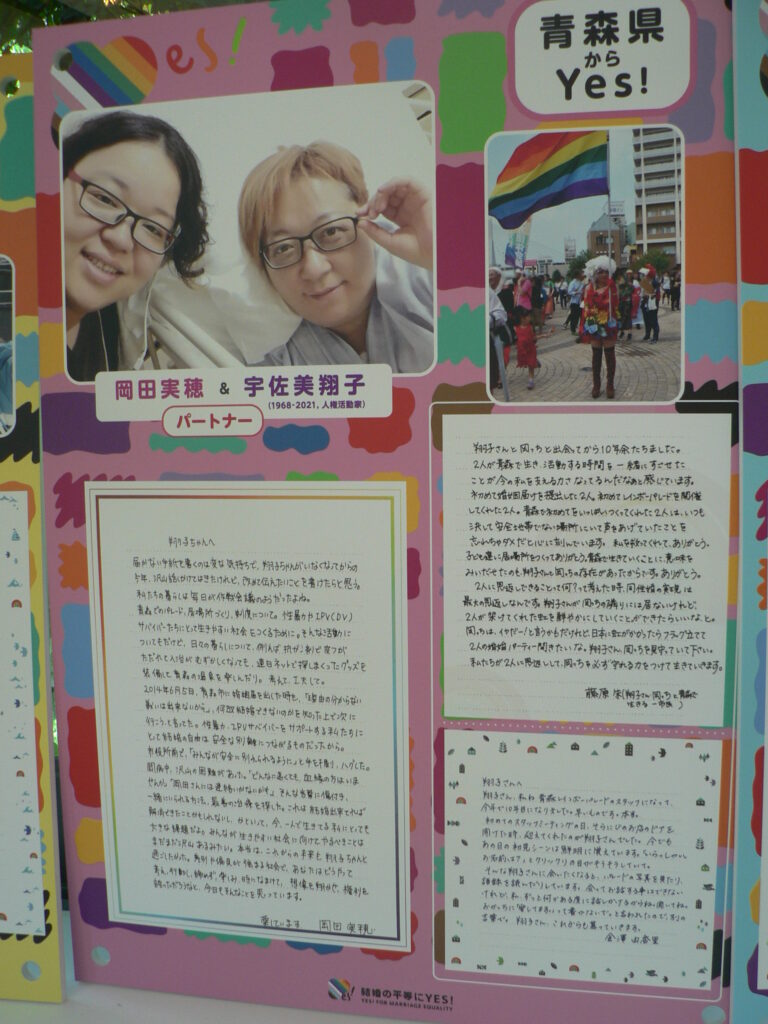
If, or when, marriage equality ends up legalized in Japan, Usami will not be able to bear witness to that historic day. Okada’s message to Usami starts:
Writing a letter that won’t arrive feels strange. In the five years since your passing, I have talked to you a lot already, but I think I would like to once more try to put into words the things I want to tell you. Our daily life was like a constant strategy meeting, wasn’t it?
and ends:
It seems like there is still a lot of work to do to create a society where everyone can live easily. Truthfully, I wish I could also spend the future with you. In a society where prejudice and discrimination are growing stronger, I wonder about how you would have thought and acted, would have refused to give up, enjoyed yourself, sometimes allowed yourself rest, let your imagination loose, and spoken out for rights. Today, too, I think about that. I love you.
Due to Usami’s untimely death five years ago, the panel doesn’t feature a message from her to Okada. Instead, there are two additional messages from people close to the couple. One credits the pair for creating important firsts in Aomori (the first parade, the first attempted marriage registration), and thanks them for making it easier for others to live there.
They write:
…when I thought to myself, how could I repay those two?, I realized that the greatest repayment would be the realization of same-sex marriage. Shōko may not be by Okacchi’s side anymore, but I would like to make the rainbow the two of them built even more brilliant.
Keep reading

Sources
Tokyo High Court Ruling on the Constitutionality of Same-Sex Marriage in Japan. LLAN
パートナーシップ制度導入自治体における性的マイノリティ関連事業の実態調査. Shibuya City
Nepal’s queer couples caught in red tape. The Kathmandu Post
「同性カップル宣誓1号になりたかったね」 訴え続けた53歳の死. Asahi Shimbun
Nepal’s laws stuck in binary model. Nepali Times