

Immigration and national identity have become increasingly prominent political issues in Japan. Following last year’s Upper House election, in which parties including Sanseito campaigned under the slogan “Japanese First,” activists and researchers have warned that anti-foreigner rhetoric has become more visible both online and in public discourse.
Now, one of Japan’s most celebrated novelists has found herself at the center of that debate.
A growing normalization of exclusion
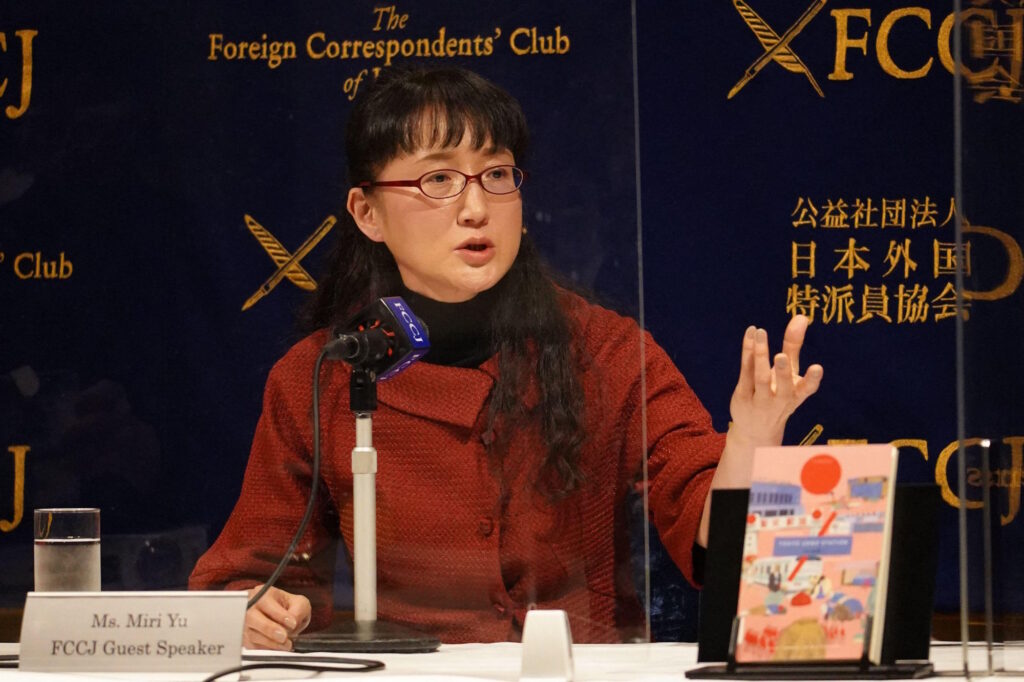
On X, Yu Miri, an award-winning author of Zainichi Korean heritage, criticized recent anti-foreigner political rhetoric in Japan, warning against the growing normalization of exclusionary attitudes. Her posts quickly attracted a wave of discriminatory abuse, with some arguing she shouldn’t be allowed to speak because of her heritage.
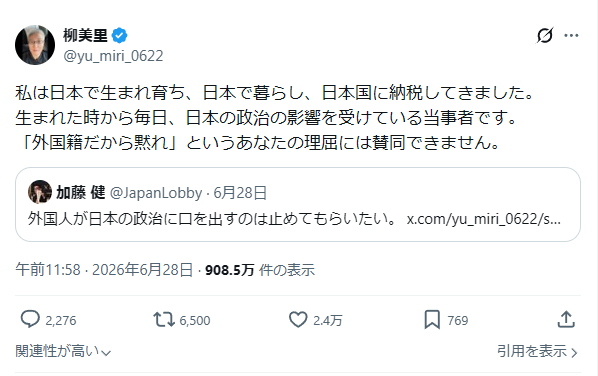
For many of her detractors, the message was simple: because she’s not ethnically Japanese, she had no right to comment on the country’s politics.
The backlash soon became so severe that her editor at Weekly Gendai, Hatori Ryō, publicly came to her defense, condemning the attacks.
“I can’t turn a blind eye to discrimination,” he wrote.
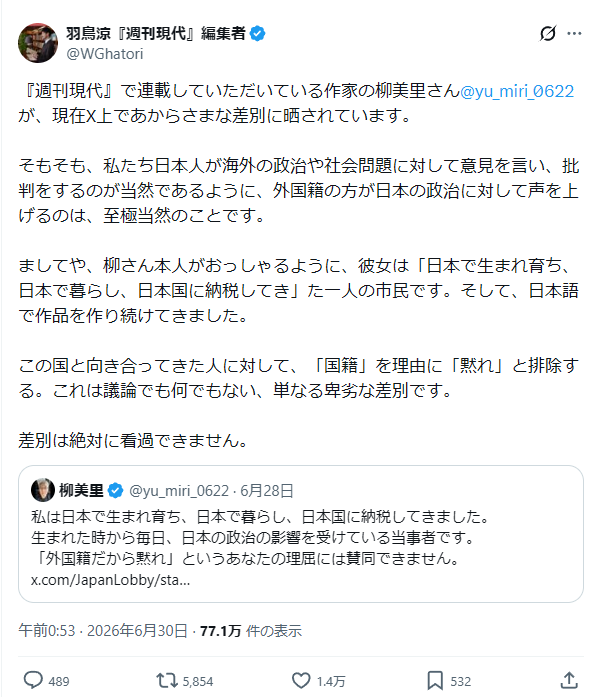
He argued that foreign nationals and ethnic minorities living in Japan have every right to express opinions about the society in which they live. The exchange ultimately sparked an online campaign condemning the abuse and calling for an end to the hate directed at the author.
Against that backdrop, the attacks on Yu Miri have become more than a dispute over one author’s political views. Instead, they have reignited a broader debate over who is considered to have the right to participate in Japanese public life.
Who is Yu Miri?
To many readers outside Japan, the backlash may seem puzzling. Yu Miri is not a foreign celebrity weighing in on another country’s politics.
Born in Ibaraki Prefecture in 1968 and raised in Yokohama, she is one of Japan’s most acclaimed contemporary novelists. Over the course of her career, she has received some of the country’s highest literary honors, including the Akutagawa Prize. Her novel Tokyo Ueno Station later won the National Book Award for Translated Literature in the United States.
Yu Miri is also a member of Japan’s Zainichi Korean community. The term generally refers to ethnic Koreans with long-standing roots in Japan, many of whose families settled here during Japan’s colonial rule over Korea between 1910 and 1945. While many have since become Japanese citizens through naturalization, others have retained Korean nationality, and many families have now lived in Japan for multiple generations.
Despite those deep roots, Zainichi Koreans have long faced discrimination in Japan. For decades, members of the community encountered barriers in employment, housing, education, and public life, while anti-Korean hate speech became increasingly visible during the 2000s and 2010s through demonstrations and online campaigns.
Although Japan enacted the Hate Speech Elimination Act in 2016, discriminatory rhetoric has persisted, with much of it shifting from the streets to social media. As recently as 2020, the head of a major cosmetics corporation used anti-Korean rhetoric when attacking his rivals.
Seen in that light, many of the comments directed at Yu Miri went beyond disagreement with her political opinions. Instead, they questioned whether her ethnic background disqualified her from participating in discussions about Japan at all.
Question: do you like UJ's independent coverage of Japan? Our writers are supported by our members. Join Unseen Japan Insider to get bonus content every week, an ad-free website, and access to our large and growing Insider archive.If you love UJ's independent coverage of Japan, join Unseen Japan Insider to get content every week, an ad-free website, and access to our large and growing Insider archive.
From political disagreement to questions of belonging

Criticism of public figures is nothing new, nor is disagreement over political opinions. But much of the reaction to Yu Miri focused not on what she had written, but on who she is.
Rather than challenging her arguments, many commenters argued that her Korean heritage disqualified her from speaking about Japanese politics altogether. The implication was clear: regardless of where she was born, the language she writes in, or her decades-long literary career in Japan, she remained an outsider whose opinions about Japan carried less legitimacy than those of an ethnically Japanese person.
It was that distinction that prompted Yu Miri’s editor at Weekly Gendai to respond publicly. Condemning the discriminatory abuse directed at the novelist, he argued that foreign nationals and ethnic minorities who live in Japan have every right to express political opinions about the society in which they reside.
His comments helped shift the conversation beyond one author’s social media posts. They’ve prompted broader discussion about the boundaries of political participation and belonging in Japan.
The debate also reflects a broader shift in how xenophobic rhetoric is expressed. While anti-Korean demonstrations organized by nationalist groups drew significant attention during the 2000s and 2010s, researchers say much of that hostility has since migrated online. Recognizing the changing landscape, Japan’s Justice Ministry has announced plans to conduct its first nationwide survey examining hate speech on social media, seeking to better understand how discriminatory rhetoric spreads in the digital age.
Who gets to be considered part of Japan?
As Japan continues to grapple with immigration, demographic decline, and questions of national identity, the backlash against Yu Miri illustrates how those debates increasingly extend beyond policy and into everyday public discourse. While disagreement over political issues is an expected part of any democracy, the response to the novelist highlighted a different question entirely: who is considered to have the right to take part in those conversations?
For many observers, that question extends far beyond a single author or a single social media controversy. Yu Miri was born and raised in Japan, has spent decades writing in Japanese, and is celebrated as one of the country’s most accomplished contemporary novelists. Yet for some of her critics, her Zainichi Korean heritage alone was enough to cast her as an outsider whose voice did not belong in discussions about Japan’s future.
But the backlash did not go unanswered. Yu Miri’s editor publicly defended her, while thousands of people rallied behind a hashtag calling for an end to the hate speech directed at the author.
As officials prepare to examine the spread of online hate speech for the first time, the debate surrounding Yu Miri serves as a reminder that the issue is not simply what people say online, but who is accepted as a legitimate participant in Japanese society.
Keep reading



Sources
柳美里 Wikipedia (日本語版)
「排外主義」が日本の新たな政治課題に 参院選で相次いだ「外国人規制」の訴え、反対の声も高まったが… 東京新聞デジタル (Tokyo Shimbun)
法務省、ヘイトスピーチの実態調査へ ネット分析し対策検討 日本経済新聞 (Nikkei)
2026年に始まるヘイトスピーチ調査――ネット社会で広がる差別と法務省の挑戦 フジ行政書士事務所 (Fuji Administrative Scrivener Office)
「有名人の政治的発言」が叩かれる日本のゆがみ 「遊戯王」作者もインスタグラムで滅多打ちに 東洋経済オンライン (Toyo Keizai Online)