
One common worry among Western tourists to Japan is: Will my tattoos get me turned away at the door?
It’s a concern grounded in reality. And it can bite you on your trip to Japan when you’re least expecting it.
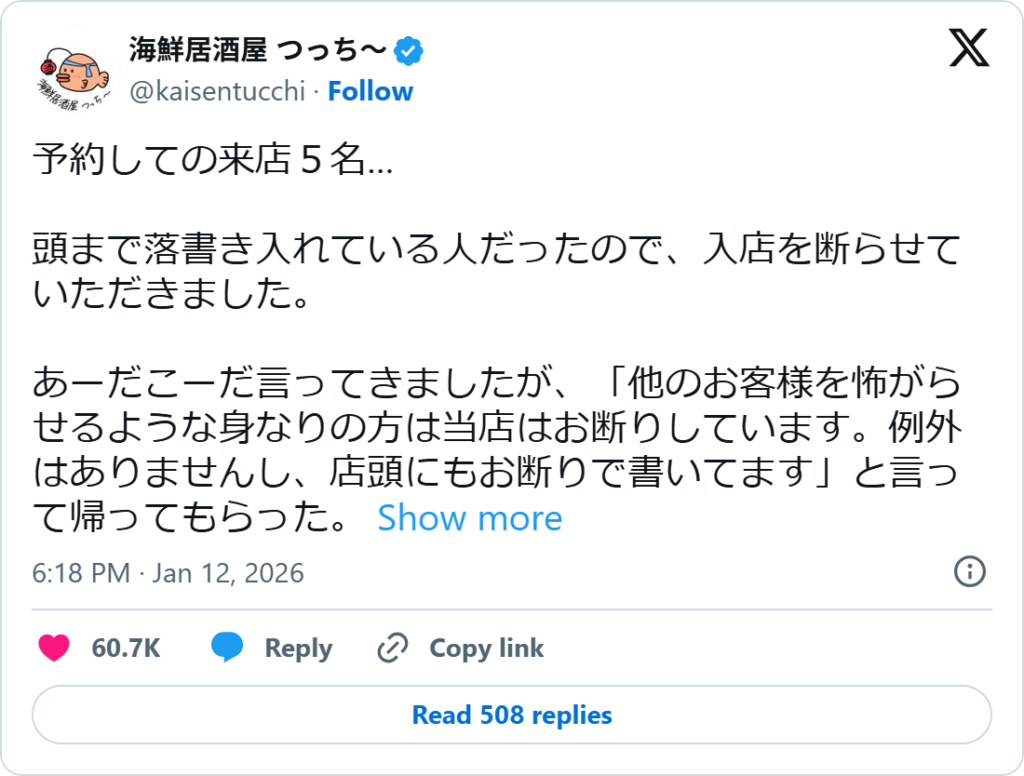
In January 2026, the owner of Tsucchī, a seafood izakaya in Tokyo, went viral after saying he turned away a five-person reservation because one of them had tattoos up to his head. In his post, he makes his prejudice clear: “I don’t think someone with scribbles inked onto their head, face, and neck is a decent person.” A majority of those engaged with the post agreed with him.
Usually, you don’t have to worry about being thrown out of a restaurant for your tats. Tattoo concerns usually center around Japan’s onsen, or hot springs. But some nightlife venues in Tokyo and around Japan may also refuse entry to anyone who’s heavily inked. Here’s what’s behind this longstanding prejudice against tattoos and which venues may send you packing.
Tattoos and criminality: a modern prejudice
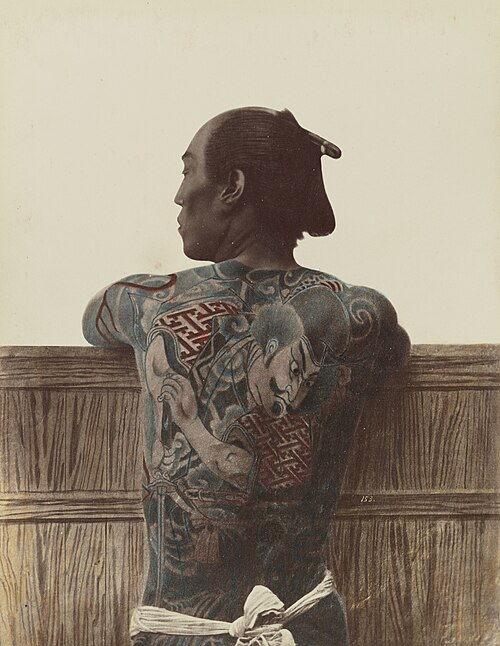
Tattoos weren’t always looked at askance in Japan. In fact, at one time, they were outright fashionable.
Two tattooing traditions have existed for centuries side by side in Japan. One is tattooing as a form of punishment. This is mentioned in Japan’s oldest pseudo-historical records, the Kojiki (712) and the Nihon Shoki (720). In 1720, shogun Tokugawa Yoshimune codified punitive tattooing as a replacement for the more brutal punishment of slicing off people’s ears and noses.
But the Kojiki and Nihon Shoki also mention tattooing as a regional art form as well. In the early 1800s, a working-class decorative tattoo boom took off. Firefighters, couriers, and construction laborers, who often worked half-naked, wore bodysuits with decorations such as a dragon, which symbolized protection. It wasn’t unheard of for a magistrate sporting tattoos himself to pass down tattooing as a punishment on criminals.
Then came the Meiji era. Afraid of how tattooing looked in the eyes of the West, Japan banned all tattooing for both the artist and the customer. (The laws, the Ishiki Kaii Ordinances, were the same ordinances that curtailed public urination.)
The tattoo ban was lifted in 1948, but the stigma stuck. In the 1960s and 70s, yakuza films associated ink with organized crime, an association that lingers to this day.
Most businesses, however, didn’t start posting signs until much later. Prefectural organized-crime exclusion ordinances spread nationwide around 2010 and 2011, putting duties on businesses to avoid dealings with gangs. “No gang members” signage followed, and since tattoos were associated with gang activity, the tattoo provisions came along for the ride.
Changing attitudes, but still a rarity
Attitudes toward tattoos in Japan are slowly changing. Part of this is due to the collapse in organized crime after decades of crackdowns. At the end of 2025, Japan’s National Police Agency counted only 17,600 organized crime members and associates and a mere 9,400 full members, marking the 21st straight year of decline.
The increase in foreign tourists is also inspiring changes as Japan works to accommodate people from cultures where tattoos aren’t only common but can be traditional. In 2013, a Māori woman, Erana Te Haeata Brewerton, made international headlines when a Hokkaido onsen refused her service over her tā moko, a traditional Māori facial and body marking that depicts a person’s genealogy. Since then, many businesses have moved from a strict ban to making judgment calls on a case-by-case basis.
It’s also easier now in Japan, not just to get tattoos, but to give them. In 2020, Japan’s Supreme Court ruled that tattooing isn’t a medical procedure, ending a run of prosecutions that had effectively required artists to hold a medical license.
People are slowly realizing that having tattoos doesn’t make someone a bad person. A 2015 Japan Tourism Agency survey found that 78.3% of facilities found no trouble whatsoever from inked customers. A separate 2021 study of public bath (sentō) operators in Ōta-ku, Tokyo, found operators saying that Japanese customers with tattoos often have good manners.
Despite this shift in attitudes, tattooing remains rare.
The strictest rules aren’t in Tokyo’s nightlife scene
There are many different types of nightlife businesses in Japan. (My guide to Tokyo nightlife, Tokyo After Dark, documents around 16 of them.) Historically, however, the toughest rules have been at public baths and lodges.
Japan’s neighborhood sentō baths, as a rule, don’t forbid people with tattoos. That’s because sentō are regarded as public-health necessities. But many super-sentō (a pricier leisure version of the public bath), spa resorts, hotel baths, and municipal pools forbid them outright. Meguro Ward in Tokyo, for example, has forbidden exposed tattoos since 2013, requiring rash guards so as not to make other swimmers “uneasy.”
Many onsen also have hard-and-fast rules as well. Tokyo’s Manyo Club Toyosu, a carried-water onsen bath in Senkyaku Banrai, requires users with tattoos to use facility-issued cover seals before bathing. Other onsen will allow users with tattoos, but only in private rooms, out of public sight.
How different Tokyo nightlife venue types handle tattoos
The good news is, most Tokyo nightlife venues don’t care if you’re tattooed. Some do, however. What’s even more frustrating is that whether you can enter or not may depend on who’s working there that night.
Izakaya and other restaurants
Many izakaya, Japan’s small-plate pubs, will have signs posted refusing service to “organized crime members” and “people with tattoos.” This ban, however, is generally not enforced in practice.
The example of Tsucchī at the top of this article was an exception, not the rule. In that case, the owner kicked out people who had visible tattoos on their face and neck. Even most commenters in the thread said they wouldn’t support kicking someone out for an arm sleeve tattoo that could easily be covered.
Small independent bars
Small bars, like the kind you find in Golden Gai or Shinjuku Ni-chōme, generally have no posted restrictions. However, the owner may forbid certain people from entering on a case-by-case basis.
Music-first clubs
A non-issue. Smaller music clubs usually have no anti-tattoo policy.
Large commercial clubs
Some large-scale commercial nightclubs in Tokyo have anti-tattooing policies. T2 Shinjuku’s site reserves the right for staff to refuse entry on a case-by-case basis. Shibuya’s Club Camelot keeps it in its dress code, reserving “the right to refuse entry to anyone with visible tattoos” alongside its bans on tracksuits, tank tops, and sandals.
This doesn’t apply to Tokyo’s international high-end clubs, like 1 Oak Tokyo in Azabu-Jūban. They generally have no posted policies, and partying while tattooed isn’t an issue.
Hostess (cabaret) clubs
Generally forbidden for both staff and customers. Hostess clubs, especially in areas such as Roppongi and Ginza, have a reputation for providing high-end service; workers generally regard themselves as distinct from the “lower” tiers of Japanese nightlife. Presenting a clean-cut image is part and parcel of preserving that reputation.
Con cafes and girls’ bars
Most con cafes and girls’ bars, where customers drink and chat with attractive staff members, don’t have explicit rules forbidding tattoos. This is especially true of girls’ bars, almost all of which run into the late hours and stay outside the settai (接待; personally entertaining customers) provision of Japan’s entertainment law by keeping staff behind a physical bar, which spares them the stricter license that provision triggers.
Con cafes may operate differently depending on whether they stick to plain sekkyaku (接客; customer service) or cross into settai, where staff sit beside customers in a more intimate setting, as at a hostess club. Such cafes may ask heavily tattooed customers to cover up or refuse service altogether.
This same permissiveness extends to staff. Nightlife businesses struggle to retain staff due to late hours and irregular shifts. A search shows 47 tattoo-friendly con cafe job listings in Akihabara alone.
Oppai bars (seku-kyaba)
Japan’s “titty bars,” which allow canoodling and fondling from the waist up, generally have no posted rules forbidding customers with tattoos. As always, however, staff at the door may make a snap judgment and turn you away if they feel your coverage is “excessive.”
Soaplands
Japan’s famous sex shops generally have no posted prohibitions against tattoos. This is probably because all activity takes place in private rooms. Staff are also generally prohibited from having tattoos at higher-end establishments.
The one thing many soaplands do forbid? Foreigners, tattooed or otherwise.
Happening bars and couples’ kissa
Happening bars, clubs where customers meet one another for one-night stands on premises, may disallow visitors with tattoos. However, the written regulations can be deceiving. I know one happening bar in Tokyo whose website explicitly forbids tattoos, yet I’ve entered with heavily tattooed friends on numerous occasions.
Need a more detailed breakdown? My Tokyo After Dark nightlife guide discusses in detail which clubs do and do not allow visitors from overseas with tattoos.
The bottom line
You may still be unsure whether you can enter a given venue. Here are two good rules of thumb to guide your decision-making:
- Ask. Some venues post “no tattoos” on their websites to show authorities they’re actively cracking down on organized crime. It never hurts to ask politely. They may let you in if your tattoos are light, or make an exception based on your demeanor or, frankly, because you’re a foreigner and thus unlikely to be associated with Japanese organized crime.
- Cover up. If you have heavy tattoos, wear a long shirt, tattoo sleeves, or other items that keep them out of sight.
It can suck to be turned away from a venue you were looking forward to entering. If it happens, take it in stride. Tokyo is huge, and there are plenty of places where your money – and tattoos – will be warmly welcome.
Keep reading

Sources
入墨・タトゥーがある客の利用可否をめぐる現状と課題 ―公共入浴施設等へのインタビュー調査に基づく定性的検討― 観光研究(日本観光研究学会)
【観光庁】入れ墨(タトゥー)の入浴可否のアンケート、訪日外国人観光客受け入れのポイントと対応事例 訪日ラボ
「タトゥー客お断り」銭湯、地元J3選手を例外にしたら苦情…「特別扱いするのか」の声 読売新聞オンライン(Yahoo!ニュース) (archived)
“顔までタトゥー”の予約客を入店拒否 飲食店の対応が物議 「他のお客様が…」店主が明かした真意 ENCOUNT
タトゥーに関する入浴制限について 三井不動産ホテルマネジメント
SYSTEM|T2 SHINJUKU T2 SHINJUKU
ABOUT|CLUB CAMELOT CLUB CAMELOT
FAQ|WOMB WOMB
システム・料金(初めての方へ/会員規約) メンバーズバー BARフェイス
SYSTEM(利用規約) CLUB ZEUS
Q & A カップル喫茶 OLIVE21
ご利用規定 カップル喫茶 KUJIRA
ハプバーにおけるタトゥーの寛容度 note(まつだ)
タトゥー・刺青がある方のご入館に関して 東京豊洲 万葉倶楽部
刺青・タトゥーを露出した方の区立プールの入場はお断りします 目黒区
銭湯は基本、タトゥーOKって知ってた? BuzzFeed Japan
お風呂で「タトゥー禁止」は変わるか? 試行錯誤する温浴施設 BuzzFeed Japan
<タトゥー>(前編) 温泉の「入浴お断り」は仕方ない? 中日新聞Web
【タトゥーぎらい】第3回 「タトゥーお断り」は法令違反? 晶文社
タトゥー彫り師の無罪確定へ 医師法裁判、最高裁が検察側の上告棄却 BuzzFeed Japan
最悪の場合、死に至る…日本人タトゥー人口急増で医師が警鐘「多くの人が知らない施術後の2大リスク」 8年間でほぼ2倍増して約140万人 PRESIDENT Online
元マル暴刑事&暴力団幹部らが明かす「ヤクザと刺青」の意外な秘話 FRIDAYデジタル