
Anime pilgrimage, known in Japanese as seichi junrei (聖地巡礼), has become a major force in anime-related tourism in Japan over the past decade. For years, anime fans have visited real-world locations that appear in their favorite series.
Various regions across Japan have taken note of the trend, building attractions for anime fans directly into their infrastructure. Here are some of the most notable locations around the country that are leveraging anime to encourage tourism – and, in some cases, recover from disaster.
A trek to the animated holy land
Despite the name, these sites are not temples or mountains that religious pilgrims frequent. They are instead train stations, bridges, staircases, and shopping streets. Fans recreate scenes and take side-by-side photos. They stand where fictional characters once stood. The goal? Total immersion in the world that fans yearn to escape to.
Like many movements, seichi junrei began online. Long before tourism agencies promoted anime routes, fans compared screenshots and identified real-world inspirations. Visitors were traveling to towns featured in series like Lucky Star, or wandering through Tokyo neighborhoods mapped almost one-to-one in Persona 5.
As a result, pilgrimages became more popular. Both local governments and the tourism industry took note.
Today, anime pilgrimage is no longer purely grassroots. A 2024 survey by the Japan Tourism Agency found that 11.8 percent of inbound visitors cited anime or film locations as a reason for travel. The industry itself now generates billions in overseas revenue. Seeing an opportunity for profit, what began as a fan ritual is now a genuine part of regional branding and inbound travel strategy.
The otaku market and post-pandemic recovery
Anime pilgrimage does not exist in isolation. It sits inside a much larger “otaku market,” a ¥700 billion sector driven by anime, manga, idols, and character fandom. For decades, it’s quietly grown, boosted by the way social media has developed in tandem.
However, during the COVID-19 pandemic, large fan events suffered. Live concerts and conventions were canceled. Comic Market (Comiket), a large fan event centered on the fan-driven doujinshi manga market, scaled back. However, thanks to fans staying home, streaming services and manga apps expanded their reach. Despite not being able to leave their homes, audiences grew.
As such, once travel restrictions were lifted, movement returned. Both seichi junrei (“pilgrimage to sacred places”) and oshi-katsu (“supporting your fave”) became visible drivers of travel recovery. Between buying merchandise and events, pilgrimages fit naturally into this behavior. Travel becomes an extension of the fandom experience. A trip is not only sightseeing; it’s bringing beloved favorites to life.
The institutional turn: Coordinating sacred geography
In 2016, the Anime Tourism Association was established to link popular anime works with regional revitalization and increased inbound travel demand. The association’s leadership includes major publishers and anime studios, as well as travel companies, airlines, and Narita International Airport. Board members include core pillars of Japan’s publishing, entertainment, and travel industries, such as KADOKAWA, Shueisha, Kodansha, Aniplex, JTB, and Japan Airlines.
Since 2018, the association has released its annual “Anime Spot 88” list, with the number 88 referencing the Shikoku 88-temple pilgrimage traditionally associated with Kukai. Each year, 88 destinations connected to anime works are selected through a voting process.
The chosen sites receive official recognition plates. Some locations offer goshuin-style stamps for visitors, mirroring traditional religious pilgrimage practices. The association’s website is also available in English, allowing overseas anime fans to participate in voting.
However, the relationship between fandom and tourism strategy is not always top-down. In some cases, local governments end up responding to existing fan geography.
See a side of Tokyo that other tourists can't. Book a tour with Unseen Japan Tours - we'll tailor your trip to your interests and guide you through experiences usually closed off to non-Japanese speakers.

From fan mapping to municipal campaign: Fate/ and Kobe

The fictional setting of Fuyuki City has long been associated by fans of the Fate franchise with real-world locations in Kobe. Architectural similarities and urban layouts encouraged speculation, even though the city is never officially named in the work.
In 2020, when the final film in the Fate/stay night: Heaven’s Feel trilogy was released, the Kobe Tourism Bureau hosted an official “Journey to Kobe” stamp rally. The campaign directed participants to sites such as the Kitano Ijinkan district and Kobe Ōhashi. Visitors collected stamps at designated locations and exchanged completed cards for commemorative prizes. Those who gathered all six stamps received numbered promotional cards. An online survey offered additional incentives.
Stamp sheets were distributed at train stations, tourist information centers, and major attractions. The campaign operated within a fixed time period and was tied directly to the film’s theatrical run. Movement through the city was structured rather than incidental.
The event did not invent the association between Fate and Kobe. It formalized it. Fan identification preceded municipal coordination, but the city translated that identification into a managed promotional program.
Building anime tourism into local infrastructure
Not all anime tourism develops in response to fan discovery. In some cases, municipalities adopt proactive branding strategies built around specific franchises.
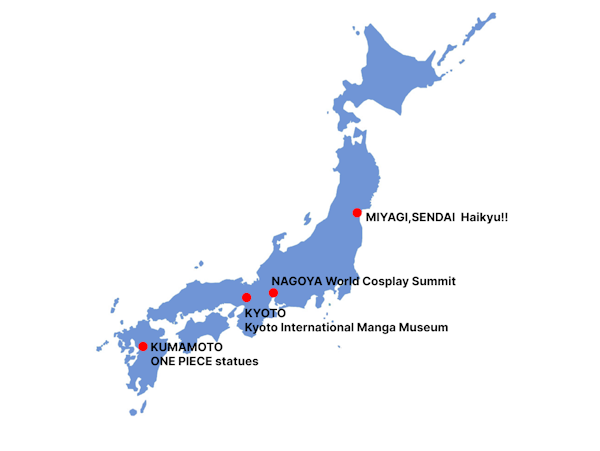
One example is Haikyu!! in Sendai. Because parts of the story are set in Miyagi Prefecture, Sendai has incorporated the series into its official tourism promotion. Characters have been appointed as tourism ambassadors. Monuments and themed manhole covers have been installed at designated locations. The city distributes maps that guide visitors through related sites.
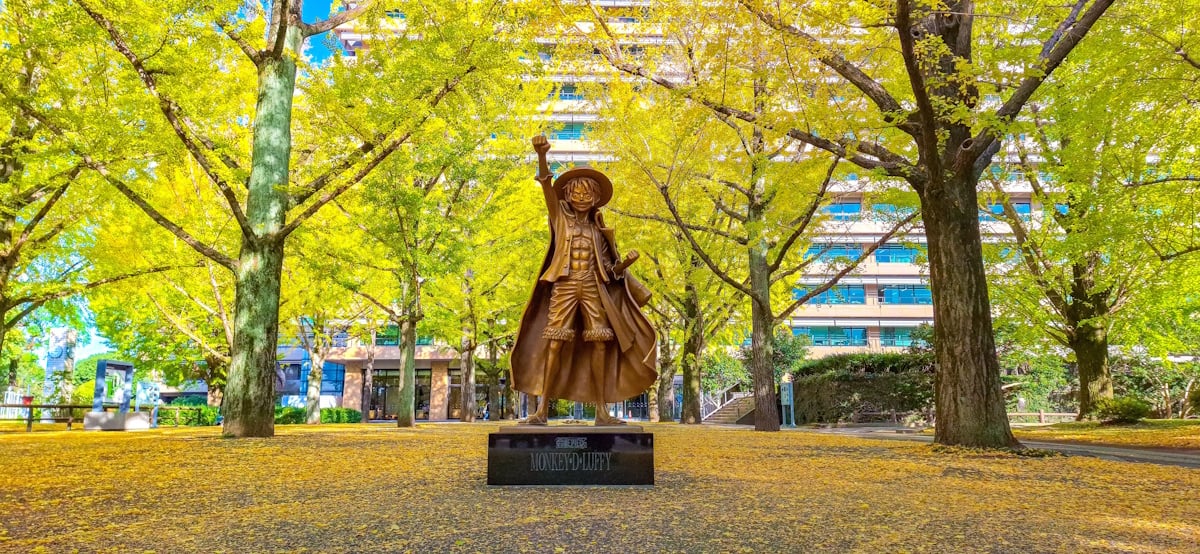
A different model appears in Kumamoto Prefecture through its collaboration with One Piece. Following the 2016 earthquakes, the prefecture partnered with creator Oda Eiichiro to install bronze statues of the Straw Hat crew across multiple municipalities, with proceeds supporting disaster recovery. The statues form a distributed tourism route. Visitors travel between towns to complete the circuit, promoting tourism at a prefectural scale.
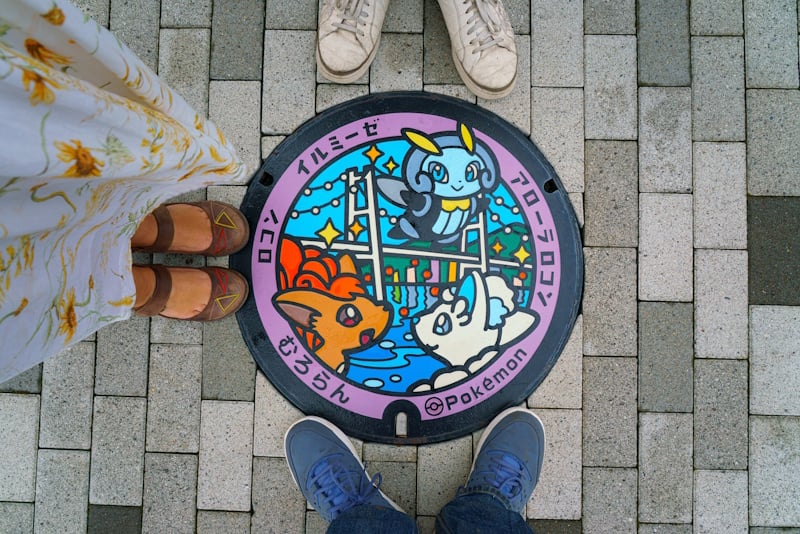
Infrastructure-level embedding can also be seen in the Poké Lid manhole initiative linked to Pokémon. Decorative manhole covers, an attraction in their own right, have been installed in more than 40 prefectures, with each design reflecting local geography or culture. The lids also serve as PokéStops in Pokémon GO, making the experience more interactive.
Even older franchises participate in localized branding. In Tokyo’s Azabu-Jūban district, Sailor Moon-themed manhole covers reinforce the neighborhood’s long-standing association with the work. The installations are modest in scale, but they formalize a connection fans had recognized since the 1990s.
With anime functioning as a planning tool, it’s highly likely that similar models of franchise-based tourism are going to show up sooner rather than later.
What changes when pilgrimage is curated?
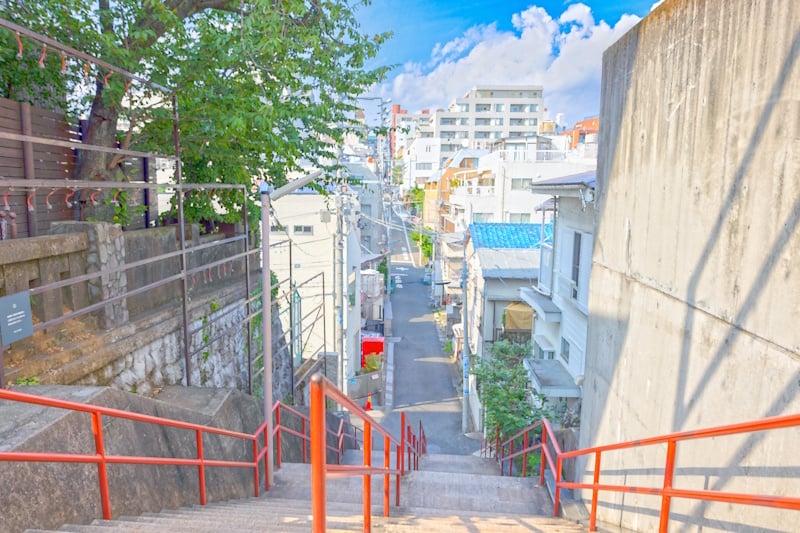
The expansion of anime tourism raises a structural question. What changes when pilgrimage is organized rather than discovered?
Early examples of seichi junrei often relied on informal knowledge passed through social media and message boards. Fans shared screenshots and compared details, and locations were identified through observation and discussion. The process felt far more investigative.
For example, the famous staircase in Kimi no Na wa (Your Name) near Suga Shrine in Yotsuya, Tokyo, became a pilgrimage site solely through viral recognition. By contrast, with the emergence of certified sites such as Anime Spot 88, the experience is now becoming far more organized.
See a side of Tokyo that other tourists can't. Book a tour with Unseen Japan Tours - we'll tailor your trip to your interests and guide you through experiences usually closed off to non-Japanese speakers.
As a result, the relationship between fandom and locality is becoming more explicit. Municipalities select which works to promote. Intellectual property holders authorize usage. Events and collaborations are planned around release schedules. Institutions are directing fan traffic; while discovery still occurs, it increasingly happens inside an established framework.
Does that make it less sacred? The fandom experience was already commercialized from the start. Yet perhaps for some, the lack of detective work may make it less fun.
It’s clear now that such fandom pilgrimages will continue to operate at the ever-changing intersection of fandom and regional policy. As anime tourism continues to expand, the question is not whether pilgrimage will persist, but how much of it will remain organic.
Tourists to Japan Are Tossing Coins into These Ponds. That’s a No-No
Officials are worried about the environmental impact after tourists dumped 18,000 coins into the ponds in 2025, despite clearly posted signs.
Suwa: One of Japan’s Best Onsen Towns You’ve Never Heard of
Japan is popular. Hot springs are super popular. But Suwa, an onsen town in Nagano Prefecture, remains a hidden gem.
Kyoto City May Partially Ban Vacation Rentals to Give Residents Tourist Relief
The city’s mayor won’t rule out creating “zero-day vacation rental” zones in residential areas in response to chronic complaints.
Sources
アニメツーリズム協会概要 Anime Tourism Association
アニメの「聖地巡礼」や「推し活」回復 「オタク」が動かす7000億円市場の魅力 Sankei
「劇場版『Fate/stay night [Heaven’s Feel]』Journey to KOBE スタンプラリー」開催概要. Kobe Tourism Bureau
ONE PIECE熊本復興プロジェクト ONE PIECE Kumamoto Revival Project
Poké Lids 公式サイト Poké Lids Official Website
