
For years, Japanese social media went about its business behind a surprisingly sturdy language barrier. Plenty of people outside Japan browsed Japanese posts, but unless they could speak Japanese themselves or they deliberately hit the “Translate Post” button, conversations mostly stayed within their own language communities.
Ah, those sweet, halcyon days. Now, social media sites like X are auto-translating languages, whether users like it or not. Some in Japan are asking: Is that a good thing? Or is it causing more friction than harmony?
From voluntary to forced translation

In late March 2026, X rolled out Grok-powered automatic translation for Japanese users. Suddenly, posts written in Japanese were automatically appearing in English for overseas readers, while foreign-language posts appeared in Japanese with no extra clicks. The old “Translate post” button became almost invisible because translation simply happened in the background.
X product lead Nikita Bier celebrated the launch by calling it “the largest cultural exchange event in history.” From one perspective, that isn’t entirely hyperbole. Millions of people who previously couldn’t read one another’s posts were suddenly participating in the same conversations. It’s a feature in effect straight out of The Hitchhiker’s Guide to the Galaxy.
The biggest difference isn’t really the translation itself. Rather, it’s that users may not realize translation is happening at all.
Previously, seeing the “Translate” button reminded readers that they were looking at a machine translation and that they should take whatever it said with a grain of salt.
Now, many readers simply see English or Japanese text, and the “translated” part doesn’t register. Readers are far more likely to assume every word reflects the author’s intent without realizing that the software might have misunderstood a thing or two.
The dangers of auto-translation
No Game No Life creator Yuu Kamiya made one of the strongest criticisms of the new feature. As a Japanese-Brazilian who speaks both Japanese and Brazilian Portuguese, Kamiya has firsthand experience watching ideas move between languages. His July 1 post quickly went viral, attracting around 84,000 likes.
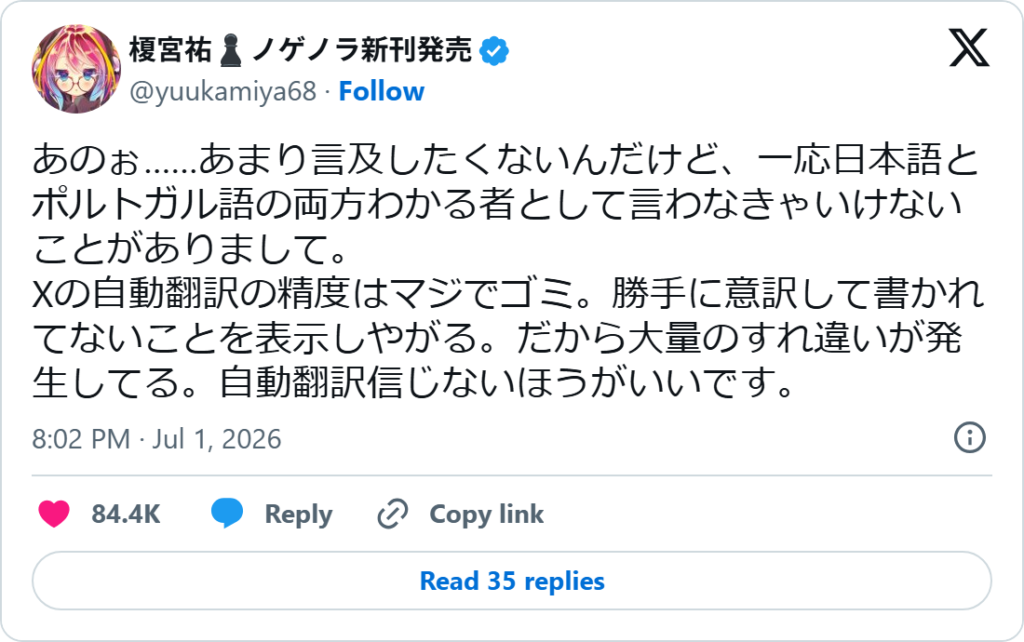
He pointed out that it’s not about whether the automatic translation is awkward. Rather, it’s that it “arbitrarily paraphrases and displays things that were never written.” He warned that it would inevitably cause miscommunications. And while a clumsy translation is annoying, a translation that confidently invents meanings a user never expressed can start arguments.
It’s even worse because with some words, auto-translation plays a guessing game. One widely discussed example involved the North American Fate/Grand Order account, in which auto-translate changed the title of the visual novel Mahōtsukai no Yoru (“Witch on the Holy Night”) to Mahō Shōjo Madoka Magica. To be clear, that’s not a simple mistranslation. It’s an entirely different franchise.
When the software isn’t sure what a given text is supposed to be, it substitutes with something statistically plausible rather than admit, “Hey, I don’t know what this is.” As a result, the translation looks perfectly fine, all while being perfectly wrong.
Japanese ramps up the difficulty
Now, of course, these auto-translate problems apply to all languages, but they’re especially egregious with Japanese. Unlike English, Japanese frequently omits the subject and object of a sentence when they can be understood from context.
In Japanese, a post might say, “Finally did it.” But… who did it? What was done? Is the writer patting themselves on the back, criticizing someone else, or describing another person’s actions? A native speaker can fill in those blanks almost automatically, but a machine can’t. It can only guess.
It’s not even just sentence structure, but names as well. Japanese kanji often have multiple pronunciations, meaning software has to guess at how a person’s name is read. Some users have already noted that “Takaichi” is sometimes shown as “Takai.”
In all fairness, humans studying Japanese encounter the same difficulty in reading names. But again, the real issue isn’t the mistranslation; it’s the illusion of certainty. Auto-translate doesn’t let you know when it has encountered something it had to guess at.
Question: do you like UJ's independent coverage of Japan? Our writers are supported by our members. Join Unseen Japan Insider to get bonus content every week, an ad-free website, and access to our large and growing Insider archive.If you love UJ's independent coverage of Japan, join Unseen Japan Insider to get content every week, an ad-free website, and access to our large and growing Insider archive.
The benefits and pitfalls of auto-translation
Of course, it isn’t all bad. For the good, media sociologist Masahiko Shoji pointed to a manga artist’s casual story about meeting American soldiers at a yakiniku restaurant.

Under the old system, it probably would have remained a small Japanese conversation. Instead, the translated post reached tens of millions of readers overseas, including former U.S. service members who responded warmly with their own memories. That kind of interaction can’t happen when language barriers keep conversations separate.
Shoji also noted that removing language barriers can speed up the international exchange of information. It can, for example, spread the latest Japanese technical research in an instant, when before it would have taken years to reach foreign audiences.
However, when you combine auto-translation with algorithms often driven by negative emotion, that’s a recipe for disaster.
Former television presenter and YouTuber Kanon Aoki has argued that automatic translation exposes hostile or xenophobic posts to global audiences. In her view, such posts come from a small, vocal minority, but their new visibility can give the impression that all Japanese people think this way.
Sensitive discussions involving religion, politics, or national identity become especially risky because cultural context rarely survives machine translation intact.
Different translating tools vs. human translators
Of course, Grok’s AI translator isn’t the only tool around. Claude, ChatGPT, and general-purpose large language models can now also do it. DeepL does a very accurate job with formal writing, but the second you throw in slang and cultural references, it loses the plot.
Machine translation is improving every year. But it still struggles with sarcasm, irony, memes, and cultural references. As Dr. Wes Robertson makes clear with his monthly breakdown of Japanese Internet slang, these are the very ingredients that dominate social media.
But you know what (or rather, who) is good at interpreting casual language? Humans. And they’ve been especially active in fandom spaces for years.
Volunteer translators subtitle VTuber streams, anime clips, and interviews. They explain jokes, add cultural context, and rewrite puns so they actually work in the translation. Studios and streaming services sometimes hire experienced fan translators because they understand that context matters just as much as vocabulary.
In the end, Grok’s automatic translation isn’t destroying the language barrier so much as making it invisible. That opens the door to genuine friendships and fascinating discoveries. But it also creates an illusion that understanding has become effortless.
Sometimes the translation is accurate. Other times, millions of people end up reacting to a sentence that nobody actually wrote.
Keep reading



Sources
Xの自動翻訳で「言葉の壁」崩れる 開発者「史上最大規模の文化交流が始まった」 ただし誤解を危惧する声も ITmedia NEWS
世界が押し寄せてきた? 自動翻訳で大きく変化した「X」にマンガ家が期待すること、そしてちょっと恐れていること ITmedia NEWS
Xの自動翻訳によって、日本が世界にさらされている note(庄司昌彦)
Japan’s reputation is being ‘ruined’ by “small number” of X posts Dexerto
Xの自動翻訳、あなたの投稿も事故るかもしれない 日経BOOKプラス
Xに自動翻訳で“世界中とつながるTL”に 広がる交流と懸念 おたくま経済新聞
AI翻訳の誤訳を激減させる日本語文章テクニック 主語・目的語をしっかり書く、期日を明記… 東洋経済オンライン
XのGrokによる自動翻訳、何に注意が必要か Word Tailor
How Fan Translators Made Virtual YouTubers a Global Phenomenon Anime News Network