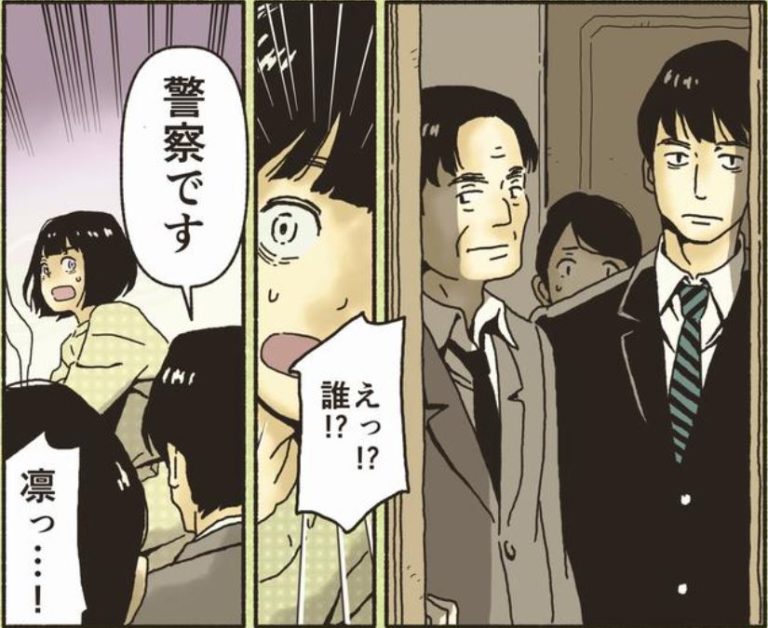
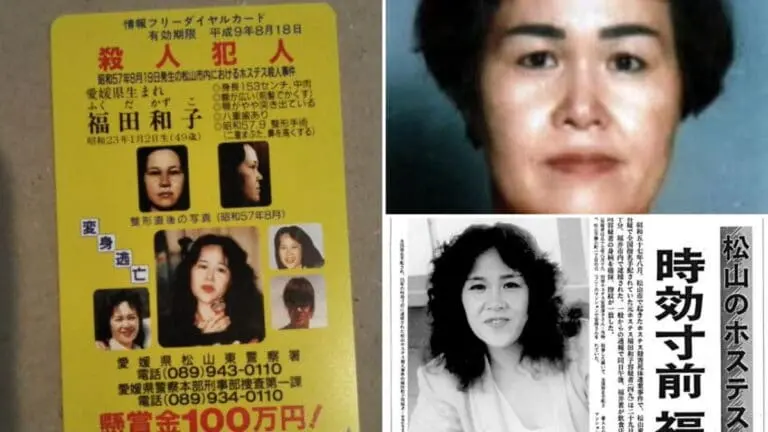
Did you know Japan once had a 15-year statute of limitations on murder? Here’s the story of how one woman, Fukuda Kazuko, a.k.a. the Woman of Many Faces, came within three weeks of being free and clear of her crimes.
An analogy for marriage?
When you learn a new language, you don’t just learn the language itself; you learn about the culture. You discover new and strange stories that, for the most part, are only familiar to those who have lived within that culture. Often, I’ll be reading an article or book in Japanese and will trip across the mention of a place, a name, or an historical event, and suddenly, before I know it, I’m 12 links deep inside the Japanese Wikipedia, familiarizing myself with something that, to tens of millions of others, is common knowledge.
In her book Sour Grapes (負け犬の遠吠え), author Sakai Junko tosses out a casual metaphor that initially went right over this foreigner’s head:
負け犬生活を長く続けた人が結婚した時、幸福というよりは安堵の表情に包まれているのも、「これで長い逃亡生活が終わった」という福田和子的心情が湧き上がってくるからなのでしょう。
When someone who’s lived a long while as a loser-dog [ed.: woman over 40 who has not married] gets married, the reason her face shows relief more than happiness is probably that a Fukuda Kazuko-like sentiment wells up in her: “And with this, my long life on the lam has ended.”
Some language learners recommend that, when you see a word you don’t know in a language you’re studying, that you underline or mark it for later study. It’s the best advice that I never follow. Encountering something unknown sends me into the Google pit, and I refuse to crawl out until I feel I’m slightly less ignorant than before I crawled in.
In this case, this one off-hand metaphor sent me on a day-long hunt for anything I could find about Fukuda Kazuko (福田和子). What I found was the fascinating story of a woman who nearly got away with murder.
The Murdered Hostess of Matsuyama (松山ホステス殺害事件)
In 1982, in the city of Matsuyama in Ehime prefecture, Fukuda, a 34-year-old married mother of four who worked as a hostess at a local cabaret, strangled her co-worker to death in the woman’s own apartment. Police and prosecutors would later contend that Fukuda killed the club’s top-earning hostess to pay off debts to a loan shark that at the time were costing Fukuda ¥100,000 (roughly $400 at 1982 exchange rates) every month, and that this crime was cold and calculated. Fukuda’s defense team would claim that it was an unplanned murder committed in the heat of the moment.
Whatever the motive, Fukuda wasn’t prepared to go to jail for her crime, a sentiment that I’m sure most criminals share. But Fukuda’s reasons for avoiding the Big House were more tragic than most.
The Matsuyama Prison Matter
Given that Fukuda’s mother ran a brothel out of their apartment when Fukuda was a kid, it’s fair to say she wasn’t set up for success at an early age. At age 18 (1966), Fukuda and the man she was living with at the time robbed the official residence of the head of the Takamatsu Regional Taxation Bureau. They were caught and convicted, and Fukuda was sent to Matsuyama Prison.
What happened in that place would later become known as the Matsuyama Prison Matter (松山刑務所事件). Essentially, gangsters paid off prison guards to have the run of the prison. They drank, they smoked, they gambled, they wandered the halls freely. And they raped the female prisoners. Fukuda Kazuko was one of the victims.
There was a weak investigation into the prison in the 1960s, but no charges were ever pressed. Decades later, the publication of Fukuda’s memoirs brought renewed public attention to conditions in the prison. By that time, however, the statute of limitations on any crimes committed had expired.
Question: do you like UJ's independent coverage of Japan? Our writers are supported by our members. Join Unseen Japan Insider to get bonus content every week, an ad-free website, and access to our large and growing Insider archive.We manage to keep most of our content free thanks to the generosity of our members. Join Unseen Japan Insider and you'll get access to new, exclusive UJ member content weekly, an ad-free website, and access to our large and growing Insider archive.
Fukuda Kazuko Runs
Fukuda would do whatever it took to avoid prosecution. This included enlisting her husband in disposing of the hostess’ body, and moving all of the woman’s furniture into another apartment in an attempt to make the woman’s disappearance look like a 夜逃げ (yonige; “night flight”: running away under cover of night, usually to avoid one’s creditors). In a particularly ballsy twist, Fukuda moved most of the woman’s furniture into another apartment that she shared with her lover, a salaryman who knew nothing of Fukuda’s husband or family.
This sham didn’t last long, however. One night, the police phoned Fukuda’s house to ask her into the station for questioning. Fukuda held the officers at bay by pretending to be one of her kids, and saying her mom would be back shortly. After hanging up, she took the ¥600,000 (roughly $2,400 at 1982 exchange rates) she had stolen from the hostess, and fled Matsuyama.
Of course, it would be impossible to run from the police forever. But Fukuda didn’t have to run forever. At the time of her crime, the statute of limitations on murder in Japan was short, a mere 15 years. That meant that, for Fukuda to get away with her crime, she would have to avoid capture by police anywhere in Japan for 5,479 days.
What’s remarkable is that she almost pulled it off.
Fukuda Kazuko: The Woman of Many Faces (七つの顔を持つ女)
Fukuda’s continued flight was a balancing act between deliberate cunning and ballsy risks. She would travel to the Kansai region to make calls home to her family and former lover from public phones. She knew full well her calls would be traced; this gambit was a deliberate attempt to throw investigators off the trail.
Fukuda also underwent numerous plastic surgery treatments to change her appearance. Investigators eventually cottoned on to this gambit, and the press dubbed her 七つの顔を持つ女 (nanatsu no kao o motsu onna), or “The Woman of Many [Seven] Faces.”
Fukuda’s actions were at times shrewd, and at other times outright brazen. After settling in as the common-law wife of a confectioner in Ishikawa Prefecture, she re-established contact with her biological son and convinced him to live with her under the ruse that he was her nephew. Fukuda kept up such shams for a while until relatives grew suspicious of her and reported her to the police.
But Fukuda managed to discover that police were on to her. She slipped away minutes before officers arrived, and eventually made her way to the city of Fukui.
Last-Minute Arrest
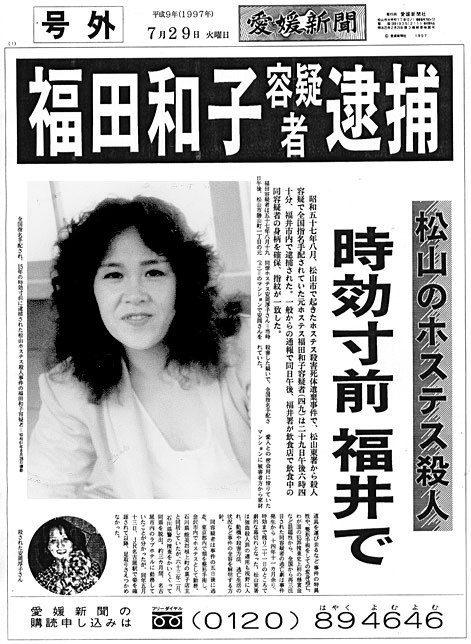
Fukuda was arrested in Fukui just 21 days before the statute of limitations on her initial crime was set to expire. The proprietress of an oden shop that Fukuda frequented recognized her voice from a recording played on a TV program about the fugitive. The shopkeeper worked with police to obtain Fukuda’s fingerprints from a beer bottle; once confirming the suspect’s identity, they swooped in and arrested her, bringing her nearly 15-year life as a fugitive on Japanese isles to a breathtaking close.
Fukuda went on to write a book about her exploits entitled The Valley of Tears. Convicted of robbery-murder and sentenced to life in prison, she lived until 2005, when, at age 57, she collapsed at Wakayama Prison and never regained consciousness.
In 2010, Japan revised the statute of limitations law. Under the revision, crimes punishable by death, which include murder and robbery-murder, no longer carry any statute of limitations at all. (That period had been 25 years since an earlier 2005 change, up from the 15 years Fukuda nearly ran out.) For fatal crimes whose maximum penalty is life imprisonment, the limit was doubled from 15 to 30 years. A fugitive in Fukuda’s position today would have no clock left to outrun.