

If you’re learning how to read Japanese, it’s probably kanji’s dual reading system, on’yomi and kun’yomi, that’s slowing you down.
On’yomi (音読み) is a reading derived from the Chinese pronunciation of a kanji, while kun’yomi (訓読み) is the native Japanese word associated with the character. For example, 水 has the on’yomi reading sui, derived from Chinese, and the kun’yomi reading mizu, the native Japanese word for “water.”
To the dismay of Japanese learners, many kanji have multiple on’yomi readings. That’s because Chinese pronunciation reached Japan in separate waves from the sixth century onward, through Buddhist sutras, missions to Tang China and, later, medieval Zen Buddhism.
A historical phonologist argues in his new book that no other language that adopted kanji developed the same system, although Korea and Vietnam once read Chinese texts through their own languages, too.
So why did Japanese preserve its native kun’yomi readings, while they largely disappeared in other languages that adopted Chinese characters?
The kun’yomi that only Japan kept
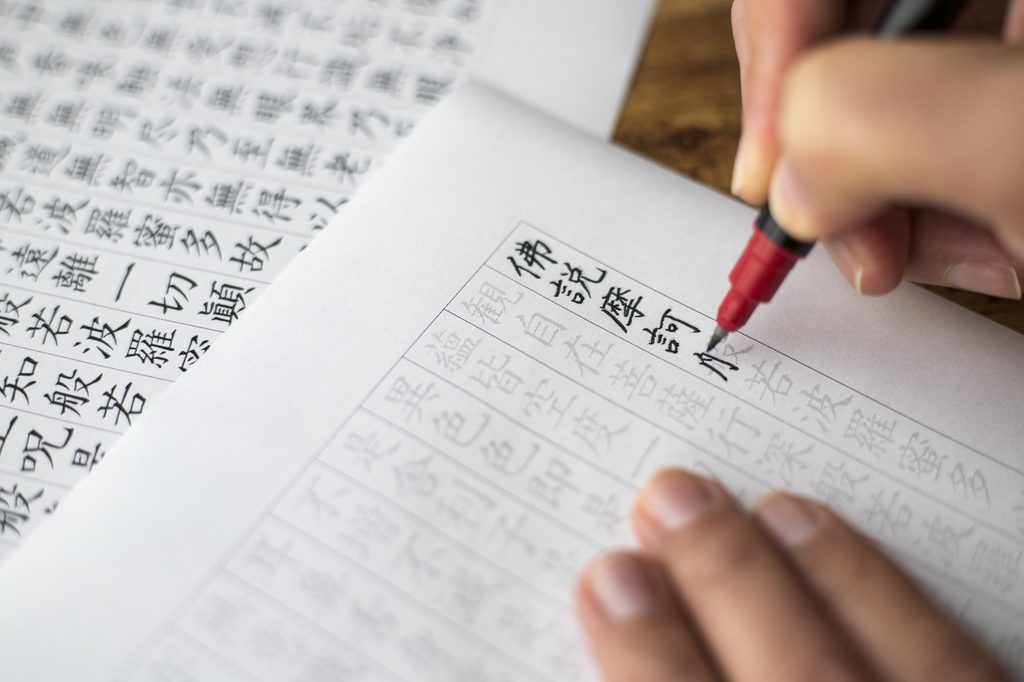
Here are two examples of kanji that ended up with not one but three Chinese-derived on’yomi readings, alongside two native Japanese kun’yomi readings: 行 and 明.
| On’yomi | Kun’yomi / okurigana in () | |
| 行 | – kō – gyō – an | – i (ku) [meaning “to go”] – okona (u) [meaning “to carry out”] |
| 明 | – mei – myō – min | – aka (rui) [meaning “bright”] – aki (raka) [meaning “clear”] |
“Most people know that on’yomi come from Chinese and kun’yomi from old Japanese,” historical phonologist Nakazawa Nobuyuki said, explaining that kanji were Chinese characters adopted by the Japanese. Nakazawa, a professor at Yamagata University, made the point in a three-part excerpt from his new book published by Fujin Kōron.
But kun’yomi took root only in Japan, even though Korea and Vietnam also read Chinese texts through their own languages, Nakazawa wrote.
“It’s interesting that in the end kun’yomi took root only in Japan,” he said.
Multiple on’yomi are also unique to Japanese. In the rest of the region, there is “in principle” one sound per character, Nakazawa added.
Ishii Eriko, a professor at Tokyo Woman’s Christian University, offered a similar explanation. While Chinese and Korean generally have one reading per kanji character, she said, the multiplicity of Japanese kanji readings is what makes the writing system difficult to learn for students both inside and outside the traditional kanji-using world.
Japanese kanji readings are so complex that they have become fodder for quizzes on TV and other media. In 2017, an X user posted the sentence:
3月1日は日曜日で祝日、晴れの日でした (March 1 was a Sunday, a holiday and a sunny day)
Each of the five 日 characters is read differently: tsuitachi for 1日, nichi for 日曜, bi for 曜日, jitsu for 祝日 and hi for 日でした.
Japan’s official guide to everyday kanji lists 2,136 characters. The Jōyō Kanji Table (常用漢字表), established by Cabinet notice on Nov. 30, 2010, specifies the approved on’yomi and kun’yomi readings for each character and serves as a guide for general writing. The current list expanded the 1,945 characters included in the 1981 version to 2,136.
No native writing system
Japanese, of course, existed long before Chinese writing arrived, as a spoken language with its own sounds and grammar. Its native vocabulary is called wago (和語) or Yamato kotoba (大和言葉), including words such as yama (mountain), kawa (river), taberu (eat), nomu (drink), atsui (hot) and samui (cold).
But Japanese had no native writing system. Nakazawa wrote that Japanese was spoken but not written in ancient times, while the theory that Japan once had its own script, jindai moji (神代文字, “script of the age of the gods”), is rejected by scholars today. Of more than 7,000 spoken languages, only about 300 scripts have ever existed, including extinct ones, so a language developing without its own writing system was hardly unusual.
Japan eventually borrowed China’s writing system, as Korea and Vietnam did. With China the dominant civilization in ancient East Asia, Japan adopted Chinese characters because it probably had “no other choice,” Nakazawa wrote. Korea and Vietnam likewise adopted Chinese characters under strong Chinese cultural influence.
Japanese kun’yomi grew out of the practice of reading Chinese texts in Japanese: assigning existing native Japanese words to Chinese characters. In other words, the characters were Chinese, but the words attached to them could be Japanese.
Go-on, kan’on and tō-on: three waves from China

Each of 行’s three major on’yomi has a name: kō is kan’on (漢音), gyō is go-on (呉音) and an is tō-on (唐音). For 明, the corresponding readings are mei, myō and min.
These readings entered Japanese at different periods. Go-on is the oldest layer, associated especially with Buddhist texts and other early transmission of Chinese learning. Kan’on followed, particularly from the Asuka through Heian periods, through contact with Tang China and Japan’s official missions to the Tang court. Tō-on arrived later, particularly in the medieval period, through contacts including Zen Buddhism, according to Nakazawa.
The differences between go-on and kan’on are not random. Britannica’s Japanese encyclopedia notes that go-on preserves Chinese m and n sounds in places where kan’on has b and d. For example, 馬 is ma and 男 is nan in go-on, but ba and dan in kan’on.
Go-on also preserves a voicing distinction that kan’on does not. 刀 and 陶, for example, were written タウ (tau) and ダウ (dau) in go-on, but both were タウ in kan’on. These old kana spellings correspond to the modern readings tō and dō.
The names themselves also reflect how Japanese scholars understood the different layers. Until the mid-Heian period, the older layer was called wa-on (和音, “Japanese sound”). The Nihon Kokugo Daijiten says Japan apparently borrowed the terminology from a Chinese practice: after Sui and Tang China treated northern pronunciation as the standard, southern pronunciation was labeled the “Wu sound,” carrying the sense of an old or corrupted accent.
From the mid-Heian period, Japanese likewise came to call kan’on the “correct sound” (shōon, 正音) and the older wa-on go-on. That name later gave rise to the idea that go-on originated in southern China, an interpretation passed down by Edo-period scholars that still appears in explanations today.
Kan’on was closely tied to the kentōshi (遣唐使), Japan’s official missions to Tang China. The missions brought back not only new pronunciations of Chinese characters but also political institutions such as the ritsuryō (律令) legal codes, abstract concepts, and Chinese poetry.
Question: do you like UJ's independent coverage of Japan? Our writers are supported by our members. Join Unseen Japan Insider to get bonus content every week, an ad-free website, and access to our large and growing Insider archive.We manage to keep most of our content free thanks to the generosity of our members. Join Unseen Japan Insider and you'll get access to new, exclusive UJ member content weekly, an ad-free website, and access to our large and growing Insider archive.
Why didn’t the new readings replace the old?
“When a new pronunciation arrives, you’d expect the old one to be weeded out. It’s curious that that didn’t happen,” Nakazawa said.
The answer lies partly in who was using which reading. The court promoted kan’on as the “correct” pronunciation, but that didn’t displace go-on among ordinary people, who had already absorbed the older readings into the Japanese language.
An ordinary kanwa jiten (漢和辞典, kanji dictionary) contains about 10,000 characters, many of which are listed with both kan’on and go-on readings, and some with tō-on as well.
Customary readings muddy the system further. Kanji dictionaries also mark some readings as kan’yō-on (慣用音), or customary readings. Nakazawa said these add another layer to an already complicated system.
The Nihon Kokugo Daijiten defines kan’yō-on as readings that have become established through common use but don’t belong to the standard go-on, kan’on, or tō-on categories. Examples include 耗 in 消耗 (shōmō, “exhaustion”), where 耗 is read mō rather than kō; 輸 in 運輸 (un’yu, “transport”), read yu rather than shu; and 雑 in 雑誌 (zasshi, “magazine”), read zatsu rather than zō.
How Korea and Vietnam settled on one reading

Korea once had native, kun’yomi-like readings too. Kin Bunkyō (金文京), a Kyoto University professor emeritus and scholar of Korean and Chinese literary traditions, notes that kanji readings unrelated to Chinese pronunciation, like Japan’s kun’yomi, also existed in the past on the Korean Peninsula and elsewhere. He argued that kundoku, long assumed to be uniquely Japanese, can also be found in Korean, Uyghur, Khitan and Chinese traditions.
Vietnam developed its own Sino-Vietnamese reading system, while older Chinese loans were absorbed into the language as native vocabulary. Vietnamese also developed its own system of writing native Vietnamese words in chữ Nôm, using Chinese characters and characters created on their model, before eventually abandoning the Chinese-character writing system in favor of the Latin-based quốc ngữ script.
The difference is especially visible today: kanji no longer plays the same everyday role across East Asia. Mainland China, Taiwan and Japan continue to use Chinese characters in ordinary writing, while Vietnam has abandoned them and South Korea uses them only sparingly in modern everyday life.
From Tang envoys to kira-kira names
The problem of competing readings has survived all the way to Japanese names. Kin pointed to kira-kira names, given names whose readings stray far from the usual readings of their kanji, as a modern example of what happens when reading conventions become less clear.
“There, too, there were once rough norms, but they’re rapidly being forgotten,” Kin said. “As a result, kanji readings have become arbitrary, to the point that so-called kira-kira names have appeared.”
Kin argues that the government should regulate readings, rather than further limiting the number of characters people can use.
Japan has now begun doing exactly that, at least for names recorded in the family register. A revision to the Family Register Act took effect on May 26, 2025, adding the reading of a person’s name to the information recorded in the koseki (戸籍). Previously, name readings were not officially certified in the family register.
Under the new rules, the reading of a newly registered child’s name must have a “generally accepted reading” for its characters. The government’s guidance specifically addresses kira-kira names and gives examples of readings that wouldn’t qualify.
Keep reading



Sources
音読みと訓読みに分けているのは日本だけ…なぜ日本の漢字だけこんなにも複雑なのか?音韻史の専門家が語る<漢字の歴史> 婦人公論.jp
「日本人が本当の意味で漢字を使うようになったのは6世紀になってから」<漢字>の奥深い歴史を音韻史の専門家が解説 婦人公論.jp
漢字の音読みと訓読みの区別はなぜ生まれたのか?「漢語が中国からやってくる以前から、日本人は独自の言葉を話していて…」専門家が由来を解説 婦人公論.jp
漢字と音読みの謎を解く 呉音・漢音・唐音の奥深い世界 中央公論新社
呉音(ゴオン)とは? 意味や使い方 コトバンク
漢音(カンオン)とは? 意味や使い方 コトバンク
唐音(トウオン)とは? 意味や使い方 コトバンク
字音(ジオン)とは? 意味や使い方 コトバンク
慣用音(カンヨウオン)とは? 意味や使い方 コトバンク
東アジア文化講座2・金文京「序 東アジアの漢字・漢文文化圏」公開 文学通信
漢文と東アジア : 訓読の文化圏 岩波書店(版元ドットコム)
Literary Sinitic and East Asia – A Cultural Sphere of Vernacular Reading Brill
「角筆」の世界 文化功労者の小林芳規名誉教授に聞く 広島大学
ベトナム語(ベトナムゴ)とは? 意味や使い方 コトバンク
日本語は難しいので、外国人が学ぶのは大変ではないですか ことば研究館(国立国語研究所)
日本人なら誰でも簡単に読める文章だが、外国人には超難問の文章に納得のTL Togetter
常用漢字表(平成22年内閣告示第2号) 文化庁
戸籍にフリガナが記載。2025年5月26日以降に自治体から通知が届いたら必ず確認を! 政府広報オンライン
戸籍にフリガナが記載されます 法務省