
If you’ve been studying Japanese for any length of time, you’ve probably had a moment where you looked at a familiar pair of kanji and thought, “Hey, I know how this is pronounced.” Except, then you find out the reading, and it’s not what you expected. At all.
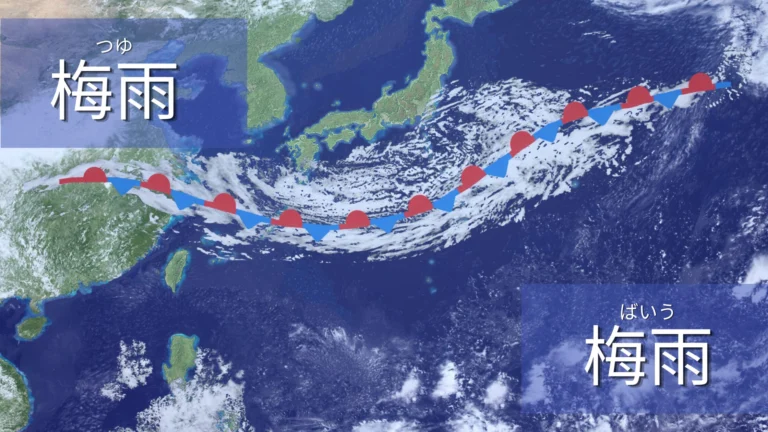
One recent viral post on social media had a picture-perfect example of this: 梅雨. Normally, you read it as tsuyu-ake (梅雨明け). But when you hear it on the news, it becomes baiu-zensen. And yet, as the post joked, it’s never “tsuyu-zensen.” So, why exactly is that?
The difference between tsuyu and baiu: casual speech vs. technical language

In everyday conversation, you almost always pronounce 梅雨 as “tsuyu.” People talk about tsuyu-iri (梅雨入り), the beginning of the rainy season, and tsuyu-ake, when the season finally ends. These are the expressions you’ll hear in daily life, on the news, and in casual conversation. In other words, it’s a casual reading (much like the word “yabai!”).
But when the topic becomes more technical, the reading changes. Weather forecasters almost always use baiu in compounds like baiu-zensen (梅雨前線), referring to the stationary “rainy-season front” that brings weeks of cloudy skies and heavy rain. Another technical term is baiu-ki (梅雨期), meaning the “rainy period.”
To be clear, this isn’t a dialectal or regional difference, with eastern Japan saying one thing and western prefectures saying another. Rather, “tsuyu” belongs to everyday speech, while “baiu” belongs to meteorology and formal writing.
That’s why the original viral post pointed out that nobody says “tsuyu-zensen.” Once the weather forecast starts talking about fronts and atmospheric conditions, the reading automatically flips.
Special compound readings, and why tsuyu is such an outlier
Part of the reason it trips people up is that “tsuyu” doesn’t actually come from either individual kanji (梅 or 雨) at all. Instead, it’s an example of something called jukujikun (熟字訓). These refer to special readings assigned to compound words rather than separate kanji.
A lot of common Japanese words fall into this category. The word “today,” for example, uses two kanji that, separately, read as ima (今) and nichi (日). But together, they become kyō. The same goes for words like ashita (明日) for “tomorrow,” otona (大人) for “adult,” and samidare (五月雨) for “early-summer rain.”
In fact, these readings are so common that most learners will have encountered a bunch way before even hearing the word “jukujikun” or realizing they have a whole category.
It’s contrary to how most kanji are read, using either the Chinese-derived on’yomi or native kun’yomi readings. And unfortunately, there’s no easy trick to figuring out a jukujikun reading. You just have to memorize the special compound words.
Question: do you like UJ's independent coverage of Japan? Our writers are supported by our members. Join Unseen Japan Insider to get bonus content every week, an ad-free website, and access to our large and growing Insider archive.If you love UJ's independent coverage of Japan, join Unseen Japan Insider to get content every week, an ad-free website, and access to our large and growing Insider archive.
Why is the literal translation of tsuyu “plum rain?” An etymological deep dive

Something else you may have noticed if you’ve studied Japanese is that, individually, the kanji for tsuyu mean “plum” and “rain.” Literally, “plum rain,” which doesn’t quite fit with the compound translation of “rainy season.”
One explanation is that the rainy season overlaps with the period when ume (梅), often translated as Japanese plums or apricots, ripen. According to this theory, writing the season as “plum rain” simply reflected that coincidence.
Another theory is more colorful. Some linguists believe the original word was actually written 黴雨, meaning “mold rain.” Since the rainy season is warm, humid, and perfect for mold growth, the name made sense. But humans are aesthetic creatures at heart, and calling it “mold rain” is hardly appealing. So, since mold (黴) and plum (梅) share the same pronunciation in Chinese-derived readings (bai), the unpleasant character was eventually replaced with the much nicer-looking 梅.
And that’s just the kanji. The origin of the native reading “tsuyu” is even less certain.
One theory links it to 露 (tsuyu), meaning “dew,” a reference to the moisture that covers everything during early summer. Another traces it to old verbs meaning “to decay” or “to rot,” referring to fruit ripening, clothes becoming damp, and food spoiling during the humid season.
Of course, no one really knows. Even the Japan Meteorological Agency notes that the true origin is a mystery.
Tsuyu across Asia, in all its pronunciations
Interestingly, while Japan, China, and Korea all experience the same East Asian rainy season, they don’t pronounce it anything alike.
China writes the same characters, 梅雨, but reads them as méiyǔ. The famous Meiyu front is the same weather system Japanese meteorologists call the baiu front.
Korea, meanwhile, doesn’t use the characters at all. Instead, the rainy season is simply called jangma, a native Korean word with an entirely different origin.
Maybe that shouldn’t be too much of a surprise, since these countries all have different languages. But since they’re relatively close together, you’d normally expect a few more similarities, much like the Romance languages (Italian, Spanish, French, etc.) have many similar words.
But, well, that’s just how it is. At the end of the day, tsuyu/baiu is just one of many quirks in the Japanese language. It captures both how fascinating and frustrating learning it can be.
Keep reading




Sources
「梅雨」は何で「つゆ」というの?(はれるんランド 天気のFAQ) 気象庁 (Japan Meteorological Agency) (archived)
梅雨前線(ばいうぜんせん)って何?(はれるんランド 天気のFAQ) 気象庁 (Japan Meteorological Agency)
梅雨/つゆ/ばいう 語源由来辞典
熟字訓 Wikipedia (日本語版)
「梅雨」の由来はカビ(黴)? 約40日間続く梅雨を快適に過ごすために知るべきこと 日本気象協会 tenki.jp
「熟字訓」って何だっけ? 特別な読み方についてまとめました ことばのエチュード