

Ah, Kanto and Kansai…two parts of Japan separated by a common language.
Kanto in Japan’s east consists of the Tokyo Metropolis, Kanagawa, Ibaraki, Tochigi, Saitama, Chiba, and Kanagawa Prefectures. Meanwhile, Kansai in the west has Kyoto, Osaka, Kyogo, Nara, Wakayama, and Shiga.
The tension between the two areas is so thick sometimes, you could cut it with a samurai sword. Besides having different attitudes and customs, the two also have distinct dialects of Japanese. What makes sense in one region’s Japanese might totally mystify someone in the other.
Take, for example, our phrase today, which comes to us by way of social media. It shows, not just how expressions differ by region, but how eating habits do as well.
You say “I like bread,” and someone replies, “oh so you hate rice”
The expression 明日のパン (ashita no pan), or “tomorrow’s bread,” means what it says: Buying the bread you plan to eat for tomorrow’s breakfast.
The phrase also more generally means ensuring you have bread on hand in your house in general, not necessarily just for tomorrow. It also can refer to ensuring you have rice or even cereal on hand for the morning, if that’s your preference. The intent is that you’re thinking ahead about what your family will have for breakfast, and are taking steps to ensure everyone has what they need to start the day.
This is a set phrase in Kyoto and Osaka, but is rarely used in the rest of the country. This was news to X user @tsutsui_ota. Born in Kansai, they expressed their surprise when talking with acquaintances from the Kanto (Tokyo, Chiba, Saitama, Tochigi, Ibaraki, and Kanagawa prefecture) and Kōshinetsu (Yamanashi, Nagano, and Niigata prefecture) areas.
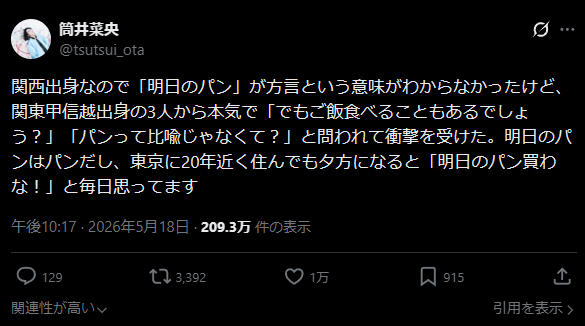
“…I’ve had three people from Kanto/Kōshinetsu go, ‘But you also eat rice occasionally, right?’ and ‘Bread’s a metaphor, right?’ and it threw me for a loop. Tomorrow’s bread is bread, and even after living in Tokyo for 20 years every day I think ‘Gotta buy tomorrow’s bread!’
This isn’t the first time the phrase has made social media discourse. It went viral in 2022 as an everyday phrase used by Osaka mothers, who will often find themselves thinking, “Do we have enough bread in the house?” They might even tell their kids at the supermarket, “Pick out whatever you want for tomorrow’s bread.”
The phrase is so set that many residents can autocomplete it. A 2025 nationwide survey of 1,077 subscribers to Pansuku, a bread subscription service (no I did not make that up), found that 38.6% of Kansai respondents voluntarily responded with “pan” (パン) when asked “ashita no…” (In Kansai, the next popular phrase was “tomorrow’s weather,” at 12.7%. In Kanto, weather topped the list at 20.3%, and bread came in at just 6.6%.)
Question: do you like UJ's independent coverage of Japan? Our writers are supported by our members. Join Unseen Japan Insider to get bonus content every week, an ad-free website, and access to our large and growing Insider archive.We manage to keep most of our content free thanks to the generosity of our members. Join Unseen Japan Insider and you'll get access to new, exclusive UJ member content weekly, an ad-free website, and access to our large and growing Insider archive.
Kansai is Breadland

But…wait. Isn’t Japan the land of rice? Why are Osaka and Kyoto so hung up on bread?
The phrase is more than a regional linguistic quirk. It reflects how Kansai does breakfast a little differently than the rest of the country.
Historically, rice has been a staple food eaten with every meal in Japan. However, the increasing popularity of bread has led to a decline in rice consumption for breakfast. These days, around 50.2% of the nation says they eat rice for breakfast, compared to 49.8% who eat bread. So the two food items are running neck and neck.
That’s not true in Kansai, though. Bread is the clear regional winner according to a 2021 J-Town survey of 1,204 residents. 61.1% said they ate bread over rice for breakfast. The biggest bread-eaters are in Hyogo Prefecture, at 77.6%, followed by Nara at 76.5% and Kyoto at 67.7%.
The numbers are also reflected in bread sales. Kobe, in Hyogo Prefecture, leads the nation in annual household bread spending at 41,183 yen ($259). The top five also includes Wakayama, Otsu, Kyoto, and Osaka, meaning all five are Kansai cities.
Why is Kansai so bread-crazy? Experts say you can credit Kobe: it opened a port to the world in 1868, at the start of the Meiji Restoration, and immediately adopted bread culture for breakfast. When the Kobeya Baking Company launched its own mass-market shokupan brand in the 1960s, launching it as a breakfast food as opposed to a snack.
The importance tied to breakfast bread also leads to another regional variation: slice size. In Kanto, where bread is treated more as a snack or a side, supermarket loaves are cut into six or eight slices, around 20mm apiece. The standard in Kansai, however, is five slices of around a 24mm thickness.
It’s all good in the Shizuoka hood

Of course, this isn’t the only regional linguistic difference between Kanto and Kansai. While Kanto is considered Japan’s “national” dialect, this development only dates back to Japan’s Meiji era (1868-1912). Kansai and many other areas of Japan, such as Tohoku, retain distinct Japanese dialects. Kansai phrases such as なんでやねん! (nande ya nen; equivalent to そんなあるわけないだやろ, or “as if!”), ええやん (ee yan; equivalent to いいじゃん, “good”), and おおきに (ookini; equivalent to ありがとう, “thank you”) act as linguistic signatures that immediately identify someone as hailing from the region.
Some dialects depart from the national dialect in ways that are rather amusing. We’ve written, for example, about how in Aichi Prefecture, the word for the weather being extremely hot is chin-chin – which means “penis” in the rest of the country.
Even prefectures not known for having distinct dialects develop signature phrases specific to the area. Another example a user floated on X this week is Shizuoka Prefecture’s いいにする (ii ni suru), a phrase which has multiple meanings. While most residents say it means to give up on something, others in a TBS News poll say it can also mean to compromise, to permit, or to take a pause.
Keep reading



Sources
大阪のオカンがよく言う「明日のパン」って、他地域では言わないの? 関西人は「めっちゃ言う」「脳内でも普通に言ってる」 まいどなニュース (Maidona News)
関西では明日の朝食として食べるパンを「明日のパン」と言うが、方言とは知らなかった Togetter
関西では当たり前のこと!?「明日のパン買ってきて」って言う?言わない? クックパッドニュース (Cookpad News)
「明日の◯◯」と言えば? 日本の暮らしの違い ― パンスクユーザー1,000人調査 PR TIMES (パンフォーユー調査)
朝食にするならパン?ご飯? 全国調査の結果→関西人のパン愛が浮き彫りに Jタウンネット (J-Town Net)
食パン、関西なぜ厚切り?(謎解きクルーズ) 日本経済新聞 (Nikkei)
関西人のパン好きは、せっかちだから? 年間支出額、トップ10に関西勢ずらり 神戸は4年ぶり日本一に 神戸新聞NEXT (Kobe Shimbun)
「もうええでしょう」静岡弁では意味が4つも 9割超の県民が知る究極の方言「いいにする」とは. TBS News Dig