
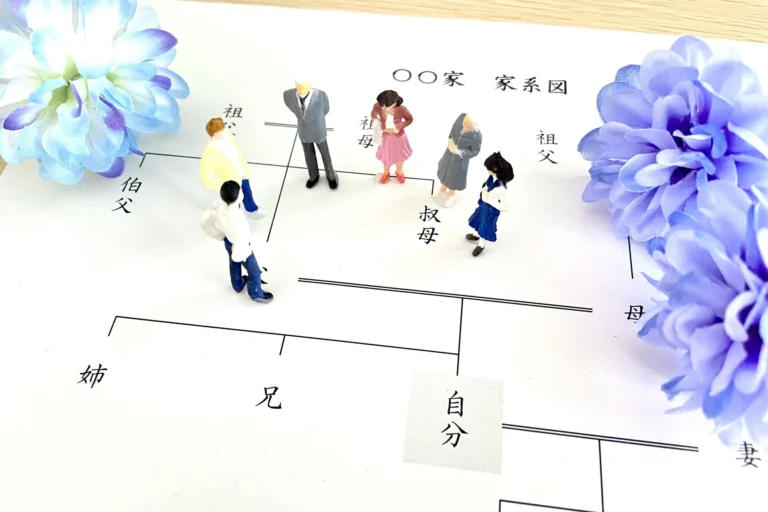
Kira-kira names (キラキラネーム), literally “sparkling” names, are names where the reading is a bit (or a lot) different from standard readings of the kanji. In English, the equivalent would be an unusually spelled name, like “Reighleigh” for “Riley” or “Payj” for “Paige.” In Japanese, it takes the form of having a name like 可愛, usually read “Ai,” but pronouncing it “Pinku.”
As you might guess, not everyone is happy about having a kira-kira name. Most people suck it up and live with the inconvenience, but now, a viral post about changing a name in Japan has made this particular bureaucratic process look almost suspiciously affordable.
For less than the cost of eating out, a new name
On September 8, X user Maschera shared a photograph of a Japanese family court ruling. The court had granted permission to change both the kanji of the applicant’s given name and its furigana. The funny part was that the reading stayed exactly the same; the furigana was マサキ (Masaki) before the change and マサキ afterward. Only the characters changed.
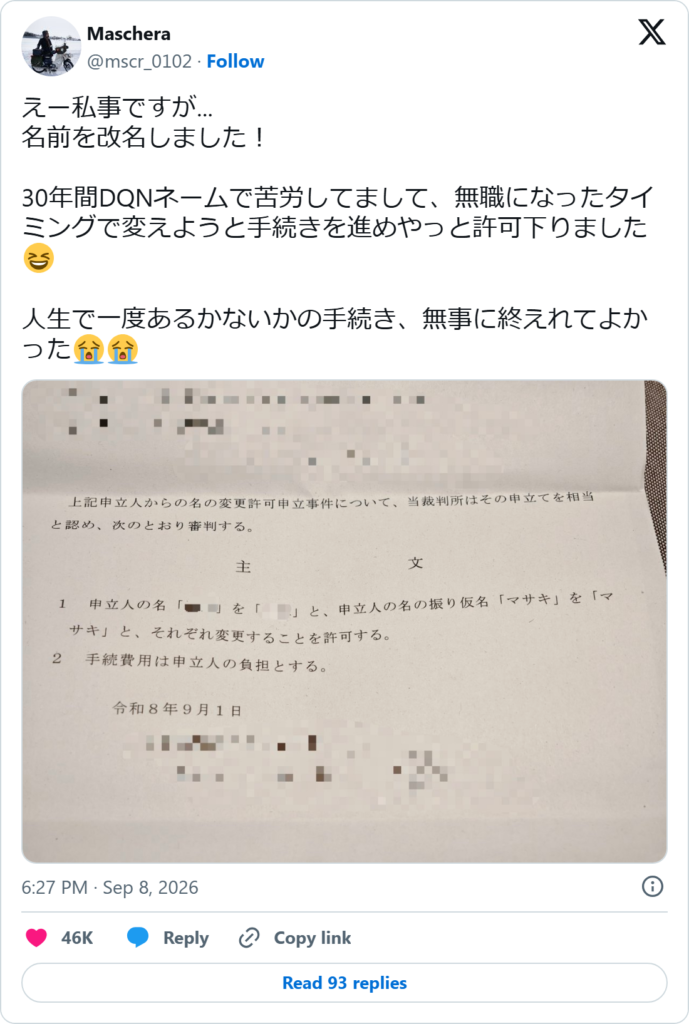
The post collected around 46,000 likes and 7.1 million views. The most common replies were offering congratulations. The second most common reply was people asking how to change a given name. And, more to the point, how much does this cost?
The answer was not ¥100,000, as one commenter wondered. The court fee itself is just ¥800. But the process is a little bit more complicated than just strolling into court with ¥800 and walking out with a new identity.
A rundown of the process from start to finish
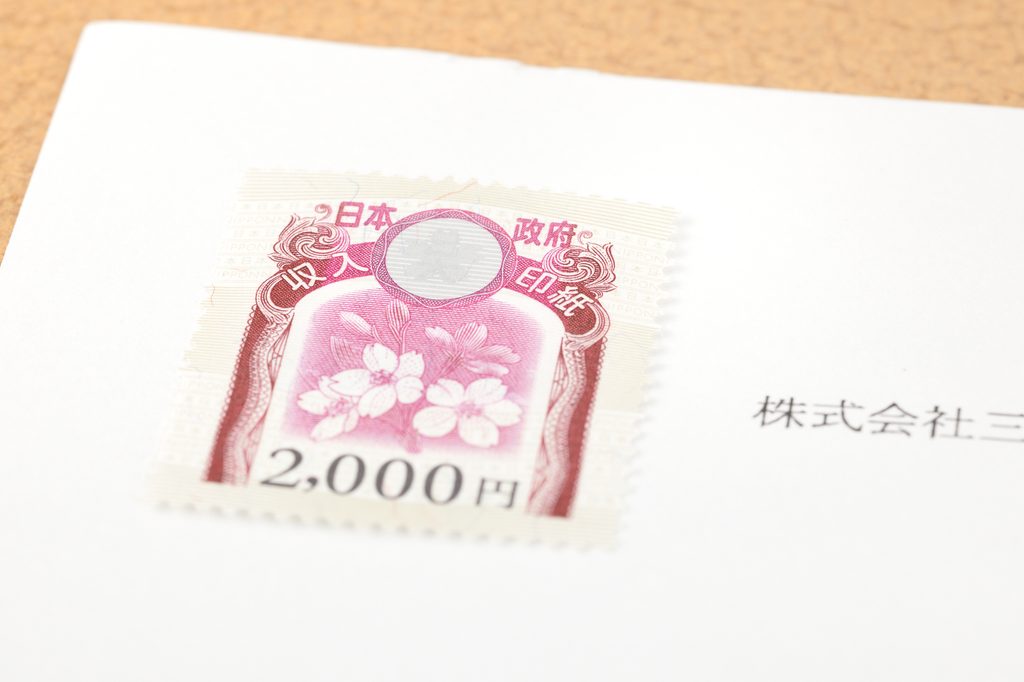
The Supreme Court’s instructions for a given-name change require an ¥800 revenue stamp, plus postage for court correspondence. Tokyo Family Court’s published guidance lists ¥800 in stamps and another ¥1,770 in postage, making the Tokyo filing cost about ¥2,570 before adding the cost of obtaining a certified copy of your family register. So the court portion is cheap, but the entire filing isn’t quite pocket change.
The difficult part is not paying. You also have to convince a judge that you have a good reason. A seitōna jiyū (正当な事由), or legitimate reason, is a legal requirement in Japan for changing a given name.
As for what counts as a “legitimate reason,” the Tokyo Family Court describes this as any situation where keeping the existing name causes problems in a person’s social life. Simply disliking your name, wanting something that sounds cooler, or having a personal or religious preference isn’t enough.
How common are name changes? A look at the statistics
So, if you’re thinking that the system is an easy way out for a name you don’t like… yeah, it’s not that simple.
At the same time, it’s not some impassable barrier. In 2024, Japanese family courts received 5,168 petitions to change a given name. Of the cases disposed of, 3,572 were granted, 431 were refused, 1,071 were withdrawn, and 55 fell into other categories.
On the bright side, the court granted about 70% of applicants their desired name change. However, it’s a bit hard to get the full picture since one in five people withdrew their petitions. There also aren’t that many applications to begin with.
There were 8,301 given-name petitions in 2005, compared with 5,168 in 2024, a decline of about 38%. The numbers have generally trended downward over the past two decades. Since no national statistical breakdown shows how many successful applications involved kira-kira names, there’s no real way to know how common changing kira-kira names is.
Question: do you like UJ's independent coverage of Japan? Our writers are supported by our members. Join Unseen Japan Insider to get bonus content every week, an ad-free website, and access to our large and growing Insider archive.If you love what we do, help us pay our writers to do more of it by joining Insider. You'll get bonus content every week, an ad-free website, and access to our large and growing Insider archive.
How a 2025 reform changed some things… but not a whole lot
It’s also important to note that in 2025, the government made some changes to the family register system. Researcher Makino Kunio has pointed out that much of the media reported the reform as if it were a crackdown on unconventional/kira-kira names, but that interpretation conflates separate provisions of the law.
The reform introduced furigana into the family register, meaning the reading of a person’s name (i.e., including readings that are different from the standard, as with kira-kira names) is now officially recorded. It also requires that a reading be a generally accepted reading of the characters. That means that you can’t call your child 黄熊 (yellow bear) but pronounce it “Pooh.” (Yes, people have done that.)
Existing unusual readings were also grandfathered in. People already registered with a non-standard reading can generally preserve it by submitting evidence that they actively use the reading. This can be a passport, bankbook, or health-insurance card.
The reform did, however, make one thing more complicated. There was a one-year window after May 26, 2025, when people could correct the furigana recorded in their family register (i.e., the reading) without getting family-court permission.
That free correction period ended on May 25, 2026. Anyone who filed during that window has used their free shot, and changing the reading again requires the same kind of legitimate reason as changing the name itself. People who didn’t file still get one change without going to court.
Bringing years of evidence to court to get that name change
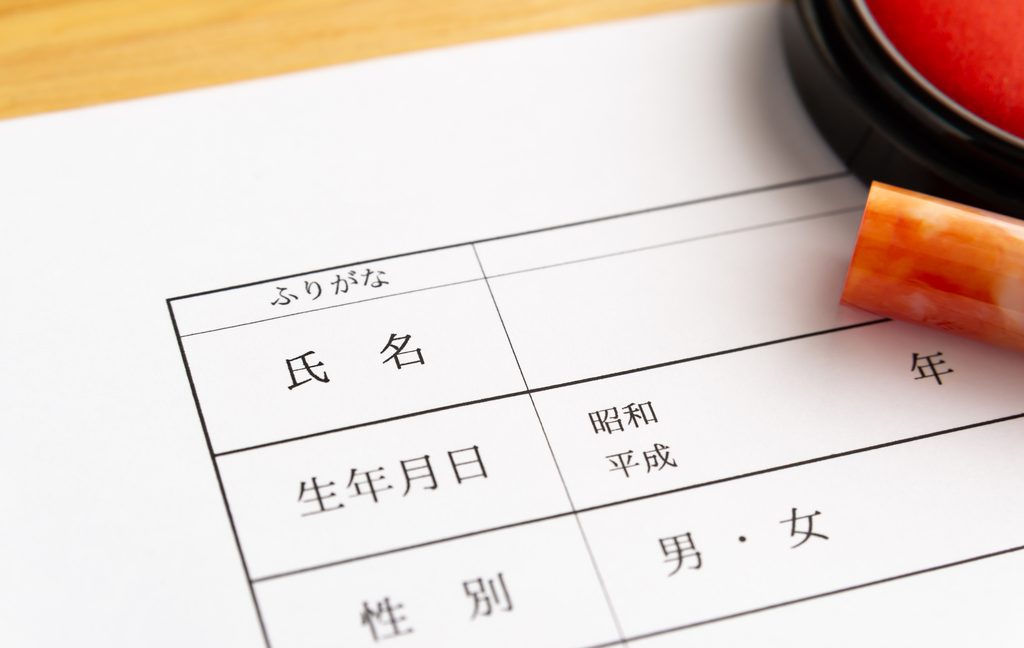
In the case of Maschera’s viral post, the interesting thing isn’t really the ¥800 court fee. It’s that the applicant had enough evidence to satisfy the court. One commenter described bringing 12 years of proof that they had lived under the desired name.
That kind of evidence matters. Japanese courts have historically looked at whether a name creates genuine social difficulties and whether there is substantial evidence of established use of another name. In 2019, the Osaka High Court allowed a transgender applicant to change their name after providing medical documentation and records showing sustained use of the new name at work, while commuting, and in medical settings.
The courts don’t always give their approval. One 2024 online discussion featured an adult complaining about the humiliation of having their name called in hospitals and written on résumés. (Considering some kira-kira names, you can imagine what they might’ve experienced.) They had already petitioned the family court and been turned down, and said spending about five years living under a new name to build up evidence felt like too much of a hassle.
What’s in a name? The age-old question.
So yes, changing your name in Japan can be remarkably cheap. However, it’s just one step of many in the whole process. After filing, you need to wait for the court’s approval (or rejection), and then take a certified copy of the ruling to your municipal office and submit the name-change notification.
Then comes the true hurdle: changing everything else. Banks, credit cards, insurance, accounts…you get the idea. But, as much of a headache as it can be, it gives people plenty of opportunities to either affirm that the name change is something they really want, or decide the extra sparkle is fine after all.
Keep reading



Sources
名の変更許可 裁判所
<名の変更許可>(令6.10 東京家) 東京家庭裁判所
令和6年司法統計年報 3 家事編 最高裁判所
戸籍にフリガナが記載されます 法務省
よくあるご質問 法務省
フリガナが記載されるまで 法務省
テーマ判例コラム「キラキラネーム」前橋家裁沼田支部昭和37年5月25日審判ほか プラスワン法律事務所
流行りは「キラキラ」ではなく「読めない」…2025年版「赤ちゃんの名前ランキング」からわかる令和の親の傾向 PRESIDENT Online
キラキラネームを付けられてしまった人が大人になり本音をぶちまける『病院で名前呼ばれてみろや、履歴書に名前書いてみろや。もう恥だよ恥』 Togetter
名の変更届 大阪市
「最新」改名の申立て件数と許可の確率|年代別に総まとめ 戸籍改名の相談所