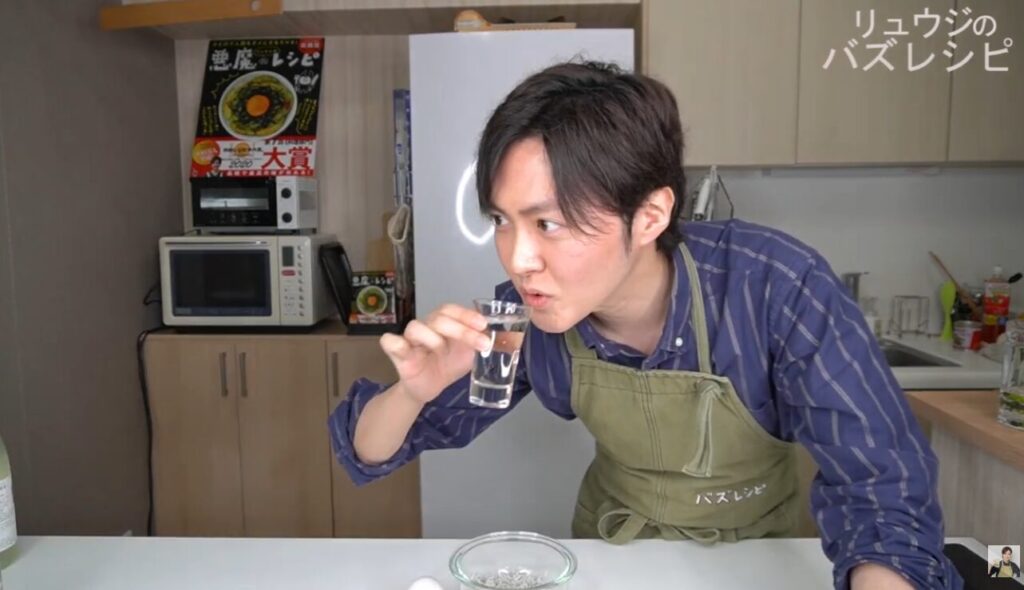
Call him the Marie Kondo of the kitchen. At a whopping 5.6 million YouTube subscribers, Ryūji is one of Japan’s top home-cooking and recipe bloggers. His channel, Buzz Recipe, features him cooking mostly otsumami (small dishes eaten while drinking) while getting progressively drunk.
Ryūji’s drinking has been a source of concern for his fans. He’s stated that he usually starts filming around 1pm, and by this time, he says he often has a buzz going already. Some have openly wondered whether he’s an alcoholic. (As an alcoholic myself I can only respond, “Ya think maybe?”)
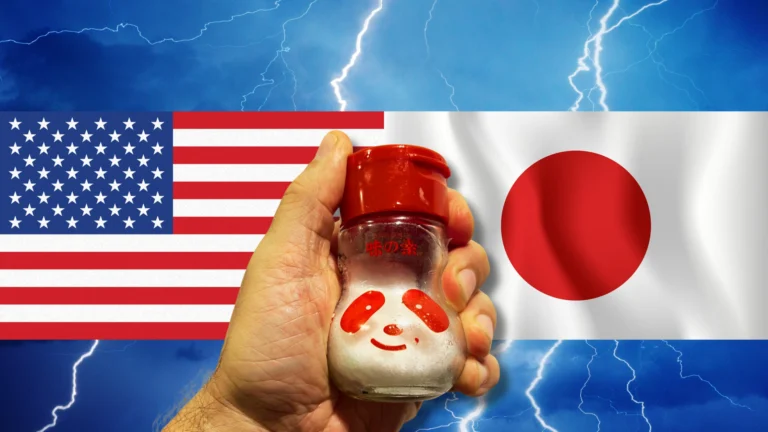
But it isn’t Ryūji’s penchant for Dewar’s highballs that his critics have singled out. It’s his love of MSG, or monosodium glutamate, known in Japan by its brand name AJI-NO-MOTO (味の素, “the root of taste”).
Critics in Japan have pounced on Ryūji for liberally using MSG in his cooking. Some have even called him a “murderer” for it. The backlash was so stiff that, in 2023, the YouTuber released a book attacking his MSG-hating critics.
“Everyone who says MSG is bad for you is, without exception, anti-vaccine,” Ryūji mused. “Why is that?”
Today, products by Ajinomoto Group are sold in more than 130 countries and areas. Ajinomoto and other Asian companies sell MSG worldwide, with China the market leader by annual tonnage. Ajinomoto remains the dominant brand: the company reported consolidated revenue of about ¥1.53 trillion (roughly $9.6 billion) for the fiscal year ending March 2025.
MSG is in the news in Japan this week thanks to a video by Japanese YouTuber Pajime, who revisits for his domestic audience how MSG became stigmatized abroad. It’s an interesting contrast. On the one hand, you have America, which embraced MSG until the “wrong” people started using it. MSG skepticism in the states fits inside a long tradition of Americans sinultaneously embracing and declaring their love of Japanese food while also demeaning actual Japanese food – not the Americanization of it – as “alien.”
Meanwhile in MSG’s home country, you have Japan’s mutenka (無添加, anti-additive) movement. Born out of mass poisonings in the 1950s and 60s, the conspiracy theory-laden movement has profoundly shaped Japan’s food industry – and it’s got it out for Ajinomoto.
Why America loved umami…until it didn’t
In 1908, chemist Ikeda Kikunae (池田菊苗) set out to improve what he saw as Japan’s bland diet. Trained in Germany, then the world home of organic chemistry, he isolated 30 grams of glutamic acid from 12 kilograms of kelp (昆布; konbu). Ikeda christened the new taste “umami” (うま味) and patented the process behind producing glutamate in Japan, the United States, England, and France.
Iodine manufacturer Suzuki Saburosuke turned the new flavor into a commercial product in 1909: AJI-NO-MOTO. It gained no traction for four years as the company, Ajinomoto, tried selling it to chefs.
Finally, Ajinomoto switched to selling it in perfume-style glass bottles to housewives, marketing it as hygienic and “civilized.” Between 1922 and 1937, it mailed a free sample, along with a cookbook, to every high school female graduate. (Yes, yes, I know.)
The new seasoning also caught on in America. From the mid-1930s to 1941, the US bought more Ajinomoto than any country outside of Japan and Taiwan. (To this day, Taiwan remains one of Ajinomoto’s biggest markets.) It was purchased mainly by industrial buyers, such as Campbell’s, who used it to kick up the flavor of canned goods.
And then Americans discovered that the wrong people, in their estimation, were using MSG, and the entire equation flipped.