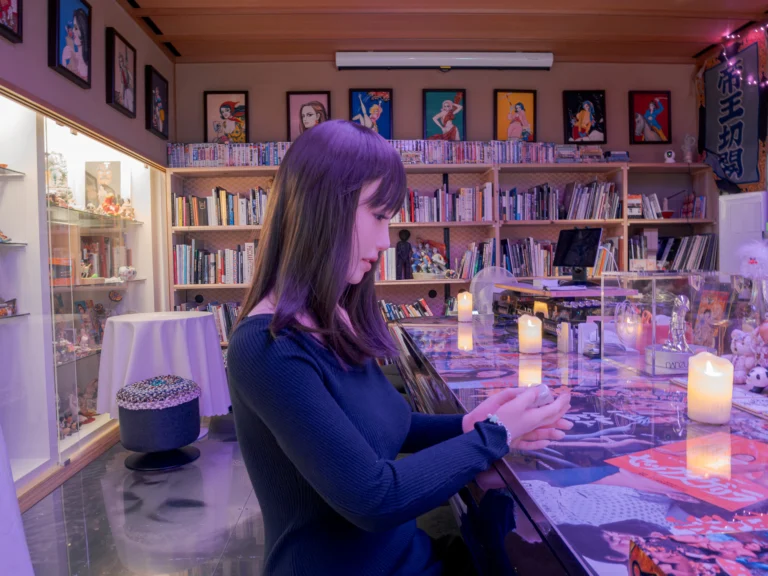
One of the first things that actually startled me when I entered an old ryōtei building in Sumida Ward’s Mukōjima was the figure sitting at the bar.
I had assumed that proprietress Konta Atsuko and I were the only two people in the building that day. I almost raised my voice to the “woman” until I realized that she, like nearly every other human figure in this building, wasn’t real.
“That’s the hostess,” Konta tells me, adding in a deadpan, “She doesn’t move, though.”
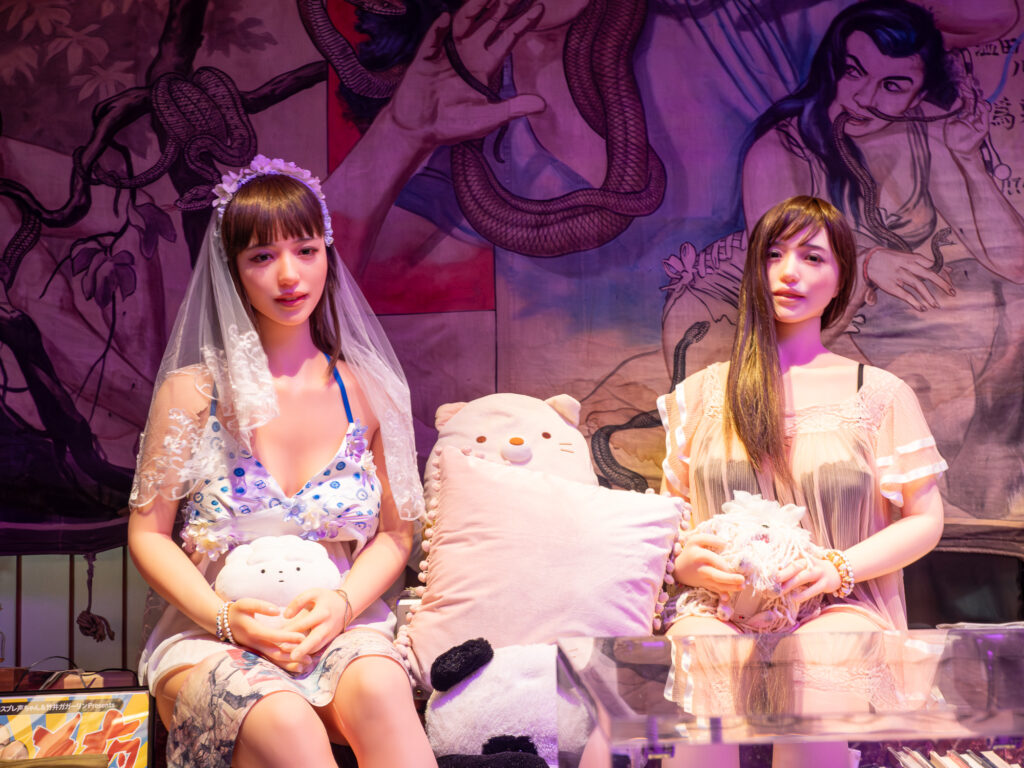
The figure is one of seven Orient Industry love dolls. She’s joined by a dozen or more fiber-reinforced plastic (FRP) figures brought to life by movie special effects artists. She’s also one of the more presentable figures in this place. The floor above holds figures in far more explicit and compromising positions, sex scenes meant to outrage and titillate in equal measure.
This is Cha to Sake Wakame. It sits on the second floor of the Museum of Roadside Art, journalist Tsuzuki Kyōichi’s salvaging of Japan’s old hihōkan, or roadside sex museums. After contacting them for my stories on the museums, Konta graciously invited me in to photograph the location and talk with her about the museum, why it’s important, and why it sees more foreign visitors these days than Japanese.
What follows, exclusively for our Insider members, is my discussion with Konta…and the photos I couldn’t include in a public article from the museum’s wild third floor.
Warning: Content below is explicit.
Sex and violence in a historic geisha quarter
The hihōkan were “sex museums” that operated nationwide in Japan at onsen towns, where they awaited corporate travelers (mostly men) sent by their companies for a little R&R. At one point, there were 20 around the nation.
After Japan’s economic bubble burst, many disappeared. Anti-obscenity laws took out the stragglers. Today, only two remain. The Atami Hihōkan in Shizuoka Prefecture is the last authentic roadside sex museum still operating.
Tsuzuki’s Museum of Roadside Art features exhibits salvaged from the Toba SF Miraikan, which opened in 1981 and closed in 2000. Toba was created by pearl magnate Matsuno Masato, the same man whose Ganso Kokusai Hihōkan near Ise had defined the genre in 1972. Toba’s intricate displays crossed science fiction and sex.
On the outside, you would never guess what’s inside. It’s not like the museum is out of place, however. The building, a short walk from nearby Hikifune Station, is in a working hanamachi (花街), or geisha district. About 10 ryōtei continue operating there, with over 100 working geisha.
The museum is more than a snapshot in time. It’s Tsuzuki’s 40-year running collection, including many of his own photographs.
“Mostly it’s people whose names aren’t known at all, what they’d call ‘bad art’ abroad, things that might genuinely have been thrown away,” Konta explains. “Truly unknown people who work alone with nowhere to show their work. Tsuzuki interviews them and buys a piece.”
As Tsuzuki interviewed more and more people for his mail magazine, the pieces piled up. “Someone said let’s put them on permanent display,” Konta said. “That’s how this place came about.”
As if to underscore the point, the museum carries a pencil drawing of The Shaggs, the band whose Philosophy of the World many have deemed the worst album ever created. It’s fitting that a museum full of things people refuse to call art pays homage to a group nobody calls musicians.
The museum reinforces Tsuzuki’s philosophy: art isn’t business. Art is cheap. And art can also be erotic, playful, and fun.
Sources
ROADSIDER’S=路傍の編集人、都築響一が手掛けるリアルアートの巣窟「大道芸術館」 TOKION
大道芸術館 museum of roadside art(都築響一コレクション) 大道芸術館 公式サイト
電子画像集第3弾『おんなのアルバム キャバレー・ベラミ』 ROADSIDERS’ weekly
元祖国際秘宝館 Wikipedia (日本語)
料亭紹介|墨東の隠れ家 向島花街 向嶋墨堤組合
見世物小屋 Wikipedia (日本語)