Dangerous – or Dated? Japan Debates Use of Smartphones Near Train Priority Seats

Everyone’s always warning tourists to Japan to mind their manners when they’re here. That’s why I find it fascinating when people in Japan themselves don’t agree on what constitutes good manners. A recent social media post has started a debate over the proper use of smartphones on trains – particularly when you’re near a priority seat.

The X post on March 3rd from lawyer and celebrity talk show guest Yamaguchi Mayu relates an experience she had on a train ride:

“I was standing by the door on an uncrowded train checking my email when a guy across from me sitting in a priority seat said, ‘Turn your phone off or stand over there, please.’ When I stared blankly, he asked, ‘Do you speak Japanese?’ I apologized and did as he said. I know you’re supposed to turn your phone off near priority seats on crowded trains, but does that mean I can’t check my mail where no one’s even sitting?”
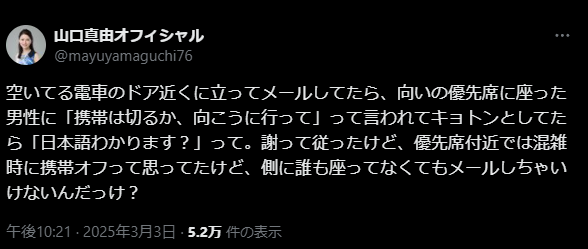
Yamaguchi’s tweet refers to a rule on Japanese trains meant to protect people with pacemakers. It’s rooted in a fear that a cell phone’s signal could potentially disrupt the lifesaving equipment.

You’ll see signs to this effect near priority seats in every train car in Japan. Some will specify that you only need to do this when the train is crowded. Others will ask you to do it regardless of the train’s status.

A belief not based in reality
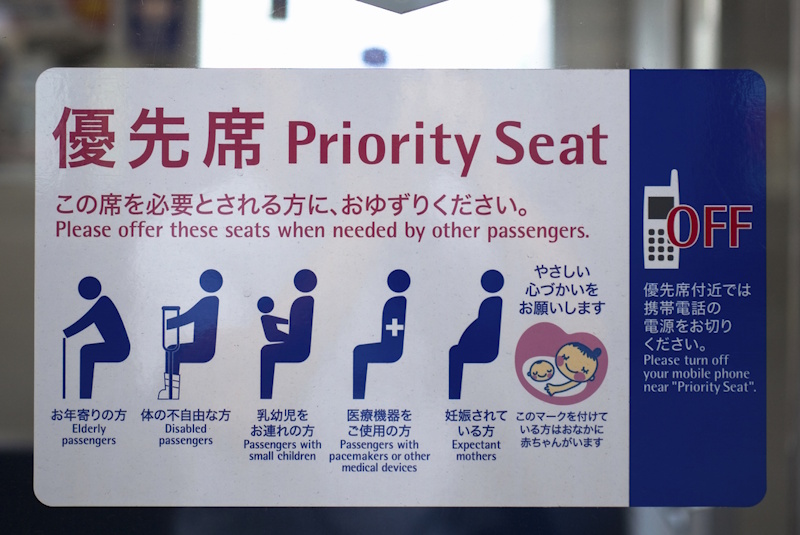
Priority Seat sign in Japan asking passengers to turn off their signs when near the seat
Picture: ペイレスイメージズ 2 / PIXTA(ピクスタ)

This caution, however, has no basis in scientific fact.

According to the American Heart Association, cell phones “are a very small risk to ICDs and even less of a risk for pacemakers.” While there might be a tiny risk, it only seems applicable if your phone is very near the device – e.g., in the pocket of your shirt.

The post sparked a discussion on social media site X as well as a fevered discussion on Yahoo! News Japan. Most commenters reiterated that modern smartphones are of no risk to pacemakers several feet away. Some labeled the belief an urban legend.

The debate echoes similar recent debates around how you should hold your backpack on trains. That one’s still being debated. In previous years, Japanese passengers have gone off on things that tick them off on trains and in train stations, with improper cell phone use coming in at number four. Placement of bags came number three (and would probably rank higher now, given the preponderance of tourists’ luggage.)

Still, even if there’s no real risk of using smartphones near priority, this post shows that many people still believe there is. If you want to avoid a spat on public transit in Japan, it’s probably best to keep your phone in your pocket if you’re anywhere near priority seating.
“Pseudo-Chinese”: New Japanese Social Media App Only Allows Kanji

How good is your knowledge of kanji? Could you get by in Japanese by kanji alone? A new social media app aims to test that with a unique new feature: it forbids kana input, allowing only Chinese characters.

Written Japanese consists of three components: kanji, Chinese-derived ideographs, plus the two kana syllabaries, hiragana and katakana. Hiragana generally represents grammatical elements and certain common words, while katakana is used for loan words, onomatopoeia, and emphasis.

There have been attempts to change this beautiful but admittedly complex system over the years. All of them have failed. One group that wanted Japanese to shift into using romaji (Latin characters) admitted defeat last year.

The long and the short of it is, modern Japanese uses a combination of all three writing systems to represent the written language. There’s no such thing as writing Japanese without kana.

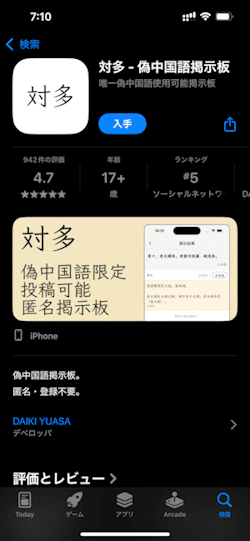
Until now. Independent developer Daiki Yuasa (@app_asa on X) has re-released 対多 (pronounced “Tsuita” – get it? Get it?), a social media app that prevents entering kana and allows only kanji. The app bills itself as the “Pseudo-Chinese forum” (偽中国語掲示板; nise-chuugokugo keijiban).

Tsuita, the kanji-only Japanese app

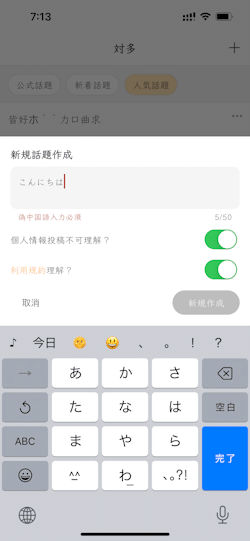
Tsuita operates as an anonymous message board. There’s no user sign-in – you can start posting to it immediately. You just can’t include kana – attempting to will produce an error message that prevents you from posting. (The error message, of course, is entirely in kanji- 偽中国語入力必須; nise-chuugokugo nyuuryoku hissu, input in Pseudo-Chinese required.)

Tsuita - posting screen preventing anything but fake Chinese

The app was so popular that it caught its developer off-guard. The service went down due to the crush of users and a lack of server resources. Asa announced yesterday that he’d brought it back online.

The thing that makes the app fun is that, as the existence of Chinese proves, it’s entirely possible to communicate meaning using only kanji characters. The richness of kanji plus the abundance of kanji compound words means kana isn’t strictly necessary. Indeed, before the creation of kana, systems of writing based on kanji, such as kanshiki-wabun, were used to write Japanese.

Pseudo-Chinese isn’t a new thing. It first appeared on forums starting in 2009 and became trendy on Twitter around 2016.

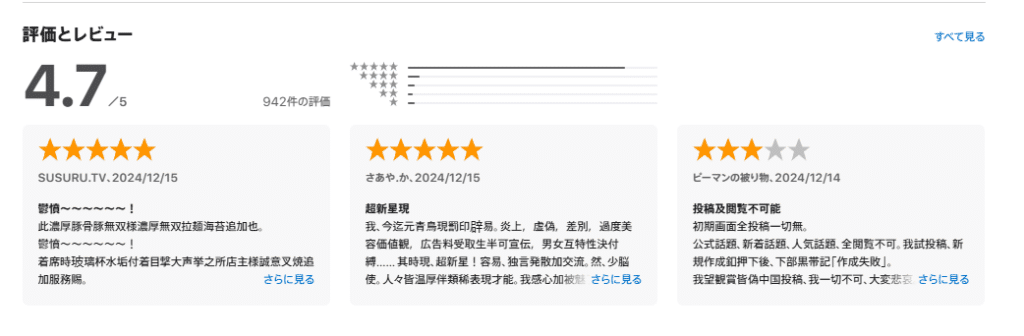
Users seem to be having fun with the new service. The app currently has a 4.7 out of 5 rating on the App Store. And, yes, all of the reviews are in Pseudo-Chinese.

Tsuita reviews, all in Pseudo-Chinese

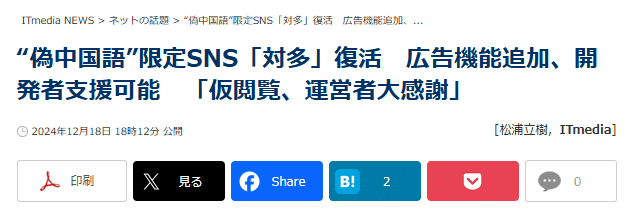
Even media outlets are getting in on the fun. The headline of ITMedia’s story on the app’s outage is itself written only in kanji characters.

Article about Tsuita in ITMedia with the headline writtemn solely in kanji

As users flee from X, services like Bluesky and Mixi are trying to become the new home for people looking for a Twitter-like social media service. Tsuita will not be that service. But it’s sure a helluva lotta fun.

How Japanese Men Are Sexually Harassing Female Job-Seekers

Nearly every country worldwide has issues with sexual harassment in the workplace. Japanese women are now facing additional harassment during the job-seeking process itself. The culprit? A new type of online app that’s supposed to give people a leg-up in their job search. Instead, it’s leaving many women in Japan feeling betrayed.

The Japan Harassment Association, which provides consultation to employees experiencing various forms of workplace harassment, says it’s seen a rise in consultations from women seeking employment or internships. A survey by Japan’s Ministry of Health, Labour, and Welfare (MHLW) of 1,000 people revealed that 20% of respondents said they’d experienced sexual harassment during the job-seeking process.

Job search harassment, sadly, isn’t a new issue. Back in 2019, organizations like SAY brought to light numerous stories of women who’d been told to stop looking for a job and work on getting married.

However, sexual harassment during job searches has increased in recent years partly due to so-called “broker apps” (仲介アプリ). These apps connect job-seekers or students looking for positions with people in target companies or industries.

Female job-seekers sometimes connect with male employees on these apps, hoping their sempai will help them navigate finding work in their chosen industry. However, stories gathered by the Japan Harassment Association show some men using these apps to pressure women into sex.

“A guy I met through my internship invited me to a dinner meeting and got me to drink a lot of alcohol,” says one job-seeker. “He made me promise not to tell anyone we’d met.”

“One guy tried to get me to go to a hotel, telling me he’d help me get a job offer.”

Japanese companies are cracking down on the practice through additional training. Construction firm Ohayashi Group, for example, makes employees sign an anti-sexual harassment pledge and requires them to use work e-mails for all communication. Insurance company Nihon Seimei forbids employees from using broker apps at all. It also forbids one-on-one meetings in private meeting rooms.

Japan’s MHLW, meanwhile, says it’s pursuing a policy that would hold companies accountable for preventing sexual harassment during the job-seeing process.

Colleges are also telling students how to keep themselves safe, advising female students to arrange meetings in public places, avoid alcohol during business-related meetings, and be wary about using broker apps.

Sources

就活セクハラ相談深刻「ホテル連れ込まれそうに」「大量に酒を飲まされた」…社員と学生の接触増え. Yomiuri Shimbun