

Japan’s a bit notorious for its uneven chore distribution between men and women, and Fukushima City is trying something slightly unusual to get families to share housework: turning it into a game.
The city launched a pilot project on September 18 that asks participating households to log chores in a smartphone app. Cooking, shopping, cleaning the bathtub, and other tasks earn points, which families can later trade for rewards they choose.
The idea is simple enough: make everyone’s contribution to housework plain as day, and see whether that changes what happens at home.
How housework points work

The roughly six-week pilot mainly targets dual-income, child-raising households. Participants complete a survey before using the system and again two weeks later, and the city plans to analyze the results for future policy. Sign-ups run until October 31.
The app, CAJICO, lets families assign points to chores and record them as they are completed. Everyone in the family can receive notifications when somebody logs a task. Family members can then exchange accumulated points for rewards such as a favorite item of clothing, a day out, or a nice dinner.
Despite the headline focus on husbands, this isn’t really a “get your husband to do the dishes” program. The city’s stated goal is broader: reduce the housework and childcare burden that tends to fall on women and challenge fixed ideas about gender roles.
CAJICO itself also predates the company behind it. The app was launched in 2023, while its current company, CAJICO, was founded in January 2026. The city says the app had about 100,000 users as of September 18.
Fukushima already knows there’s a problem
Probably the biggest news event that drew attention to this issue was this year’s World Cup, when Japanese fans were seen picking up trash after a game, and a Japanese professor argued that they should do it at home.
However, it’s hardly a recent issue. Fukushima conducted a survey on the chore gap back in 2024. Of 727 valid responses, 67% opposed the traditional breadwinner model, where men work and women take care of the home. However, that same survey found wives or mothers still mainly handled meals in 68.5% of responses, laundry in 61.2%, cleaning in 52.5%, and after-meal cleanup in 50.9%.
There’s also a striking difference in how couples see the same workload. For cleaning, 62.2% of women said the wife was primarily responsible, compared with 39.5% of men. Meanwhile, 29.9% of men described cleaning as something the couple did together, compared with only 17.7% of women. Cooking and after-meal cleanup show similar gaps.
In other words, the problem may not simply be that people disagree about who should do housework. They may disagree about how much housework is actually being done.
Question: do you like UJ's independent coverage of Japan? Our writers are supported by our members. Join Unseen Japan Insider to get bonus content every week, an ad-free website, and access to our large and growing Insider archive.We manage to keep most of our content free thanks to the generosity of our members. Join Unseen Japan Insider and you'll get access to new, exclusive UJ member content weekly, an ad-free website, and access to our large and growing Insider archive.
The devil’s in the details: nameless chores
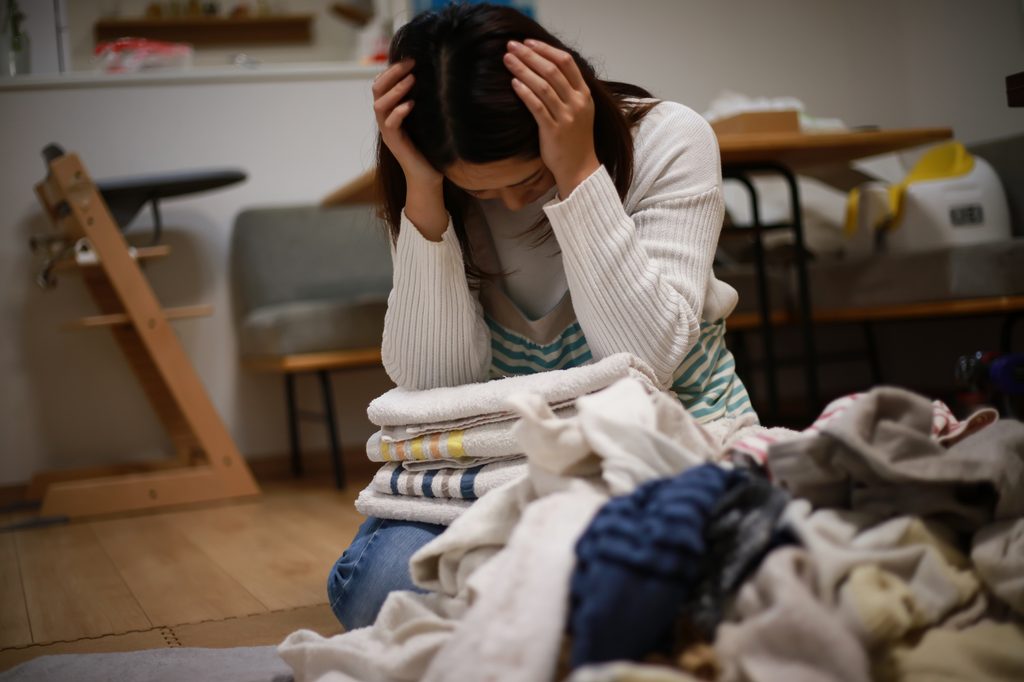
Japan’s been wrestling with that problem for years. The phrase “nameless chores” (名もなき家事, na mo naki kaji) became popular after a 2017 survey highlighted all the small tasks that tend to disappear from the household workload: putting things away, organizing shoes, and other jobs that nobody necessarily counts as “housework.” That survey found that 86.5% of respondents said wives mainly handled these invisible tasks.
With CAJICO, a smartphone can easily record that someone cooked dinner. However, the list of potential nameless chores is endless. How do you keep track of or assign value to the work done by the person who noticed the refrigerator was nearly empty? Or who remembered that the child needed something for school tomorrow, planned the week’s meals, or realized that the laundry needed to be done before the weather changed?
Those nameless chores are exactly the kind of work that can disappear from a checklist.
How the balance between paid and unpaid work complicates matters
There’s another complication: paid work.
One article discussing the new pilot project had a flood of online comments, and the most-liked response argued that household balance should consider both paid and unpaid labor. After all, if one partner works long hours and the other works part-time, the commenter argued, simply demanding a 50-50 split of chores may not produce a fair overall workload.
Other commenters liked the idea of making invisible work visible. Some, however, questioned whether points could do much if one partner simply doesn’t want to participate. Others worried that people would avoid chores that weren’t worth enough points.
CAJICO’s founder has said the goal isn’t necessarily to make housework perfectly equal. Rather, it’s to shine a light on how much labor goes into running a household and help couples agree on how they want to divide it. The mayor of Fukushima, meanwhile, said that he hopes to shape policy based on the data the project gathers.
So, really, the project is asking two different questions. Can an app help couples negotiate housework more clearly? And can making the work visible actually change who does it? The city doesn’t have those answers yet, but it will be interesting to see how the app is used in real life.
Keep reading



Sources
家事分担をアプリで可視化、男女平等目指す 福島市で実証実験 毎日新聞
家事シェア実証プロジェクト 始動!~アプリを活用して、家事の“もやもや”を解消~ 福島市
令和6年度男女共同参画に関する意識調査の結果の報告 福島市
【個人開発】世の「家事やれよ論争」を撲滅するスマホアプリをリリースしました Qiita
家事・育児の見える化で夫婦のコミュニケーションをサポートする「CAJICO」とは?|MamaCollege取材 MamaCollege
2017年「母の日」を前に、共働き夫婦の「家事」に関する意識調査 大和ハウス工業(共同通信PRワイヤー)