
Every time there’s a major sporting event, English-language press outlets love sharing pictures of Japanese fans cleaning up the stadium afterwards. It’s routinely used as an example of how clean and fastidious Japanese culture is.
One prominent voice in Japan, however, is pushing back on that rhetoric. Her viral social media post digs into something that’s irritated Japanese women for years: men not doing – and, in some cases, actively avoiding – their fair share of housework and childcare.
“Do it at home”
On X, the official FIFA World Cup account posted a picture of Japanese fans picking up trash in the stadium after Japan’s Samurai Blue soccer team drew the Netherlands to a 2-2 draw. “Respect, Japan,” the account said, followed by another post containing a video of a fan picking up trash that read, “Japanese culture is beautiful.”
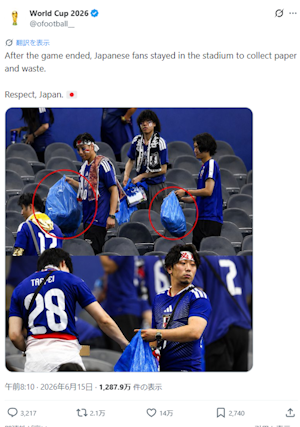
Not everyone in Japan, however, would agree that men voluntarily cleaning something is a staple of “Japanese culture.”
Tamada Atsuko (玉田敦子) wasn’t impressed. A professor of the 18th-century French Enlightenment who specializes in the status of women in pre-revolutionary France, Tamada shot back with a post that contained what appears to be an AI-generated image exhorting Japanese men to “do it at home.”
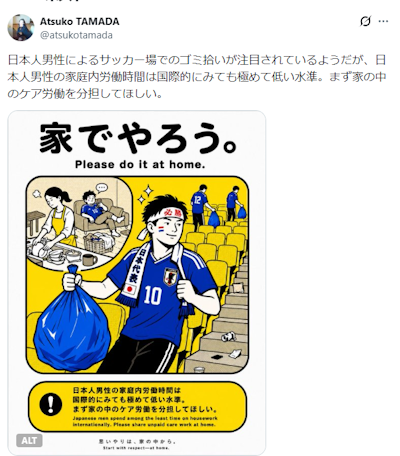
“Japanese men’s trash-picking at the soccer stadium is apparently getting a lot of attention, but Japanese men’s domestic care-labor hours are extremely low by international standards,” she wrote. “I’d like them to start with sharing the work inside the home.”
The picture she posted included a cartoon-styled representation of a male Blue Samurai fan picking up trash in the stadium. In an inset, however, his wife does the dishes while he sits in a chair. Likely watching the World Cup, I’d assume.
Question: do you like UJ's independent coverage of Japan? Our writers are supported by our members. Join Unseen Japan Insider to get bonus content every week, an ad-free website, and access to our large and growing Insider archive.If you love what we do, help us pay our writers to do more of it by joining Insider. You'll get bonus content every week, an ad-free website, and access to our large and growing Insider archive.
Japanese women do 5.4x more housework than men

Tamada’s post drew 59,000 likes and 13,000 reposts. (It only drew 61 comments because she restricted comments. Very wise.) A quick glance at the reposts shows the usual hostility – mainly from men – that she would dare to bring the subject up.
The thing is, Tamada is absolutely right. As we’ve reported on UJ for years, Japanese men do a pathetic amount of housework – and it’s pissing Japanese women off.
According to the OECD Time Use Database, which was last updated in 2021, Japanese men spend just 47 minutes a day on unpaid work such as childcare and house cleaning – the lowest among the 35 countries that OECD tracks. (South Korea comes in next at 49 minutes.)
By contrast, Japanese women do 208 minutes of unpaid work a day. That’s 4.4 times more than their husbands.
The situation is worse for couples who have kids. In households with a child under six, wives in Japan average ~414 minutes of unpaid work daily.
Japanese women have accused their male mates of deliberately ducking housework. Years ago, the word furariimen (フラリーメン) trended to describe men who deliberately stayed out late and didn’t come home in order to avoid doing the dishes.
To be fair, the issue isn’t solely the fault of men: it’s structural. Men also log one of the largest amounts of paid work in the OECD Time Use Database – 442 minutes (7.4 hours) per day. Some dads have also said their workplaces have punitively transferred them across the country in retaliation for demanding paternity leave.
On the positive side, the gap is dropping – it’s just dropping slowly. In 2016, women did closer to 5.4x the amount of unpaid work as men. Still, more recent domestic surveys show that, even though most couples agree that men and women should share unpaid work duties, most also admit that the majority of the work still falls to women.
Are World Cup fans just showing off?
Even before Tamada made her post, some voices within Japan questioned the “squeaky clean” image of the country that these World Cup fans promote.
Domestic media coverage notes that the Sumida River is always strewn with trash, for example, after the area’s major summer fireworks festival. We wrote recently about how Shibuya City statistics show that at least 48% of the littering in the tourist-heavy area comes, not from inbound travelers, but from domestic Japanese tourists.
An article in Shukan Josei Prime, published the same day as Tamada’s post, captured wider skepticism about the practice. The article notes that some Japanese social media voices were rebutting the stereotype, saying that fans just “wanted to be praised by foreigners.”
This isn’t the first time that voices within Japan have criticized fans for what they see as performative cleanliness. During the 2022 World Cup in Qatar, Daio Paper ex-chairman Ikawa Mototaka (井川意高) said that fans cleaning the stadium exhibited “a slave mentality happy to be praised by foreigners.” Ex-Tokyo governor Masuzoe Yōichi joined in the criticism, arguing the practice threatened the livelihood of sanitation workers.
Nonfiction writer Kubota Masaki went even further. Writing in Diamond Online, he declared that the very prominence of the praise signals national decline: “When Japan trots out moral/spiritual arguments, it’s usually because it’s weak.”
Tamada’s critique is, as far as I’m aware, the first time a prominent voice in Japan has critiqued the practice from a feminist perspective. Her post helps expose for an international audience the tremendous gap between the unpaid work done by men and women in Japan.
Unfortunately, fixing it will require more than awareness. It’ll require both a change in cultural attitudes, as well as structural changes that see men and women spending less time in the office so they can spend more time keeping their houses (literally) in order.
Keep reading


Sources
FIFA公式、日本サポーターのごみ拾い称賛「リスペクトだ」 オランダ戦後に客席清掃…W杯の風物詩 海外メディアも紹介 THE ANSWER
W杯日本人のゴミ拾いに海外が称賛も「習慣的に拾ってる人いる?」国内では”見せる善行”批判の理由 週刊女性PRIME(Yahoo!ニュース)
【W杯】日本代表サポごみ拾い、なぜ浸透した? 海外メディア大絶賛の清掃作業 原点は「応援グッズ」 スポニチアネックス(Yahoo!ニュース)
男性の家事・育児実態調査2025 東京都(生活文化局)
男女差5倍!家事・育児の時間格差は一体何が原因なの?データで探ってみた データのじかん(ウイングアーク)
Reaching equal pay: a pending job ECOSCOPE (OECD)
玉田 敦子 (Atsuko Tamada) — researchmap (profile of the original poster) researchmap
OECD Time Use Database: minutes per day of unpaid and paid work by sex OECD
Gender Equality in a Changing World: Persistent gender gaps in paid and unpaid work OECD (2025)
「ゴミ拾い褒められて喜ぶ奴隷根性」W杯日本代表&サポの清掃、大王製紙元会長がブチギレ批判「気持ち悪い」 J-CASTニュース
「日本人のゴミ拾いは世界一」報道から”日本の衰退”を感じてしまうワケ ダイヤモンド・オンライン(窪田順生)
舛添要一氏がW杯日本サポーターのゴミ拾い活動に物言い「観客が掃除まですると、清掃を業にしている人が失業してしまう」 中日スポーツ