
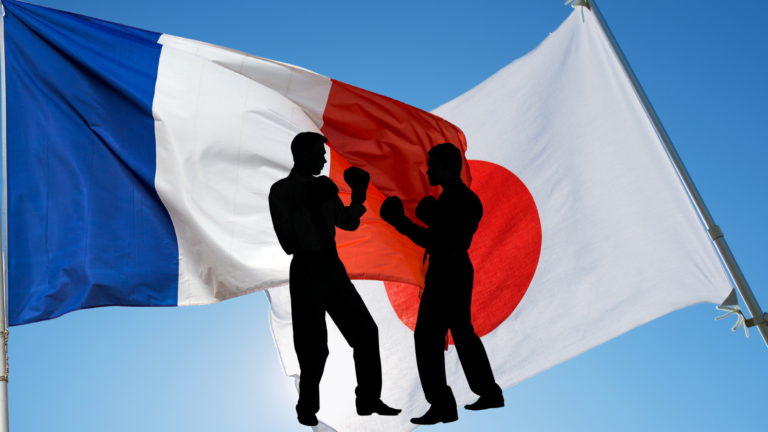
France and Japan have long enjoyed a close cultural relationship. From Japanese enthusiasm for French fashion and cuisine to France’s enormous appetite for Japanese manga and anime, the two countries have found plenty to appreciate about one another.
Yet that mutual admiration apparently doesn’t extend to everyone on social media.
In October, Japanese and French-speaking users on X (formerly Twitter) found themselves embroiled in an increasingly hostile exchange of insults. What began amid widespread protests in France quickly escalated into arguments involving immigration, racism, and even the countries’ respective histories during World War II.
The insults ranged from jokes about France’s defeat by Nazi Germany to remarks about the atomic bombings of Hiroshima and Nagasaki. Some users went further, resorting to openly racist language.
X’s automatic translation feature helped bring these exchanges to audiences who might otherwise never have encountered them.
But as the controversy spread, some Japanese users began questioning whether their country’s reputation abroad was suffering. Others pointed the finger at Japan’s online right, known as netto-uyoku (ネット右翼), or netouyo, accusing them of damaging the international goodwill Japan had spent decades cultivating.
But who was fueling the hostility on the Japanese side? And how much of the controversy could be attributed to Japan’s online right?
Of riots and disinformation
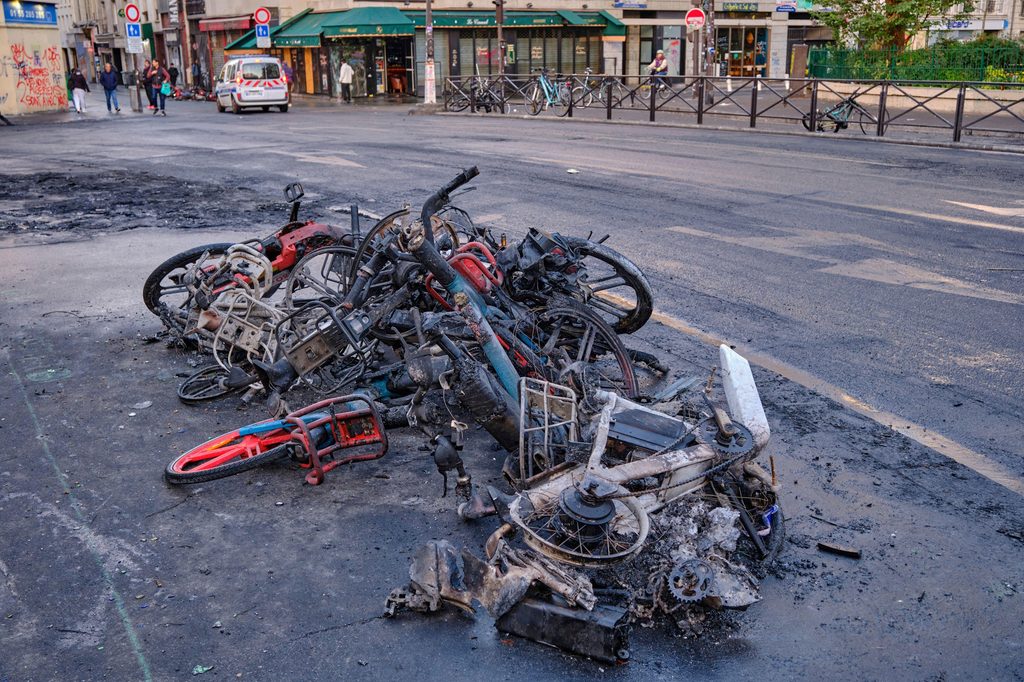
The controversy unfolded amid widespread demonstrations and unrest in France in October. Protesters took to the streets over rising living costs and education funding, with approximately 550,000 people reportedly participating nationwide on October 17, according to figures attributed to the French Interior Ministry.
The unrest also reportedly involved more than 2,000 arrests and the burning of the historic city hall in Limoges.
As images of the disturbances circulated online, some Japanese users began comparing France’s immigration policies to Japan’s own future.
There was just one problem: not everything being shared was real.
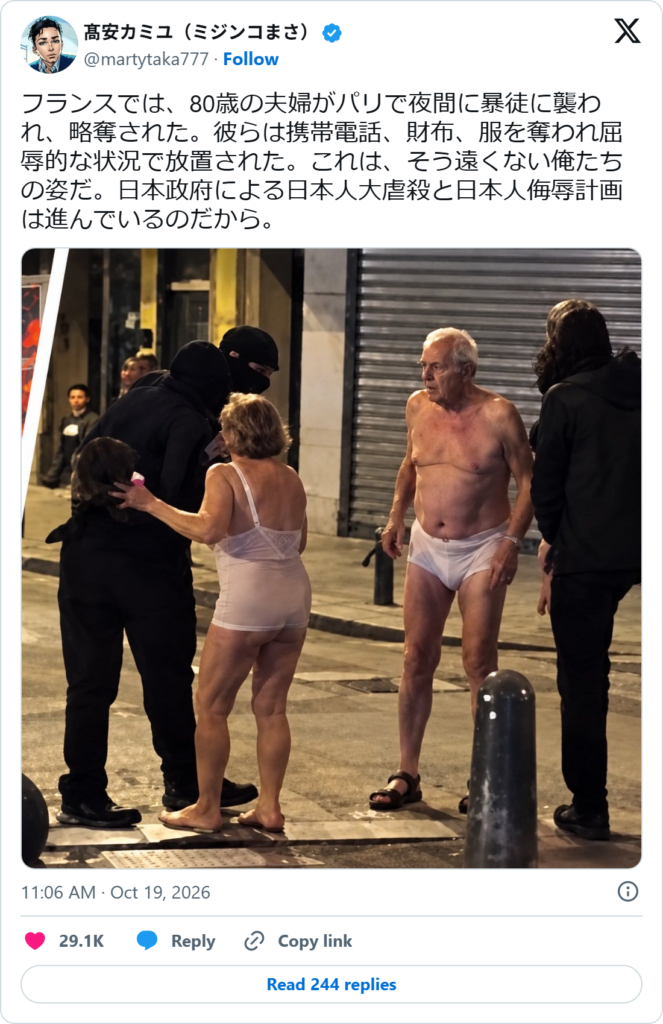
On October 16, NHK reported that unrelated footage was circulating on social media alongside claims that immigrants were responsible for rioting in France. Days later, French President Emmanuel Macron condemned a fabricated image depicting an elderly couple being stripped and robbed by a masked gang.
The fabricated image had already reached Japanese audiences. On October 19, an X account with nearly 200,000 followers shared the same image with the warning, “This is what we’ll look like before long.” The post received more than 29,000 likes.
But how did a controversy unfolding in France become such a heated topic among Japanese social media users?
Part of the answer lies in X’s automatic translation feature.
Since late March, the platform has automatically translated foreign-language posts appearing in users’ feeds. Rather than requiring readers to manually request translations, X now makes posts written in other languages immediately accessible.
The feature has made it easier for people worldwide to communicate. Unfortunately, it has also made it considerably easier for them to argue.
In April, Taiwanese media reported a surge in international disputes involving Japanese X users after automatic translation was introduced. Remarks that might previously have stayed within Japanese-language communities suddenly reached audiences overseas, sometimes without the cultural context needed to understand them.
By October, Japanese and French-speaking users were discovering just how quickly those misunderstandings could escalate.
“Just Nazis”: The insults on both sides
It didn’t take long for the disagreement to move beyond France’s immigration policies.
By October 20 JST, French-speaking users were taking aim at Japan itself, with some resorting to familiar stereotypes about Japanese society and the country’s history during World War II.
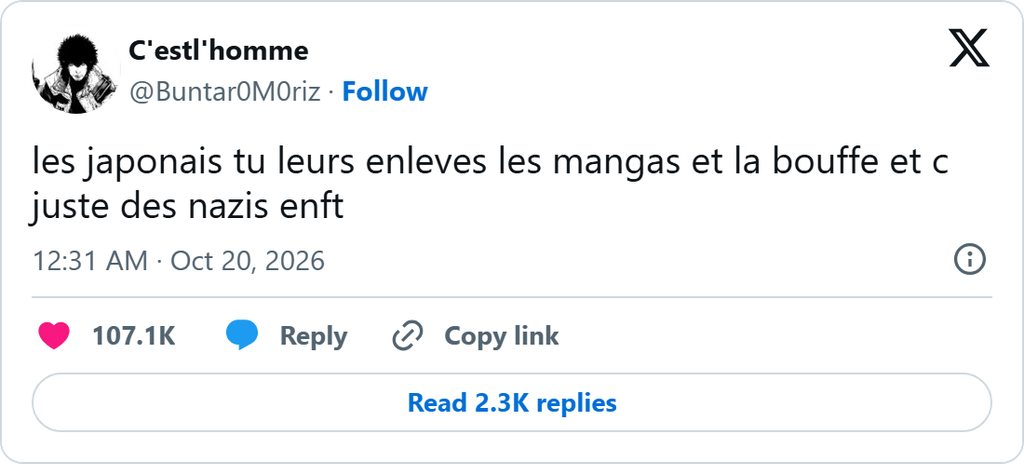
One particularly popular post declared that if you took away Japan’s manga and food, the Japanese were “just Nazis.” The remark received more than 106,000 likes.
Another user took a different approach, mocking Japan’s relationship with the United States.
“We fought and defeated the Nazis, while you never defeated the Americans and continue licking their boots,” the user wrote in response to a Japanese account.
The post attracted more than 2.5 million views.
Japanese users, however, weren’t about to let that particular historical comparison go unanswered.
Several responded by pointing to France’s defeat by Nazi Germany in 1940, when German forces overwhelmed the French military in approximately six weeks. Two such responses received more than 66,000 and 41,000 likes, respectively.
The exchanges only grew more personal from there.
On October 24, a French-speaking user made a joke referencing “Little Boy,” the atomic bomb dropped on Hiroshima in August 1945. The post received more than 324,000 likes.
Others targeted Japan’s notoriously demanding work culture. One post joked that a Japanese employee thanked his boss for letting him leave three minutes early after working a 65-hour week. That particular remark attracted more than 361,000 likes.
Meanwhile, Japanese users continued responding with their own insults, including remarks about France’s military history and increasingly hostile comments about the country’s immigrant population.
Some exchanges went beyond national stereotypes and historical grievances, descending into explicitly racist language.
But while the controversy was increasingly being described as a confrontation between Japan and France, that characterization overlooked an important distinction. Not everyone posting in French was necessarily French. Nor did every Japanese participant share the same political views.
And as the arguments continued, a question began emerging among Japanese users themselves: Who, exactly, was fueling the hostility?
Who was posting on the Japanese side?
As the insults continued, some Japanese users began pointing the finger at a familiar group: Japan’s online right.
Known as netto-uyoku (ネット右翼), or netouyo for short, the term generally refers to individuals who express strongly nationalist and often xenophobic political views online.
But not everyone making an offensive remark about another country necessarily belongs to Japan’s online right.
In a 2017 academic paper, Osaka University researcher Tsuji Daisuke identified three characteristics used to define netouyo: hostility toward China and South Korea, strong conservative or patriotic political views, and a history of participating in political discussions online. His research found that in 2007, only 1.3% of survey respondents met all three criteria, rising to 1.8% in 2014.
So how many Japanese accounts involved in the latest controversy actually fit that description?
To investigate, Unseen Japan examined 55 accounts involved in the exchanges, selected from X’s engagement-ranked search results and Japanese responses and quote posts under five French-language posts. A quote post allows a user to share another person’s post while adding their own commentary.
The analysis examined account biographies and about 40 posts outside the controversy for each account, looking for evidence of political affiliations, xenophobic attitudes, and prior online activity. The criteria were adapted from Tsuji’s research to include hostility toward immigrants, Muslims, and foreign residents.
The findings painted a more complicated picture.
The breakdown
Of the 37 accounts that attacked French-speaking users or used the riots to warn about immigration, 18, or approximately 49%, displayed characteristics associated with the online right. Those accounts also accounted for about 44% of the likes hostile accounts received in the sample.
Another four accounts expressed xenophobic views without meeting all three criteria. Together, these groups accounted for 22 of the 37 hostile accounts examined, or approximately 59%, and 61% of their likes.
However, the remaining accounts included conservatives without a history of xenophobic posting, politically unaffiliated users, and even individuals whose previous posts suggested more liberal views. In fact, the two Japanese accounts responsible for some of the most popular World War II comebacks didn’t fit the netouyo profile at all.
One was a welfare worker who had previously argued against judging people based on nationality. The other, an account primarily discussing baseball and programming, had explicitly criticized mocking France’s immigrant population.
Yet the distinction became considerably clearer when examining posts that used the French unrest to advance anti-immigration arguments. All seven accounts identified in that category met the adapted criteria for Japan’s online right. Among them was Shimada Yōichi, a former Diet member for the Conservative Party of Japan (Nihon Hoshutō), whose X profile lists him as the party’s special adviser.
“France kept letting in ‘cheap foreigners,’” Shimada wrote. “Japan is speeding down the same road.”
His post received more than 24,000 likes.
Another account, describing itself as an “ultra-flame-war singer,” published seven posts about the riots that collectively attracted nearly 80,000 likes.
The online right was also particularly prominent in another troubling aspect of the controversy: attempts to deny the identity of French-speaking users based on their race or background.
Five accounts in the sample appeared to question whether their opponents were genuinely French based on their race, religion, or background. All five met the adapted netouyo criteria, although two cases involved less explicit examples of this rhetoric.
One particularly active account shared a response suggesting that removing white people from France would turn the country into a zoo. The post received more than 81,000 likes.
Separately, the same account posted support for banning Islam, calling it a necessary step toward world peace. (Japan’s right is also no stranger to rabid anti-Muslim sentiment.)
Racist remarks weren’t limited to accounts confidently identified with the online right. Two accounts with insufficient posting histories to classify also published anti-Black responses.
There were also signs that some participants were particularly interested in attracting attention.
At least 25 of the 55 accounts displayed characteristics sometimes associated with engagement-seeking behavior, including recently created profiles, unusually high engagement relative to their follower counts, or frequent posts about inflammatory subjects.
One account with just 582 followers received more than 76,000 likes for a joke about France’s defeat by Nazi Germany.
However, these patterns don’t establish that the accounts were bots, paid engagement farms, or part of a coordinated campaign. The investigation found no evidence of such coordination.
The findings also come with limitations. The sample focused on highly visible accounts rather than every participant, and 14 of the 55 classifications carried low confidence. The results therefore cannot establish the political makeup of everyone involved in the dispute.
Nevertheless, the sample’s distinctions were revealing.
While Japan’s online right accounted for approximately half of the hostile accounts examined, its presence was particularly pronounced among those using the French riots to promote anti-immigration narratives or questioning whether their opponents were genuinely French.
Meanwhile, the broader exchange of national insults extended well beyond any single political group.
Question: do you like UJ's independent coverage of Japan? Our writers are supported by our members. Join Unseen Japan Insider to get bonus content every week, an ad-free website, and access to our large and growing Insider archive.We manage to keep most of our content free thanks to the generosity of our members. Join Unseen Japan Insider and you'll get access to new, exclusive UJ member content weekly, an ad-free website, and access to our large and growing Insider archive.
Does the world hate Japan?
As the arguments continued, some Japanese users began wondering whether the controversy reflected something more troubling than another social media dispute.
“Somehow, it feels like the world really hates Japan,” singer Ellie wrote on X on October 20.
Her post received more than 38,000 likes.
But not everyone agreed with that assessment.
Economist and author Emin Yurumazu responded, suggesting Japan’s reputation abroad wasn’t necessarily the problem. Rather, he argued, the country’s own online right was undermining the goodwill Japan had spent decades cultivating.
“That’s going too far, but it’s a fact that stupid netouyo are destroying, in a short time, the soft power Japan spent many years building,” Yurumazu wrote.
He added that this was precisely the development he had feared when X introduced automatic translation.
“I really think nothing in this world is more anti-Japan than the netouyo.”
His response received more than 14,000 likes.
Others expressed similar concerns, arguing that automatic translation had exposed an unpleasant side of Japanese social media to international audiences.
Although translation tools had long made Japanese-language posts accessible to international audiences, X’s new system removed an important barrier. Users no longer needed to seek out translations themselves. Posts that might previously have attracted little attention outside Japanese-language communities were suddenly appearing in other users’ feeds.
However, other users questioned why Japanese participants were being singled out for criticism.
One acknowledged that many Japanese accounts had posted racist remarks but pointed out that French-speaking users had also mocked the atomic bombings, Japanese people’s height, and the country’s suicide rates.
Why, the user asked, should Japanese people be expected to remain polite while receiving such insults?
Another suggested that the controversy reflected Japan’s longstanding culture of online arguments. Japanese internet users, the account argued, had spent more than two decades exchanging increasingly elaborate insults on platforms such as 2channel. Automatic translation had simply made those exchanges accessible to an international audience.
Yet another Japanese user pointed out a fundamental problem with how the entire dispute was being understood.
“Lots of Japanese people assume a French-language post means a French person,” wrote a user who describes themself as an emergency doctor on October 19.
The user argued that most French speakers actually live in Africa. They’re right: according to the International Organization of La Francophonie’s 2026 report, approximately 396 million people speak French worldwide, with 65% living in Africa.
In other words, someone posting in French isn’t necessarily posting from France, much less speaking on behalf of the French population. And even when a person is French, their race or ancestry doesn’t determine whether they belong to the country.
It was an important reminder of something that had become increasingly easy to overlook amid the insults: neither side represented an entire nation. Nor did a collection of viral posts establish that the world had suddenly turned against Japan.
In fact, some of the most popular exchanges to emerge from the controversy suggested quite the opposite.
Sushi with Algerian sauce
Fortunately, not every exchange between Japanese and French-speaking users ended in hostility. Some even resulted in unexpected culinary discoveries.
On October 24, a French-speaking user with Algerian and Chinese flags on their profile joined the controversy with a rather unusual provocation. They announced they could eat sushi with sauce algérienne, a popular French condiment, and that there was nothing Japanese people could do to stop them.
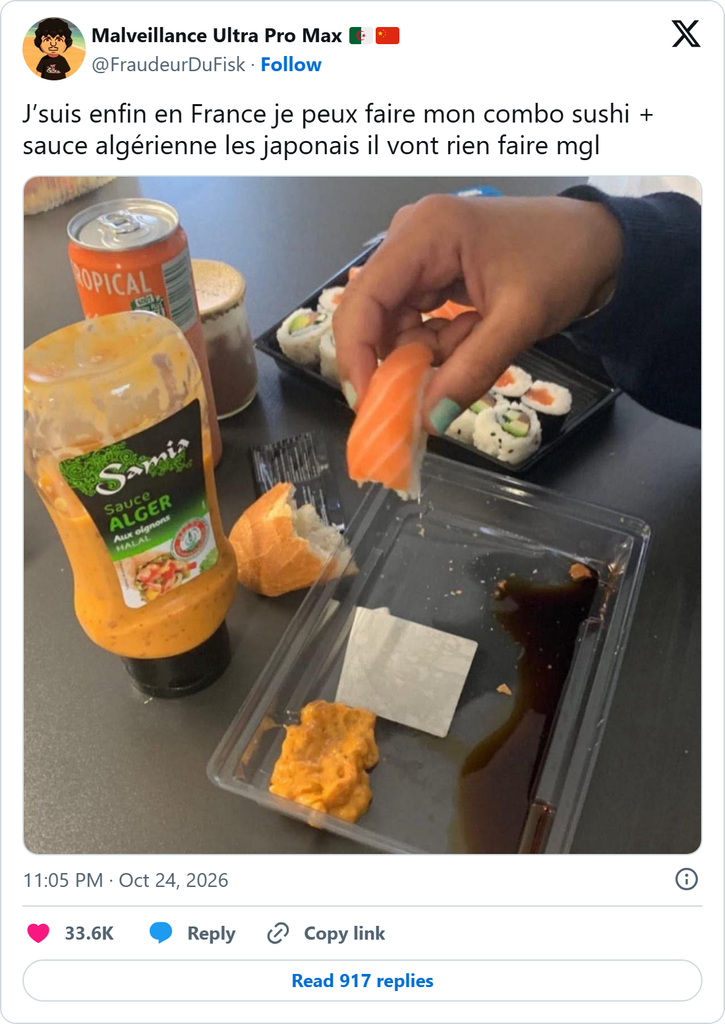
Rather than taking offense, one Japanese user decided to try it for themselves. After making the sauce from scratch, the user paired it with sushi and discovered that the combination was surprisingly good, particularly with salmon.
The original poster was delighted.
“I can only applaud you now,” they replied, joking that Japanese sushi chains Kura Sushi and Sushiro should start serving it.
What began as an attempt to provoke Japanese users had somehow turned into an international recipe exchange.
And it wasn’t the only interaction to end on a considerably friendlier note.
In another widely shared post, a French visitor praised the kindness and hospitality they experienced in Japan, describing how welcoming Japanese people were throughout their stay.
A Japanese user responded with a simple observation.
“That’s because you were polite and a good guy.”
The reply received more than 207,000 likes, exceeding the engagement of any individual hostile Japanese post included in Unseen Japan’s sample.
Amid the insults, accusations, and arguments about national identity, these exchanges reminded us that social media doesn’t always bring out the worst in people.
X’s automatic translation feature may have fueled an international argument, but it also let strangers who might never have communicated otherwise find common ground.
And sometimes, apparently, all it takes is a little Algerian sauce.
Keep reading




Sources
フランスを揺るがす抗議デモが暴徒化、2000人超逮捕──マクロン大統領、「怒りと恥」を表明 Forbes JAPAN
フランス抗議活動 無関係映像で“移民が暴動”偽情報拡散 NHK
仏暴動の偽画像を海外政治家が拡散 マクロン大統領「生成AI作成で事実無根」と非難 KAB
Photo of elderly French couple ‘stripped and robbed’ during riots is AI Full Fact
X(Grok)自動翻訳をオフにする方法|勝手に翻訳される対策【2026最新】 neworder
日本発の「ののしり合い」激増、Xの自動翻訳で「言語のガラパゴス」消失―台湾メディア Record China
論文「計量調査から見る「ネット右翼」のプロファイル」 辻大介の研究室
「なんだ、父は“ネット右翼”だったのか。」…大阪大学でも研究されている“ネット右翼”の「基準」とは 現代新書
サイエンスへの招待/「ネット右翼」は弱者ではなかった 東京大学
L’Afrique, locomotive de la langue française (rapport OIF) Financial Afrik
フランス人が日本人を煽るつもりで、寿司にアルジェリアソースを付けて食べようとする→日本人がソースを自作し実際に食べた結果、世界が驚く Togetter
フランス人「日本人ってみんなくそ優しくて親切で、ここでこれほどまでに心地良くなったことなかったよ」→それはあなたが礼儀正しくていい人だったからです Togetter