
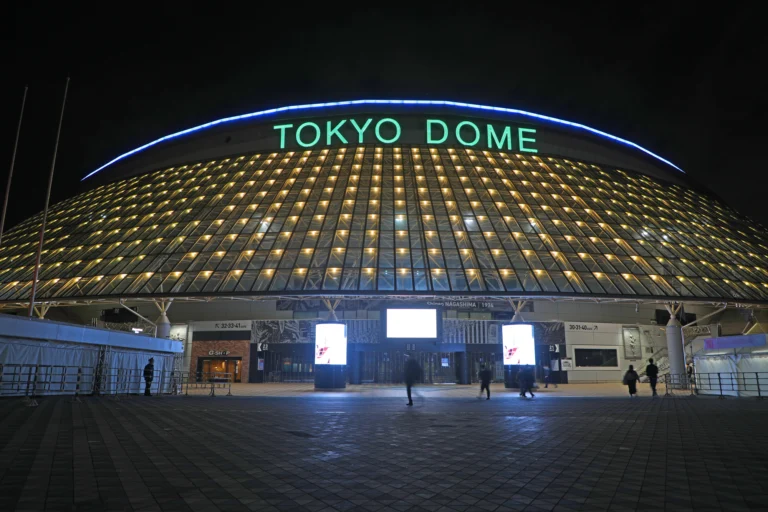
You’d think a country pushing “Cool Japan” would be happy that foreign music fans want to listen to the music and see the shows put out by Japanese pop artists.
Sadly, you’d be wrong.
Despite the global success of manga and anime, J-pop remains oddly inaccessible to a non-Japanese audience. A recent debate on social media about how hard it is to buy tickets for concerts in Japan as a non-resident drove this point home, with some foreign fans of Japanese pop accusing the Japanese music industry of xenophobia.
I think the truth, however, is more complicated.
A debate erupts
The debate kicked off on X when NANO, a Japanese music artist, made a long post about how hard it is for Japanese artists to do more shows overseas.
“There is only a SMALL percentage of artists that can rely on the power of big labels/agents to promote their shows internationally,” she wrote.
NANO was specifically talking about shows performed outside of Japan. However, a sizable number of English-speaking J-pop fans responded that the real problem is that the Japanese music industry seems to work overtime to make J-pop inaccessible to foreign fans.
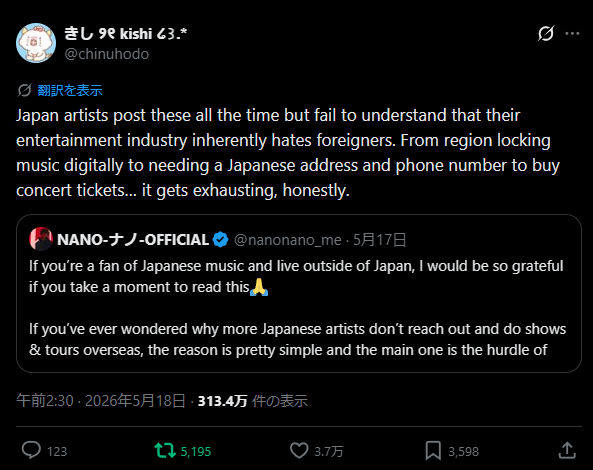
“Japan artists post these all the time but fail to understand that their entertainment industry inherently hates foreigners,” wrote user @chinuhodo in a post that earned over 37K likes. “From region locking music digitally to needing a Japanese address and phone number to buy concert tickets… it gets exhausting, honestly.”
The concert ticket issue was what riled commenters the most. Fans don’t mind if they have to come to Japan to see an artist. The problem is, even if they do, they often can’t get into shows.
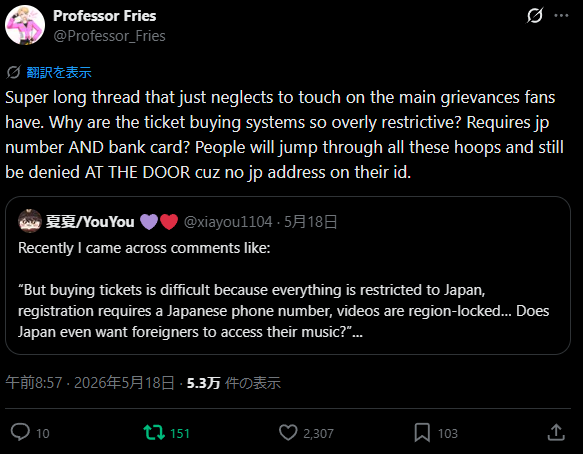
Many shows require purchasing a ticket online, and require both a Japanese phone number and a residence in Japan. Fans who have asked friends to buy tickets for them have found themselves turned away at the concert venue door because they couldn’t produce an ID that matched the address on the ticket.
Some people who say they have experience in the Japanese entertainment industry defended this situation as an unfortunate byproduct of Japanese law. Others, however, retorted that these excuses don’t address fans’ “main grievances.”
Of scalpers and chargebacks
So why are foreign fans being turned away at the door?
Blame it, the industry says, on anti-scalping laws.
Japan’s 2018/2019 Ticket Resale Prohibition Act criminalized for-profit resale above ticket face value with punishment of up to one year in prison. However, it’s an opt-in policy that only applies to “specified tickets” (特定興行入場券), which the law defines (Art. 2) as tickets the organizer has voluntarily structured by printing a no-resale notice, locking the date/time/venue, and recording the purchaser’s identity.
For such tickets, the fastest way to ensure that someone lives in Japan is to collect their phone number, as you need proof of residence to secure one. Sales for concerts are also lottery-based to ensure buyers are selected fairly, not by who can access a site with the fastest automation software.
As part of best-effort verification, some organizers will check your ID when you enter a venue. If you can’t provide matching ID, you may be denied entry without a refund.
Japan has the technology (it just doesn’t use it)
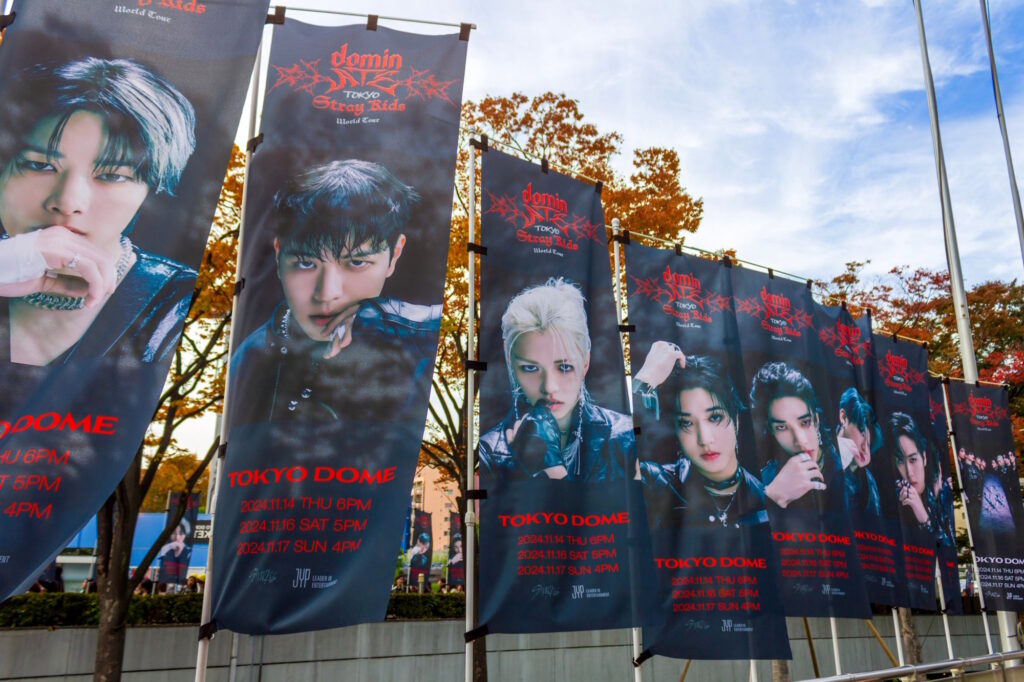
This doesn’t mean it’s not possible for concert organizers to sell even specified tickets to overseas buyers. The technology is there. But, for the most part, organizers choose not to use it.
Some popular Japanese ticketing sites, like e+, run overseas-facing versions of their sites. The problem is that they usually only have a small slice of the shows available to residents.
The lack of shows, however, isn’t necessarily evidence of anti-foreigner intent. Rather, some argue, it’s a risk assessment. METI’s April 2025 3-D Secure mandate establishes that merchants must eat the cost of unauthenticated fraud. Since an ID mismatch is a large fraud indicator, the reasoning goes, many organizers choose not to risk it.
Exclusivity deals also play a factor. Some concerts sell their events in special exclusive deals through a single ticket provider, such as Pia or Lawson Ticket.
…and yet, there’s still massive fraud
There’s a counter argument to the “foreigners will fraud” argument, though. Despite Japanese organizers’ best efforts, domestic ticket fraud persists. And on a massive scale.
In 2024, police arrested four men and women in Sapporo for ticket fraud involving the group West. (formerly Johnny’s West.; they changed their name for, uhhhh, reasons). Two men were found to have 8,000 fan club accounts they used to illicitly buy and resell tickets at 2-3x their face value. STARTO Entertainment went after the site Ticket Ryutsu Center in 2024, claiming it found around 10,000 resale listings for STARTO artists such as Naniwa Danshi.
Official attempts to stop scalping have gone belly-up. Ticket seller Pia shut down its resale site, Ticketrade, on June 30, 2025, because the solution didn’t put a dent in the problem.
How some artists bypass Japan’s old guard
This mess has led some artists to seek halfway solutions. For example, while ice skater Hanyu Yuzuru’s domestic concerts were locked down to residents, the athlete’s team made livestreams available internationally.
Another simple remedy would be for more Japanese acts to perform internationally. It’s not like there are no J-pop phenom who are global successes and hold concerts overseas. In the past several years, artists like Ado, YOASOBI, and ATARASHII GAKKO! have all had successful worldwide tours.
These cases, however, are the exception that prove the rule.
All three of the artists came to fame via the Internet. Ado was a YouTube phenom. YOASOBI’s members both got their start online: producer Ayase through Vocaloid, and vocalist Ikura through YouTube. The duo went big internationally thanks to the breakout success of “Idol,” the theme song to the popular idol anime Oshi no Ko. ATARASHII GAKKO! made good online during the pandemic.
Additionally, these artists work with overseas organizers and sponsors on their global tours. Ado’s global tour, for example, was sponsored by Crunchyroll. As someone who’s spent time in the states (and who’s aggressively working on her English), Ado is obviously someone who cares very much about her international fanbase.
In other words, for the most part, the Japanese artists who do make it big globally do so by sidestepping the existing system in notable ways.
Question: do you like UJ's independent coverage of Japan? Our writers are supported by our members. Join Unseen Japan Insider to get bonus content every week, an ad-free website, and access to our large and growing Insider archive.If you love what we do, help us pay our writers to do more of it by joining Insider. You'll get bonus content every week, an ad-free website, and access to our large and growing Insider archive.
How K-Pop roared past “oshi doping”

Regardless of whether you think J-pop is right to turn away overseas fans, the fact is that these barriers carry a real economic opportunity cost.
Japan ranks fifth in foreign-language music consumption worldwide behind South Korea, even though Japan’s domestic music market is still three to four times the size of Korea’s. (Per analyst Nakayama Atsuo, this gap was closer to 10x at the height of the 2010s). The impact is observable via Google. According to sociologist Nakayama Atsuo writing for TORJA, throughout the 2010s, J-pop had 1/10th the global search interest of K-pop.
For a country that made “Cool Japan” its catchphrase during the Abe era, that’s downright embarrassing.
Japanese music industry analysts say South Korea caught Japan while it was napping. The South Korean government rallied behind “K-pop” as a soft power brand.
Meanwhile, domestic artists were stuck in what critics such as Matsutani Sōichirō call “AKB商法” (AKB shoho), or “AKB commerce.” Revenue was tied to oshi (fan) culture: fan club purchases, benefits associated with CD purchases, and meet-and-greet events.
Matsutani has pejoratively referred to this as “oshi doping.” He and others contend these practices artificially inflated revenue and lulled the J-pop industry into a false sense of security, convincing the industry it didn’t need the international market.
A notorious symbol of this was the release of idol group AKB48’s song “Teacher, Teacher” in 2018. The single sold over two million copies; days later, people found garbage bags full of the CDs on the street. Fans overbought the media to earn ballot votes in the group’s “general election.”
As a result, Japan’s music market peaked around 1998. It’s the only major music market where sales are flat or declining, and the only one where physical media outranks streaming (62.5% to 34.4% as of 2025). That’s what allowed South Korea to overtake Japan internationally in 2021.
Cultural isolationism
Concerts aren’t the only barrier to being a J-pop fan. Region locking of music also makes many artists inaccessible outside of Japan. In 2015, for example, several major labels pulled their entire catalogs from YouTube US rather than agree to YouTube Red terms.
As someone who’s been learning Japanese for years, I can attest that this problem extends to nearly all Japanese media. Buying Japanese books or watching Japanese TV abroad requires a concerted effort to defeat region blocks. One of my favorite things about living in Japan, honestly, is that I no longer have to deal with these headaches. I can buy my yuri novels in peace.
In a larger sense, the situation shows how Japan often self-isolates from the world, whether intentionally or not. Business critics have long lamented the country’s “Galapagos” mentality when it comes to technology: a sort of “Not Invented Here” syndrome that divorces the nation from international standards.
A lost soft power opportunity that no one cares about

So, is this all proof that “Japan hates foreigners?”
As someone who’s covered news about actual racism in Japan, I think that’s a stretch. Yes, we’re currently in the middle of a right-wing surge that’s negatively impacting government policy. It’s also true that discrimination against foreigners is baked into some parts of Japanese society, such as housing.
Even so, for the most part, your average Japanese person appreciates it when people from outside Japan take an interest in Japanese culture. The problem is that no one has any incentive to change the status quo.
Given that foreign resellers of everything from Hello Kitty merch to McDonald’s Happy Set toys continue making headlines in Japan, it’s unlikely that concert organizers will take the risk of opening up more concerts to foreign fans willing to make the trip. There’s also little political pressure to make Japanese media abroad more accessible; it’s just not a problem on anyone’s radar. Your average Japanese citizen has far more pressing problems than whether someone in the states can listen to AKB48.
This isn’t likely to change until it reaches some sort of critical threshold, like manga and anime did. Japanese anime studios and broadcasters didn’t embrace the international market until after years of piracy. Crunchyroll, remember, started as a pirate site. It’s now owned by Sony. Miracles happen.
Of course, Japan doesn’t “have to” solve this problem. Nations, like people, have free will. It can do what it likes.
But it’s a shame for those of us who love Japan and Japanese media, because the problem is solvable. South Korea solved it. The infrastructure exists. It’s just that the will is absent.
With its economy stagnant, Japan is relying on its cultural power more than ever to drive revenue from sources such as anime and tourism. The recent social media discussion hints at a burgeoning market for greater access to Japanese media across the board.
There’s an opportunity there. It’s just waiting for the country to take it.
Keep reading




Sources
Music Market Focus: Japan [Latest Stats, Trends, & Analysis] Soundcharts
Japan’s Spotify Charts Belong to Japanese Artists Skoove
J-POPの国別需要が明らかに アメリカ1.9% 台湾8.5% 韓国4.0% 香港6.9% Musicman
J-POP vs K-POP、国内市場は10倍なのに海外での認知は十分の一|世界でエンタメ三昧【第94回】 TORJA
Japan’s Music Finds the World: How Streaming and Fandoms Are Powering a New Global Chapter Spotify Newsroom
なぜ日本の音楽ヒットは新陳代謝しないのか?──“推し”ドーピングの副作用から離脱するために Yahoo!ニュース エキスパート(松谷創一郎)
How to Buy Concert Tickets in Japan GaijinPot
Japanese music and vocaloid content disappears as YouTube rolls out new paid service Japan Today
チケット不正転売禁止法 文化庁 (Agency for Cultural Affairs)
Act on Ensuring the Proper Distribution of Show and Event Tickets by Prohibiting the Unauthorized Resale of Specified Show and Event Tickets (Act No. 103 of 2018), official English translation Japanese Law Translation, Ministry of Justice
YOASOBI’s ‘Idol’ Surges to No. 1 on Billboard Global Excl. U.S. Chart Billboard
世界を席巻しつつあるYOASOBIと日本発「Gacha Pop」の可能性 nippon.com
How 88rising Took a Music Industry Hub for Asian Artists From ‘Far-Off Dream’ to Singular Reality Billboard
FAQ: e+ (eplus) International e+ International (ib.eplus.jp)
Understanding 3D Secure in Japan and its impact on merchants Checkout.com
Ticket Resale Issue in Japan: Recent Cases and Shutdown of Industry-Backed Platform. Kaeru Parcels
転売ヤーが8000人分の名義保有…旧ジャニーズファンクラブ会員数の実数に疑問. Cyzo
STARTO社が「チケットの悪質転売ヤー」の身元開示請求、横行する高額転売をどうしたら撲滅できるのか?Bengo4.com
2024年の音楽市場は2.6%減。日本の音楽産業が抱える課題と可能性とは. Yahoo! News JP
Idol group AKB48 sells 2.5 million copies of new CD; bags full of them end up in trash days later. JapanToday / SoraNews24
「『AKB商法』破綻後の”音楽をちゃんとやるAKB48″──LE SSERAFIMと競うグローバル時代」. 松谷創一郎, Yahoo!ニュース エキスパート Yahoo! News JP