
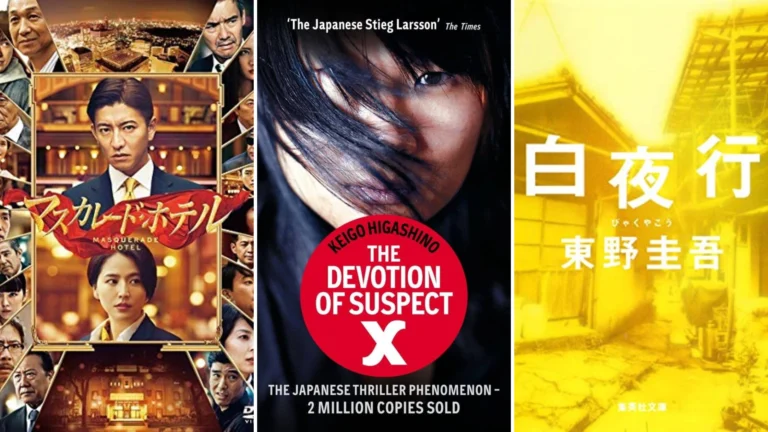
On July 27th, the official X account of Higashino Keigo, which is run jointly by seven of his publishers, delivered a sad message to the world. The author of The Devotion of Suspect X had passed away four days earlier on July 23rd after a battle with colorectal cancer. He was 68.
When I saw the news, I was going to sleep for the night. I bolted straight out of bed in disbelief and sadness. At the risk of sounding parasocial, it felt like I’d learned an old friend had died.
While I haven’t read everything Higashino’s written, I’ve read a lot. What I’ve read has been entirely in Japanese. Indeed, Higashino Keigo was one of the first Japanese authors I ever read in their original language. My Japanese skills today owe a huge debt to Higashino.
I’m not the only one, either. In Japan, Higashino Keigo has made readers out of non-readers for decades. Abroad, he’s delighted fans in translation, while providing non-native speakers a bridge into the language.
The Tom Clancy of Japan
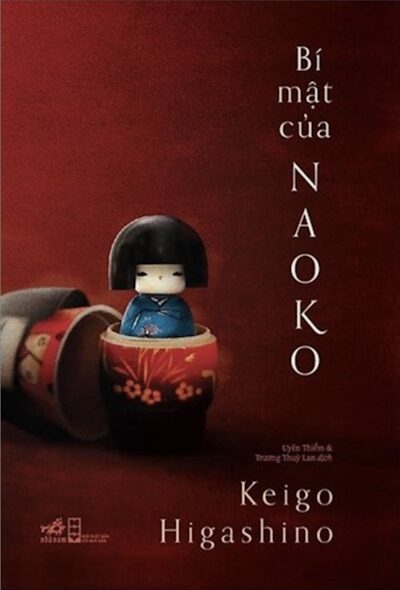
Born in 1958 in Ikuno Ward, Osaka, Higashino Keigo originally studied electrical engineering and worked as an engineer while writing. In 1985, he broke onto the scene with his novel Hōkago (放課後, “After School”), a school-set locked-room mystery, which won the Edogawa Rampo Prize. In 1999, his novel Himitsu (秘密, “Secret”; released in English as Naoko) won the 52nd Mystery Writers of Japan Award.
For years, literary critics looked down on Higashino’s work for being 大衆 (taishū) – mass appeal or commercial works. In 2006, however, he earned the recognition he deserved when his 2005 novel The Devotion of Suspect X (容疑者Xの献身; Yōgisha X no Kenshin) won the coveted Naoki Prize. In the story, a physicist nicknamed Galileo (real name Yukawa Manabu) investigates a mathematician who’s attempted to engineer the perfect crime. Alexander O. Smith’s English translation of the book was an awards finalist as well.
Galileo would become one of Higashino’s most popular recurring characters, appearing in 10 books at the time of Higashino’s death. He’s not the only beloved recurring character that Higashino would create: detective Kaga Kyōichirō appears in 13 books starting with Graduation (卒業; sotsugyō), and the duo of detective Nitta Kōsuke and hotel front clerk Yamagishi Naomi in the Masquerade series.
It’s hard to understate how popular Higashino Keigo is in Japan. The man authored 106 books in his lifetime, excluding co-authored works. His domestic print run stands at around 109 million copies.
He’s also famous abroad, with his work published in 37 countries and regions. Chinese media deems him China’s most well-known Japanese author; his books earn more in China than J.K. Rowling earns there from her Harry Potter series, with his book The Miracles of the Namiya General Store leading the pack. Worldwide, he’s sold an astounding 168 million copies.
Readers to Higashino: “Thank you for teaching me the joy of reading”

A Yahoo! News JP syndication of Asahi Shimbun’s article on Higashino’s death earned over 2,200 comments, almost all of them a mixture of sadness and appreciation. One theme is common: Higashino Keigo was an easily accessible author who got a lot of people hooked on reading.
Japan, like other countries in the world, is slowly losing the reading habit as social media continues to eat everyone’s brains. Only 27.6% of Japanese people polled in 2024 said they read 1-2 books a month. I can imagine that, today, that number’s even lower.
So it’s impressive, reading the comments on Higashino’s death, to realize how influential the man was in getting people to read again. Over 36% of the comments on the Yahoo! News JP article were from readers who say Higashino was their gateway drug to fiction.
“I read all sorts of authors, but I always come back to Higashino,” reads one comment with over 2,200 likes. “His books are easy to read, you tear through them in one sitting, and the satisfaction when you finish is the best. I came to love novels thanks to Higashino Keigo.”
“Back in school, a scene in The House Where I Once Died floored me, I got hooked, and from there I devoured a huge number of his works,” reads another. “Thank you for teaching me the joy of reading.”
Why are his books so alluring? The key reason is that Higashino was just a good storyteller with a penchant for painting vivid characters.
“His books didn’t just solve the puzzle of a crime,” one reader wrote; “they skillfully portrayed human weakness, kindness, and heartache. The lingering afterglow you experienced after finishing a book was the charm of his work.”
Question: do you like UJ's independent coverage of Japan? Our writers are supported by our members. Join Unseen Japan Insider to get bonus content every week, an ad-free website, and access to our large and growing Insider archive.If you love what we do, help us pay our writers to do more of it by joining Insider. You'll get bonus content every week, an ad-free website, and access to our large and growing Insider archive.
Why Higashino Keigo’s Japanese is so easy to read
Beyond telling good stories, however, readers in Japanese have also remarked how mechanically easy it is to read Higashino Keigo’s novels.
Kajinaga Masashi (梶永正史), a fellow mystery writer, attributes this readability to short, direct sentences with few metaphors, referring to Higashino’s writing style as “cinematic prose.” (Maybe this is why so many of his novels have been adapted to the big screen.) Kajinaga also says that Higashino was skilled at using humor to break tension. The result is that you never had to backtrack; Higashino’s work can be read in one sitting.
Many readers also applaud Higashino for employing a practice known as “opening up kanji” (漢字をひらく; kanji o hiraku). This means using hiragana, one of Japanese’s two syllabaries, to write a word instead of using kanji ideographs.
“Opening up kanji” is a widely used technique in printed news to keep Japanese accessible to native speakers, with written standards established to keep it consistent. Techniques employed usually include:
- Printing a verb in hiragana if it’s doing grammatical work
- Opening up categorical nouns like こと (koto) and もの (mono) when they’re used in an abstract sense
- Using hiragana for rare or non-Jōyō kanji – e.g., きれい (kirei, beautiful) instead of 綺麗
Literary fiction authors, or the 純文学 (jun-bungaku) crowd, don’t follow such guidelines. To the contrary: in my experience, even authors of so-called “light” novels relish tossing out rare kanji with abandon. The use of rare kanji combined with long, languid, sometimes dream-like sentences can make literary Japanese challenging to read, even for native speakers.
By employing the “opening” technique in fiction, Higashino’s writing looks more inviting, even to Japanese readers. One reader writing on note.com argues, “Kanji-packed text looks black and stiff and is genuinely hard to read. Higashino’s prose has lots of hiragana, so there’s less cognitive resistance [to reading].”
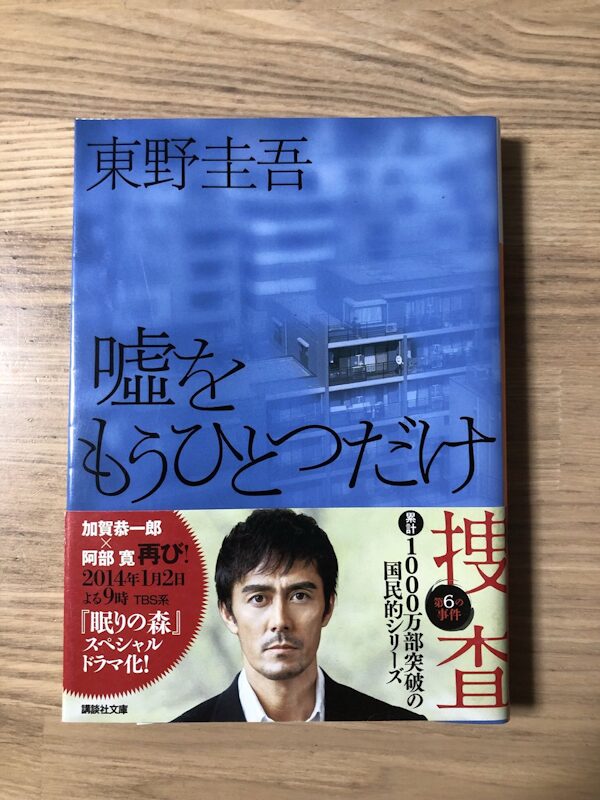
This quality is what makes reading Higashino so easy for non-native speakers of Japanese as well. According to my Bookmeter account, the first work of his I ever read was 嘘をもうひとつだけ (Uso o Mō Hitotsu Dake), or Tell Me One More Lie, a book from his Detective Kaga series. Before then, I had read authors like Akagawa Jirō, whose Japanese was accessible, but whose storytelling abilities left something to be desired.
Higashino Keigo was a breath of fresh air. His Japanese was accessible, and his stories were page-turners. As I’ve written before, this is the sweet spot for Japanese learning: interesting native material that motivates you to keep reading.
Other Japanese learners agree with me. On Japanese learning site WaniKani, learners who’ve tackled Higashino in his original language note their surprise at realizing how accessible his work is.
I’ve lost count of how many of Higashino’s books I’ve read. Like other readers, I keep coming back to them periodically. While I can read more challenging works now, I still appreciate his gripping storytelling and his accessible language.
As a result, Higashino Keigo has done wonders for my Japanese ability. He makes it easy to immerse myself in the language. His work reinforces words, collocations, and ways of speaking that teach me Japanese in a way that never feels like studying. It just feels fun.
Why you should read Higashino Keigo in Japanese (or any language)
The good news is we have one last Higashino work to remember him by. His last Galileo book, 永遠の記憶 (eien no kioku), Eternal Memory, is his next (and, sadly, last) Galileo mystery.
If you’re an intermediate to advanced Japanese learner who wants to get into reading Japanese novels, I can’t recommend Higashino Keigo enough. Reading Higashino is one of the most entertaining ways you can improve your Japanese. And with 106 books in print, you’ll have no lack of things to read.
Where do you start? I’d personally recommend Himitsu. It’s the story of a man whose wife and daughter are in an accident. The wife dies, but when the daughter wakes up, she insists she’s his wife in his daughter’s body. Somehow, Higashino manages to tread a very skillful line, telling a story that’s deeply disturbing but which, at the same time, you find impossible to put down.
Next, I’d recommend his series, particularly the Masquerade series. I’d then encourage you to dive into his two master works. Next to Devotion of Suspect X, one of Higashino’s most-lauded works is 白夜行 (byakuyakō), Journey Under the Midnight Sun. This long, epic novel follows two children involved in a murder case over 19 years, and the trail of crimes that seems to follow in the pair’s wake.
If you’re not learning Japanese – well, good news! 15 of his novels are available in English, including several from the Galileo and Kaga series. If that gets you hooked on Japanese mysteries, you can expand into reading other Japanese mystery writers whose works exist in translation.
Sadly, the English translation of Higashino Keigo’s works maxes out at a mere 14% of his oeuvre, which emphasizes how little of native Japanese media ever makes its way into English. Learning Japanese isn’t a weekend hobby, to be sure. But the payoff is that, once you get to a certain level, an entire new world of fiction opens up to you.
For those willing to start the journey, Higashino Keigo will always be there to help.
Keep reading
Sources
作家の東野圭吾さん死去、68歳 「容疑者Xの献身」「白夜行」 日本経済新聞 (Nikkei)
作家・東野圭吾さん、大腸がんのため死去 68歳 『白夜行』『容疑者Xの献身』『ガリレオ』シリーズなど ORICON NEWS
作家・東野圭吾さん、大腸がんのため死去 享年68歳「容疑者Xの献身」「新参者」など映像化も多数 シネマトゥデイ (Cinema Today)
東野圭吾さん作品 世界各国で大ヒット 日本ミステリーを世界へ広げた功績 米エドガー賞候補にも スポニチアネックス (Sponichi Annex, via Yahoo!ニュース)
「中国で最も稼ぐ外国人作家」は東野圭吾 その翻訳者は東野のファン 人民網日本語版 (People’s Daily Japan)
東野圭吾 (Higashino Keigo) Wikipedia (Japanese)
Keigo Higashino Wikipedia (English)
東野圭吾氏の小説はなぜ読みやすいのか note (さわ)
一気読みさせるミステリーの書き方とは? 「このミス」大賞作家・梶永正史による、東野圭吾『新参者』の読み方 ダ・ヴィンチWeb (Da Vinci Web)
Author: Keigo Higashino — Do “easy to read” books of his exist? WaniKani Community
Reading Pathways: Keigo Higashino Books Book Riot
東野圭吾の評価は先見的(『作家の値打ち』を読む) カクヨム (Kakuyomu / tsutsumi)