

A guy sits at a “girls’ bar” and spends a fixed fee every hour to chat with the young girl serving him drinks. A woman spends hundreds of thousands of yen a month trying to make her favorite male host the number one earner at his club. A married man collects Polaroids of himself with his favorite idol, sometimes buying a dozen at a time.
These are just a few of the many examples in Japan of a booming industry that many outside the country struggle to understand.
Tourists to Japan are fascinated by the explicitly sexual businesses (soaplands, oppai pubs, etc.) that skirt Japan’s anti-prostitution laws. I’m more fascinated, though, by its attention economy.
Attention economy businesses don’t sell sex. They sell conversation and companionship at a distance. This economy, which includes everything from concept cafes to “rental girlfriends,” is enormous. And unlike Japan’s sex trade, it’s growing.
And it’s booming. Concept cafes are exploding in popularity. Oshikatsu (推し活, supporting one’s fave), which can include supporting your favorite con cafe worker or underground idol, is a ¥1 trillion-and-growing business. Meanwhile, Japan’s traditional storefront sex trade has been in long-term decline.
This side of Japanese nightlife befuddles many Westerners I take on tours. Why do people spend so much money, they wonder, on talking?
The answer varies by buyer, of course. But in general, Japan’s attention economy is what happens when traditional culture meets the very modern problems of alienation and loneliness.
Japan’s attention economy is big business

The attention economy spans a wide range of businesses. The ones most familiar to most people outside of Japan are likely host and hostess (cabaret) clubs. In these venues, customers pay members of the opposite sex to sit at their table, drink, and chat the night away. The payoff: attention, validation, and the thrill of a “pseudo-romance” that exists within set boundaries.
Hostess clubs set the financial model, or “system,” for most such businesses: an hourly fee, cheap (or free) well drinks, and additional charges for services such as designating a cast member to stay at your table (指名; shimei), high-end alcohol, and pictures.
Concept cafes are also becoming more of a booming business. The cosplay-inspired cousin of the maid cafe, “concafes” can be either female- or male-staffed, with each store selecting a theme that ties everything together (succubus, angels, police officers, nurses, etc.). Girls’ bars dispense with the costumes and provide a simpler model: women behind a counter in outfits they choose, serving you drinks and conversation.
While most of these businesses have storefronts, there’s also an entire “rental relationship” economy that exists mostly online. Rental girlfriend (レンタル彼女; rentaru kanojo) services have become popular worldwide thanks to manga and anime. The Western press has also reported (often in breathless, “Weird Japan” terms) about services such as rental families and “rental ossan.”
There’s a lot of crossover between the attention economy and idol culture. This is seen most clearly with underground idols (地下アイドル; chika aidoru), idols who work small clubs and have a more intimate relationship with their audience. Host clubs and con cafes have also borrowed oshi language and practices, such as selling cheki (チェキ), or Polaroid pictures.
There are no hard yen figures on the total size of the attention economy. But it’s obviously a booming business. Some hosts make multiple times what even top-earning corporate workers make. Industry estimates put the country’s host clubs at around 1,000-plus nationwide, earning close to ¥170 billion (~$1 billion USD) a year, though no official statistic exists. By one oft-repeated estimate, roughly a million people work across Japan’s broad nightlife-hospitality (mizu shōbai) sector.
If you’re interested in a rundown of every business in the attention and adult nightlife economy, by the way, my Tokyo adult nightlife guide will get you up to speed. It also serves as a practical guide for having a fun night in Tokyo, identifying 30+ businesses that foreign visitors can enjoy.
The attention economy’s Edo-era origins
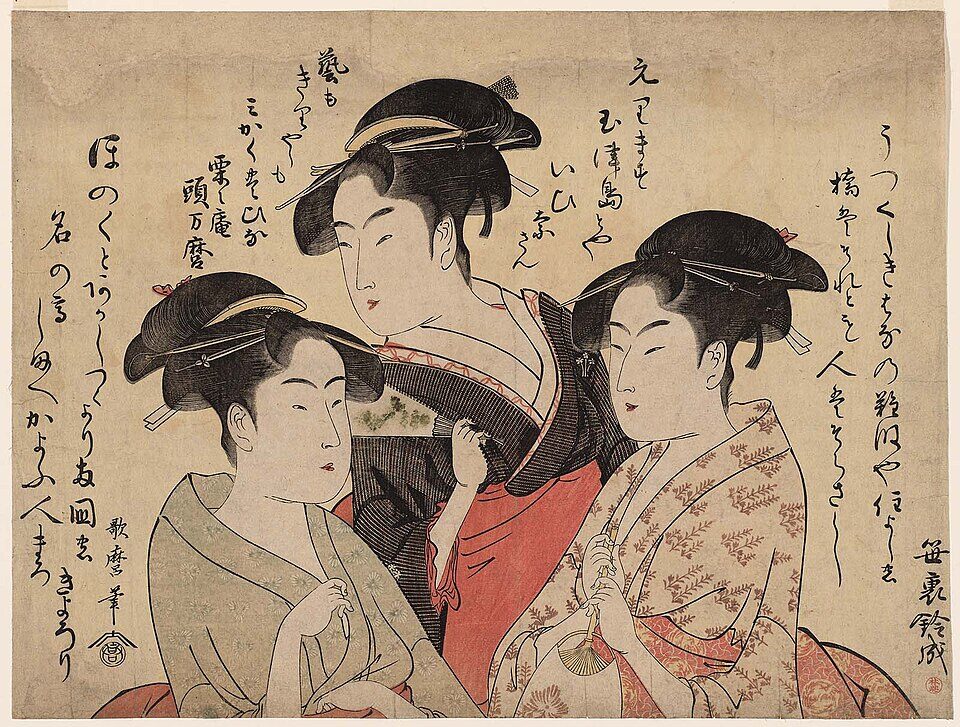
The origins of such businesses date back to the 18th century. Female prostitution was illegal outside of the walled Yoshiwara district, which held a monopoly. This fostered the growth of non-sexual female entertainment in the form of odoriko (踊り子, dancing girls) and teahouse “poster girls.”
Some teahouse girls became the Edo equivalent of idols, and artists immortalized their beauty. Two of the three women in the ukiyo-e artist Utamaro’s “Three Beauties of the Kansei Era” (寛政三美人; kansei sanbijin) were teahouse girls.
These same regulations led to the birth of the modern-day geisha. The odoriko Kikuya started the geisha tradition in Edo’s Fukagawa, proclaiming that her entertainers focus on “selling art, not bodies.”
The teahouse girl didn’t disappear with the Edo Era. Rather, she evolved with the times. The jokyū (女給) in Meiji and Taishō Era coffee houses were her natural successors. Postwar cabaret clubs eventually became the hostess clubs (still called キャバクラ; kyabakura) of the 1980s. Meanwhile, the 1960s and 70s gave birth to the country’s first host clubs, which evolved out of the dance scene.
In reality, the Tatsumi Geisha did, indeed, sell sex among their services. But it wasn’t the focus. The focus was on art and non-sexual entertainment. Geisha had to be eloquent, skilled in conversation, and accomplished in various arts.
That same pattern echoes into today’s attention economy. Legally, attention-economy businesses can’t offer sexual services. This is regulated by Japan’s Entertainment Law (風営法; fūeihō).
All girls’ bars and many concept cafes are classified as sekkyaku (接客) businesses: staff serve drinks and chat from behind the counter rather than sitting beside customers, and the businesses can stay open until 5 am. Host and hostess clubs, and some concafes, are settai (接待) businesses: staff can sit with guests, and the businesses must close by midnight or 1 am, depending on the locality. (The early-closure rule dates back to the 1948 origin of the Entertainment Law; legislators saw this as the “danger zone” when drinking had lowered people’s restraints.)
This line is strictly enforced, and clubs can land in real legal trouble by crossing it. The standout example is SOD Land, the bar in Kabukicho staffed by actresses for porn company Soft On Demand. The club insisted it was sekkyaku, but authorities deemed it settai and arrested the CEO after the company refused to make changes. Reopening in August 2023 required rebuilding the fourth-floor “Magic Mirror” room to satisfy the law.
That doesn’t mean that makura-eigyō (枕営業), or sleeping with customers to keep their business, doesn’t happen. But it’s not the core service. How common it is, nobody really knows: self-reported industry surveys, none of them rigorous, put the share of cabaret hostesses who’ve engaged in it anywhere from about 10% to over 30%. Dōhan (同伴), eating together, and after (アフター), or socializing after the club closes, are far more common, and non-sexual by default.
The allure of the attention economy
This leads to our main question: why do Japanese consumers invest so much in the attention economy?
Sociologist Yamada Masahiro says these services offer many in Japan what they crave: validation on demand. Lonely men and women can get a sympathetic ear (attached, not coincidentally, to a cute girl or handsome guy) without the hassle and disappointment that comes with using dating apps.
For women, it’s also a matter of safety and control. Sasaki Chiwawa, a researcher who specializes in Japanese nightlife, points out that women are routinely subjected to unwanted sexual attention they can’t control. Seeing a concafe guy or a host returns control to them. They get to choose who they get attention from.
It’s not cheating, it’s oshikatsu
Married men, however, use these services more than single men do. A 2017 Meiji Yasuda survey of 10,304 people aged 15 to 34 found that about 20%, one in five, of married men in their early 30s had visited a hostess club or a sex-work venue. Married men visited at a higher rate than unmarried men, and among single men, those with partners went more often than those without.
These figures might, at first blush, lead some to judge Japanese men harshly. However, Japan is also uniquely awash in loveless marriages. Some surveys estimate that as many as 1 in 5 unions are so-called “masquerade marriages.” A combination of societal pressure and a strict legal framework around divorce keeps many couples trapped in loveless relationships.
Yamada sees married men’s use of the attention economy as “the diversification of love.” Rather than cheat outright, men seek emotional support and intimacy beyond their primary relationship.
As I’ve discussed before, there’s already a certain amount of built-in tolerance around cheating in Japan. There’s even greater societal tolerance for attention-economy businesses. One survey of 1,163 people, 795 of them women, run by a divorce law firm found that 15.8% of women would consider a single visit to a sex-work business cheating. Only 7.5% would say the same if their husband went to a hostess club.
This is likely another reason that oshikatsu purchasing patterns and vocabulary have spread into the attention economy. It enables customers to frame their business, not as sexual, but as supportive.
Is the attention economy engineering unhealthy relationships?

Used sensibly, the attention economy can be nothing more than harmless fun. The danger is that such connections can morph into exploitative relationships that harm one or both parties.
Businesses such as host and hostess clubs are engineered to foster fake but seemingly meaningful relationships with clients. Workers connect with their customers via messaging apps, deepening their connection and, in many cases, encouraging romantic feelings. This leads customers to spend more to “support their oshi” and help them become the “number one earner” at their store. A part of that money goes into the host’s pocket as commission.
In recent years, more concept cafes and girls’ bars have adopted similar models. Customers who become addicted to the attention can find themselves taking desperate measures to earn the money required to feed their need.
Host clubs have garnered the most attention for ruining their customers with these tactics. Unlike patrons of hostess clubs and other businesses, who tend to be older men with careers, host club customers are usually younger women with less means. That has resulted in sensational headlines about host club customers turning to prostitution to pay off their debts. It led to such an uproar that Japan revised its Entertainment Law to crack down on the worst tactics.
Of course, men can, and do, spend themselves into a hole to keep such relationships going. There are no definitive numbers on which gender is most likely to fall into financial trouble. But female customers of host clubs have received more attention in the press.
Why? Partly, thanks to patriarchal attitudes that women are victims in need of saving. Partly, however, it’s because host clubs’ tactics, which include maximizing false romantic feelings, encouraging debt, and routing customers directly into sex work, are grossly predatory.
The danger for workers
But the danger can flip the other way, too.
Women are already at risk of becoming victims of stalking in Japan. The country’s weak anti-stalking law leaves them with few legal protections.
Entertainment workers are especially at risk due to the close relationships their work encourages them to foster with customers. Such relationships can turn deadly.
For example, in October 2024, 49-year-old Chigira Hiroyuki (千明博行) murdered 18-year-old Tanizawa Yuna (谷沢優奈), an employee at a girls’ bar in Shinbashi, stabbing her 36 times in the neck and face. Chigira’s defense audaciously tried to blame the victim, claiming she took money from him. The court rejected that, citing the 30-year age gap and the fact that Tanizawa had been trying to break things off with him. It sentenced Chigira to 19 years; in March 2026, the Tokyo High Court cut that to 18 after he paid part of a settlement to her family.
A yearning that defies regulation
Japan’s attention-based nightlife businesses continue to rake in cash, despite the government’s attempts to regulate them. Past attempts to crack down on questionable businesses, such as “no-panties shabu-shabu” restaurants, only led to the emergence of different types of stores. Last year’s host club “crackdown” hasn’t slowed the industry down at all.
This isn’t surprising. Japan’s Cabinet Office has found that 39.3% of people in the country, almost 4 in 10, report feeling lonely. It’s only the second country in the world to have a Minister of Loneliness in its government.
As the data above shows, even partnered people can feel lonely. For married people, going to a host club or a girls’ bar can give them attention and affection they feel they’re no longer getting at home. For lonely single people, it’s a fast and convenient substitute, a break from the exhausting process of searching for a partner.
Japan’s attention economy sells the promise of validation, human warmth, and emotional intimacy. And it’s clear that people are buying what they’re selling.
Want to experience Japanese nightlife for yourself rather than just read about it? My Tokyo adult nightlife guide covers every business type, featuring 30+ stores you can go to tonight. I update it monthly; buy it once and get all future editions for free, forever.
Keep reading




Sources
辰巳芸者 ウィキペディア
ホストクラブ ウィキペディア
歌舞伎町No.1ホストが叩きこまれた接客の流儀 かつての不夜城は粋なお客に支えられていた 東洋経済オンライン
キャバ嬢という矛盾した存在『キャバ嬢の社会学』 HONZ
コラム 経済トレンド137「推し活 ~若年層を中心に急成長する消費形態~」 財務省 ファイナンス
チェキで「100億経済圏」まわす地下アイドル業界の夢と実情…「推し」買い支える独特の収益構造 Business Insider Japan
3年で1億円を売り上げた歌舞伎町のコンカフェ 風営法違反で摘発のワケは? Yahoo!ニュース エキスパート(前田恒彦)
「お前はホストなんだから…」アイドル推しでは即アウトな”無茶ぶり”が横行する理由 ダイヤモンド・オンライン(佐々木チワワ)
ホストクラブに通いつめる理由とは? 恋愛に”タイパ”を求める女性たち PHPオンライン(山田昌弘・佐々木チワワ)
恋人代行サービス ウィキペディア
1時間1000円で人生相談から漫才の相方まで…「おっさんレンタル」でハイスペより普通のおっさんがなぜ人気 PRESIDENT WOMAN Online
枕営業 ウィキペディア
悪質ホスト、恋愛感情つけ込む営業規制 改正風営法が成立 日本経済新聞
悪質ホストクラブ等被害特別相談 東京都消費生活総合センター
悪質ホストクラブ対策に関する報告書(令和6年12月) 警察庁
小金井ストーカー殺人未遂事件 ウィキペディア
改正ストーカー規制法成立 GPS悪用禁止、8月にも全面施行 日本経済新聞
《卒アル写真入手》池袋・18歳”元地下アイドル”殺害「純粋すぎるほど純粋」逮捕の37歳男が凶行に走った理由 週刊女性PRIME
なぜ独身男性より既婚男性のほうが風俗・キャバクラに行くのか…女性には意外すぎる「愛の分散投資」現象 PRESIDENT WOMAN Online
2017年 男女交際・結婚に関する意識調査 明治安田総合研究所
浮気はどこから?アンケートでわかった男女で違う浮気の基準 ツナグ離婚弁護士
孤独・孤立の実態把握に関する全国調査(令和6年実施) 内閣府
「孤独・孤立対策推進法」 4月から施行 実態調査でもいまだに4割近くが「孤独感」を感じる 保健指導リソースガイド
50歳男に懲役19年 新橋ガールズバー女性刺殺―東京地裁 時事通信
〈新橋・ガールズバー刺殺〉アプリで出会った中年男(49)が金銭トラブルで18歳店員を殺害 集英社オンライン
新橋のガールズバーで18歳女性を殺害した49歳男性が沈黙後に絞り出した言葉【裁判傍聴記】 内外タイムス
キャバクラ・ガールズバー・コンカフェの違いとは│接待営業と非接待営業の境界線 ツナグ行政書士事務所
風俗営業等の規制及び業務の適正化等に関する法律 ウィキペディア
AV会社運営「セクシー女優と飲める店」が摘発、背景は「業界の情報収集」? 弁護士が解説 弁護士ドットコムニュース
SOD LAND が新体制で8月18日に復活 TOKYO HEADLINE
本の万華鏡 第34回 推し活狂想曲 第1幕 会える推し 茶屋娘 国立国会図書館
笠森お仙 ウィキペディア
カフェー (風俗営業) ウィキペディア
キャバクラ ウィキペディア
枕営業の実態とは?キャバ嬢の枕営業事情 体入ドットコム PLUS
風俗営業等の規制及び業務の適正化等に関する法律等の運用状況(風俗関係事犯等の検挙状況) 警察庁