
A Kyoto Buddhist temple is gaining attention on social media after a user claimed it was banning entry to anyone wearing a kimono. At first, users blamed Chinese influencers. But the temple made it clear the problem extended well beyond kimono wearers.
The episode is just the latest in a growing backlash in Japan against Internet influencers who use everything from cafes to holy sites to rack up impressions. Here’s how locations across the country are handling these “Insta-pests.”
From open in 2024 to “banning kimono” in 2026
Seiraiin (西来院) is a sub-temple of Kenninji, Kyoto’s oldest Zen temple, in the city’s Higashiyama district. The temple, however, remained closed to the public for years. It opened only in 2024 in preparation for the 750th memorial of Rankei Dōryū (蘭渓道隆), the celebrated Chinese Zen master who worked assiduously to bring authentic Chan/Zen practice to Japan.
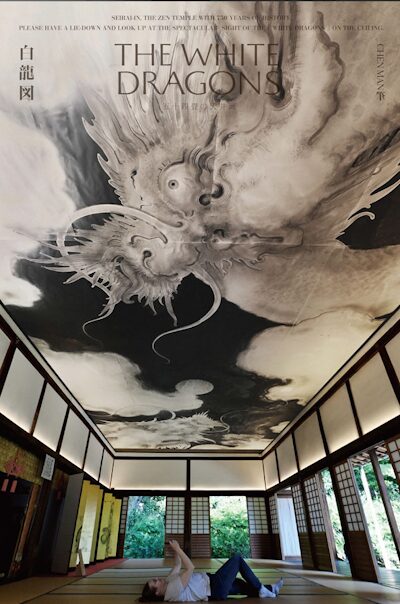
As part of the celebration, the abbot commissioned a giant white-dragon ceiling painting, “Hakuryū-zu” (白龍図), painted and donated by Chen Man (陳漫), a celebrated Chinese visual artist. The white dragon has become extremely popular, with posts of the painting hands down the most popular posts on the temple’s Instagram.
It didn’t take long for visitors to go from welcomed guests to annoying nuisances. One social media account, _saran_heyo_, on X recently posted pictures of the temple gate showing a new sign. The message? If you’re wearing kimono, entering’s a no-no.
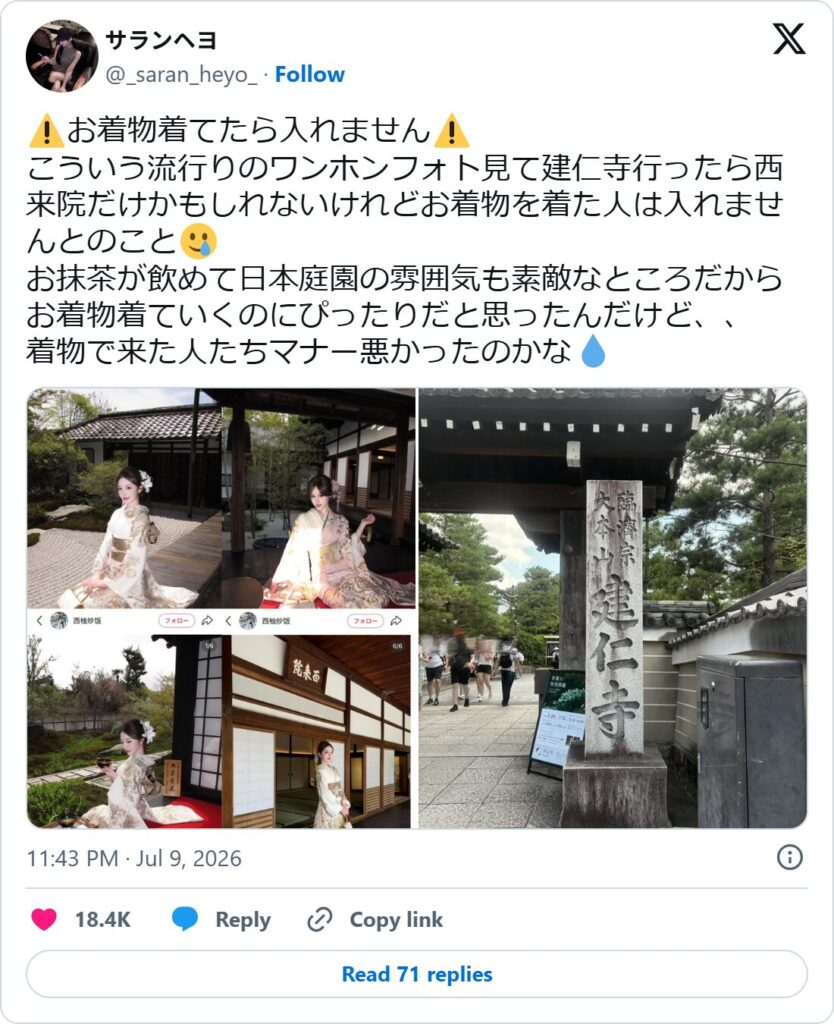
⚠️”No entry if you’re wearing kimono”⚠️ I went to Kenninji after seeing these trendy wanghong-style photos, and, at least at Seiraiin, they say people in kimono can’t come in 😢 It’s a lovely spot where you can drink matcha and enjoy the Japanese-garden atmosphere, so I thought it was perfect to visit in kimono, but…I wonder if the people who came in kimono had bad manners💧
From “Insta-genic” to “Insta-pests”
Initially, Japanese commenters went after Chinese influencers wearing rental kimono, blaming them for the closure. They specifically blamed wanghong (网红), the aesthetic that originated among Chinese influencers of taking heavily-styled, professionally-posed portraits in traditional dress at cultural sites.
Others on the X thread, however, pushed back at singling out Chinese influencers and tourists. The problem, they argued, is influencers in general, including the domestic ones.
Indeed, users reported that Seiraiin’s sign doesn’t just ban kimono. It doesn’t even ban kimono outright. The sign bans any “flashy” dress, including Lolita fashion. Everyday, traditional kimono and Japanese dress, they say, are fine.
The target isn’t Chinese influencers. It’s any would-be online star hellbent on increasing clicks and subscribes.
The 2017 Top 100 Buzzwords Awards crowned インスタ映え (insuta-bae), or “Insta-genic,” as the word of the year. It didn’t take long, however, for ordinary people across Japan to sour on the phenomenon.
Incidents of bad behavior by local influencers spread like wildfire online. A Nara record shop, Django Record, complained that a group of women visited four or five times, took photos each time, and left without making a purchase. Business owners wrote to legal sites such as Bengo4.com, asking whether they had the right to evict such freeloaders. (Verdict: yes, but they should weigh the benefits of free advertising against the inconvenience to staff and other customers.)
The bad behavior became so prevalent that online users coined a new name for it: インスタ蝿, also pronounced insuta-bae, but using the kanji hae for “fly” or “pest.”
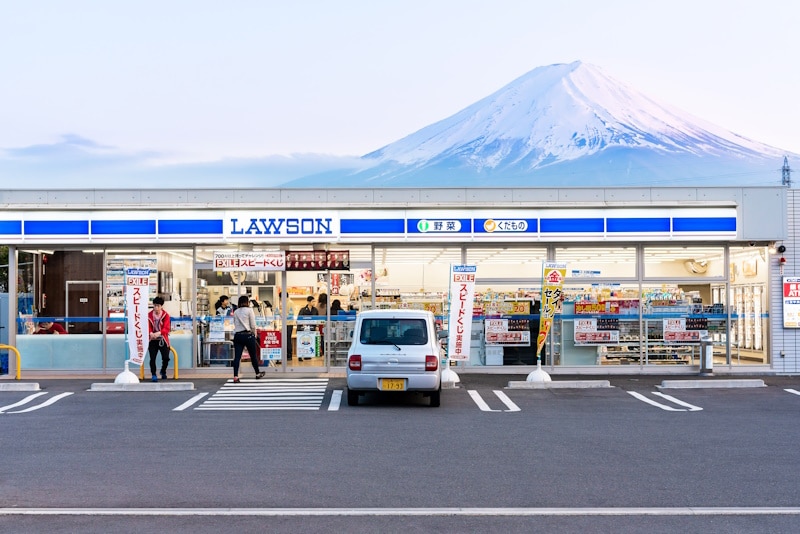
Tourism, of course, has also helped drive the Insta-pest label. One of the most famous examples of “Insta-genic” gone bad is the “Mt. Fuji Lawson” convenience store in Fujikawaguchiko. Another is the “Slam Dunk train crossing,” i.e., the famous Enoshima train line in Kamakura made famous by the basketball anime. Then there’s Gion, also in Kyoto, which started fining people for trespassing into the residential area where geisha and maiko live.
But bad behavior, as various reports make clear, isn’t limited to tourists. Nuisance TikTokers misbehaving at sushi restaurants and rail fans obstructing trains have been a problem for years.
Even Japan’s biggest homegrown creators trigger the same backlash. The YouTuber group Comdot lost ~300,000 subscribers in 2023 after residents exposed leader Yamato for running late-night shoots in a residents-only Tokyo apartment. Yamato apologized after other tenants complained…but kept filming there anyway.
Respecting property, and people’s privacy
One way influencers in Japan make a nuisance of themselves is by causing damage. Buddhist temples and Shinto shrines, in particular, have complained about tourists and negligent local visitors who knock over gates or damage buildings.
But stores and sites are also keen on protecting their other, non-influencer customers. Some stores in Japan, such as the British-style Tokyo pub Old Arrow, have made headlines recently for banning nuikatsu (ぬい活), or bringing stuffed animals into the restaurant.
Some stores just don’t like that nuikatsu visitors stay forever and order little. Others, however, are concerned that their selfies with their inanimate best friends include other customers in the frame. That raises serious issues around consent if those pics wind up on someone’s Instagram or X account.
Legally, Japan’s 肖像権 (shōzō-ken, portrait rights) are enforced not by a single statute but by case law grounded in the Constitution’s Article 13. There’s a four-fold test to determine whether you need consent to post someone’s image online. Generally, background capture that doesn’t single out an individual is legally permissible. But it’s judged on a case-by-case basis. Courts have to respect both the photographer’s right to photograph and the subject’s right not to be photographed.
Regardless of the legal status, being captured in background photos is a nuisance that can drive customers away. That’s why establishments like Bar Lupin in Ginza explicitly prohibit nonconsensual photography.
Seiraiin hasn’t gone that far. Indeed, it welcomes visitors to come in, lie down, and capture their own “Insta-genic” moments of Chen Man’s stunning ceiling painting.
They’re just asking that visitors show some respect. Which, honestly, doesn’t seem like much to ask.
Keep reading

Sources
特別公開中! コーヒーが飲めるお寺「建仁寺 西来院」とは そうだ 京都、行こう。
西来院に行ったら『着物を着た人は入れません』という注意書きがあった…「神社仏閣はフォトスタジオではありません」 Togetter
「テーブルに人形やグッズ置かないで」都内人気パブが店内での“ぬい活禁止”をお願い→一部愛好者から反発で炎上…店を訪れてわかった“実態”と店主が明かした「真意」 Yahoo!ニュース/女性自身
「富士山ローソン」問題 黒い目隠し幕にたくさんの穴、なぜ区分けしなかったのか ITmedia ビジネスオンライン
「舞妓さんに触ったり…」迷惑行為に悩む京都・祇園の私道に『進入禁止』の看板 違反したら「罰金1万」 関西テレビ放送(カンテレ)
大迷惑の「インスタ映え」優先行為、発端はインフルエンサーか?名物の木を切り倒す自衛策まで…クラウドファンディングで対策講じる農家【北海道美瑛】 訪日ラボ
若い女性たち「インスタ映えする」、商品買わないのに撮影…退店命じることは可能? 弁護士ドットコムニュース
385.勝手に「撮る権利」「撮る自由」なんてない。令和5年(2023年)7月13日に「撮影罪」という新しい法律が施行された。 note(著作権協会)
Can Posting Someone’s Photo Without Permission Be a Crime? Explaining Possible Legal Actions Monolith Law Office
インバウンド需要でレンタル着物が大ヒット 日本人観光客が減る時期でも予約好調 J-CASTニュース
市場縮小で老舗の淘汰が続く「呉服業界」 和装文化を現代に生かす価値創造が急務 東京商工リサーチ(TSR)