
Japan’s capital is set to dramatically change how visitors pay lodging taxes, becoming the latest destination to overhaul its tourism funding model as municipalities across the country search for ways to keep pace with record visitor numbers. The good news? The increases won’t make a difference for most visitors.
Taxes double, but that’s not saying much
The Japanese government has officially approved revisions to Tokyo’s accommodation tax, allowing the city to replace its long-standing fixed-rate system with a new tax equal to 3 percent of a room’s nightly rate. The change starts in April 2027.
The changes, approved by Internal Affairs Minister Hayashi Yoshimasa and announced by the Tokyo Metropolitan Government this week, will also expand the tax to cover private lodging, or minpaku. (It already covers standard lodging options such as hotels and ryokan.) They’ll also raise the exemption threshold for lower-cost accommodations.
Under the current system, guests staying in rooms costing ¥10,000 to ¥14,999 per night pay ¥100, while rooms priced at ¥15,000 or more incur a flat ¥200 tax. Beginning next April, accommodations costing less than ¥13,000 per night will remain exempt, but all others will instead be subject to a tax equal to 3 percent of the room rate.
For example, a traveler staying in a ¥15,000 room would see their per-night tax rise from ¥200 to ¥450. Meanwhile, guests booking higher-end hotels would see significantly larger increases: a ¥50,000 room would incur a ¥1,500 tax, and a ¥100,000 room would incur a ¥3,000 tax.
According to the Tokyo Metropolitan Government, the changes are intended to better align tourism-related revenue with the growing costs of maintaining the city’s tourism infrastructure. Officials estimate the current tax raises approximately ¥6.9 billion annually, while tourism-related expenditures exceeded ¥30 billion in fiscal 2025. The revised system is expected to generate roughly ¥19 billion each year.
An ongoing trend
Tokyo’s reform reflects a broader shift away from the flat-rate accommodation taxes that once characterized Japan’s tourism policies. Increasingly, municipalities are experimenting with systems that scale with room prices, asking higher-spending visitors to contribute more toward the costs of maintaining popular destinations.
In fact, the current wave of accommodation taxes represents one of the most significant changes to Japan’s tourism funding model in decades. While Tokyo became the country’s first municipality to introduce a lodging tax in 2002, relatively few local governments followed suit for many years.
Osaka introduced its own tax in 2017, followed by Kyoto in 2018. But the concept remained largely confined to Japan’s largest tourism destinations.
The picture changed dramatically following the COVID-19 pandemic. As international tourism rebounded to record levels, municipalities across Japan faced overtourism and rising costs associated with maintaining popular destinations.
In response, a growing number of cities, towns, and prefectures have either introduced accommodation taxes or begun considering them to fund tourism infrastructure without relying solely on local taxpayers.
Rather than creating a single nationwide accommodation tax, Japan has allowed local governments to design their own systems. As a result, travelers are increasingly encountering different rules depending on where they stay, creating a patchwork of local policies that reflects each destination’s priorities.
Different destinations, different approaches
Perhaps the clearest example is Kyoto, which has significantly expanded its own accommodation tax.
Rather than adopting a percentage-based model, Kyoto revised its existing tiered system, increasing the maximum tax to ¥10,000 per person per night for accommodations costing more than ¥100,000. The move made Kyoto’s accommodation tax the highest in Japan and reflected the city’s ongoing efforts to balance the economic benefits of tourism with the pressures created by record visitor numbers.
Unlike Tokyo’s proposal, which ties the tax directly to a room’s price through a percentage, Kyoto’s system relies on progressively higher fixed brackets. Both approaches, however, share the same underlying philosophy: travelers staying in more expensive accommodations contribute more toward the costs of supporting tourism.
Resort destinations are also adopting their own solutions. Niseko, one of Japan’s busiest international ski destinations, introduced an accommodation tax in 2024 and is scheduled to transition to a percentage-based system later this year.
The change reflects the realities of a resort where accommodation prices can vary dramatically between seasons. By linking the tax to room rates, revenue rises alongside visitor spending during the busy winter months, creating a closer relationship between tourism demand and the funds available to support local infrastructure.
Meanwhile, Hakone, one of Japan’s best-known hot spring destinations, announced last week that it’s considering a new lodging tax beginning in April 2028. Hakone’s approach, however, differs from others.
Most accommodation taxes in Japan are classified as purpose taxes dedicated to tourism-related projects. Hakone, however, may levy it as an ordinary local tax. If approved, that would allow revenue to support a broader range of municipal services rather than being restricted solely to tourism initiatives.
Why are so many places introducing accommodation taxes?
Accommodation taxes are often framed as a response to overtourism, but local governments generally cite a much broader range of motivations.
Revenue from these taxes is commonly used to improve multilingual signage, maintain public spaces, enhance transportation infrastructure, strengthen disaster preparedness, support destination management, improve visitor information services, and fund tourism promotion. As international arrivals continue to reach record levels, many municipalities argue that existing funding mechanisms no longer reflect the true costs of hosting millions of visitors each year.
Tokyo’s own figures illustrate the challenge. While the city expects tourism-related expenditures to exceed ¥30 billion in fiscal 2025, its current accommodation tax generates less than a quarter of that amount. Revising the system, officials argue, is necessary to narrow that gap as visitor numbers continue to grow.
At the same time, many destinations are also reconsidering who should bear those costs. Tokyo’s move away from a flat ¥200 fee means visitors staying at luxury hotels will contribute substantially more than those choosing budget accommodations.
Kyoto has taken a similar approach through progressively higher tax brackets, while Niseko’s percentage-based system also scales with accommodation prices. Although the systems differ, they all reflect a growing preference for asking higher-spending visitors to shoulder a larger share of tourism-related expenses.
A changing philosophy

Japan’s accommodation taxes have traditionally relied on relatively simple flat-rate systems. Increasingly, however, municipalities are experimenting with more flexible models that reflect local circumstances.
Large metropolitan areas such as Tokyo face different challenges from seasonal resort destinations like Niseko. Historic cities such as Kyoto must balance preserving cultural heritage with welcoming millions of visitors each year. Rather than adopting a one-size-fits-all approach, local governments are developing tax systems tailored to their own tourism economies.
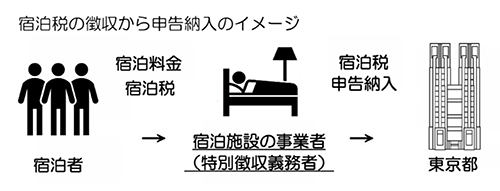
For travelers, the immediate impact may simply be a slightly higher bill at check-in. Like most accommodation taxes in Japan, this tax is collected by hotels and other accommodation providers on behalf of the local government and remitted to the municipality. To visitors, it’s just part of settling their accommodation bill.
The broader story, however, is that accommodation taxes are becoming an increasingly important part of how Japan finances tourism itself.
Rather than viewing tourism as an industry that largely pays for itself through broader economic activity, more municipalities are asking visitors to contribute directly toward the infrastructure and services that make travel possible. With Tokyo now joining destinations such as Kyoto and Niseko in redesigning its tax system, and places like Hakone considering similar measures, the question is no longer whether accommodation taxes will become more common in Japan, but how many other municipalities will follow.
Keep reading

Sources
宿泊税に係る総務大臣の同意及び施行日について 東京都
宿泊税制度見直しについて 東京都主税局
令和8年3月1日からの宿泊税制度の見直しについて 京都市
宿泊税について 大阪府
宿泊税を定率制に変更します ニセコ町
宿泊税について 倶知安町
北海道宿泊税について 北海道
箱根町宿泊税条例骨子(案)に対する意見を募集します 箱根町