
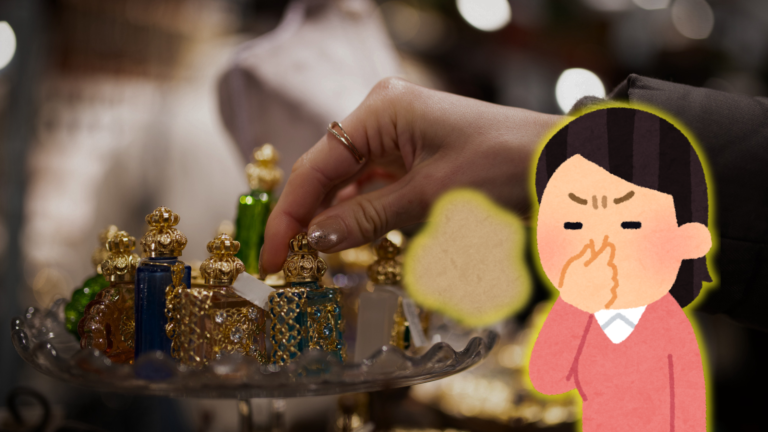
Beppu, Japan’s famous onsen town, offers aromas as much as it does sights. Steam rises from vents and gutters, mineral-rich hot spring water feeds thousands of baths, and the unmistakable sulfurous aroma of an onsen town drifts through parts of the city. It’s one of Japan’s best-known hot spring destinations, drawing visitors from Japan and abroad to soak in its waters and explore its famous “hells.”
But there’s one smell a small restaurant in Beppu would rather you leave at the door.
In June 2026, a local udon shop posted a photo of its handwritten rules, most of which were the sort of things you might expect from a cozy owner-run restaurant. Cash only. No outside food or drink. Customers should wait to be seated.
But the last rule was different.
Complete with a red handwritten sticker blasting, “THIS ONE ESPECIALLY!!” Myōban Udon said it would refuse entry to customers wearing “strong artificial fragrance.” The reason? The shop wanted diners to enjoy not only the taste of its udon and soba but also the aromas of the dashi and tempura. That’s an impossible feat when customers arrive with such strong scents that even the kitchen is affected.
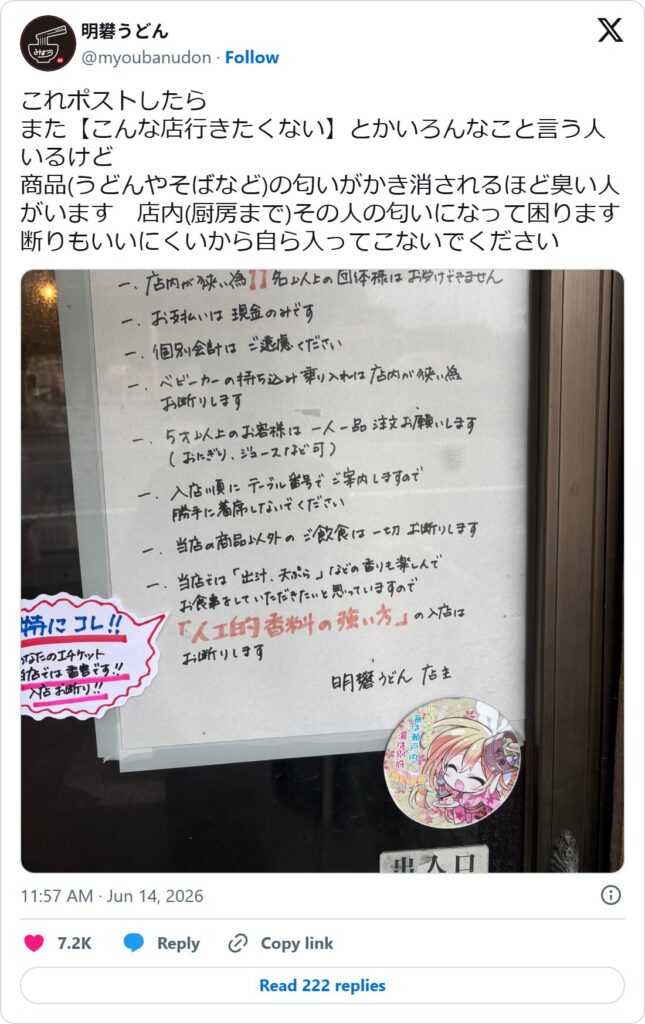
Turning someone away face-to-face is difficult, the owner added. So they would rather those customers simply not come in at all. “What you call your etiquette is, in our shop, kōgai (scent pollution)!! Entry refused!!”
For some overseas travelers to Japan, this may come as a shock. Depending on the culture, perfume or cologne isn’t just part of getting dressed up, but also a sign of being considerate enough to smell pleasant around others. For many in Japan, however, this is the opposite of good etiquette.
In fact, Japan has a word for exactly that.
What is Kōgai (香害)?
A play on the term for postwar pollution and public nuisance problems (公害; kōgai), the word Myōban Udon used on its sign was 香害 (kōgai), which can be translated as “scent pollution” or “fragrance harm.” The choice of characters is deliberate; replace 公 (public) with 香 (scent or fragrance), and suddenly someone’s choice of perfume isn’t just whether you like how they smell. Instead, it’s something being released into a space that everyone else has to share.
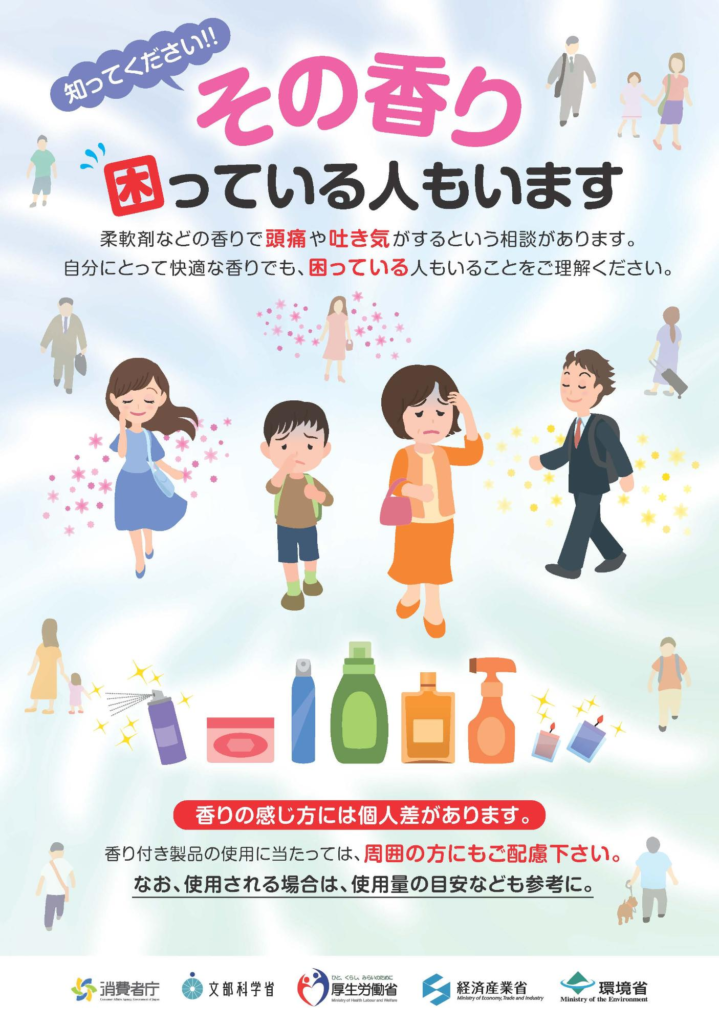
Kōgai isn’t limited to people complaining about perfume online. Back in August 2021, five government bodies (the Consumer Affairs Agency, Ministry of Education, Culture, Sports, Science and Technology (MEXT), Ministry of Health, Labour and Welfare (MHLW), Ministry of Economy, Trade and Industry (METI), and Ministry of the Environment) jointly released an awareness poster about fragrances in everyday products.
Its message was gentle: “That scent, maybe someone’s struggling with it?” (その香り、困っている人がいるかも?)
When the poster was revised in 2023, however, one small change made the message considerably more direct: “That scent, some people are struggling with it.” (その香り 困っている人もいます) The kamo, “maybe,” was gone.
The campaign hasn’t disappeared. The Consumer Affairs Agency raised the issue again in its consumer-safety mail magazine in February 2026, reminding people that scents from products such as fabric softeners can cause headaches, nausea, and other symptoms for some of those exposed to them.
That makes kōgai somewhat different from another term readers may have encountered: スメハラ (sumehara), or “smell harassment.” Sumehara is primarily an etiquette and interpersonal-conduct problem. It can refer to body odor, bad breath, tobacco smells, or someone wearing far too much perfume, especially when those smells make workplaces unpleasant for everyone else.
Kōgai approaches scent from another direction. The concern isn’t merely that someone smells unpleasant. It’s that fragrances in everyday products can enter shared environments and, for some people, reportedly cause physical symptoms.
Concepts like kōgai are something even repeat travelers to Japan may not stop to consider. We cover this and similar must-know facts about traveling to Japan in our free, five-day Japan trip planner. Sign up today, and we’ll send you more tips to help you make your trip to Japan an experience you’ll never forget.
Japan’s biggest “scent pollution” problem isn’t perfume

Given the sign at Myōban Udon, it would be easy to assume Japan’s kōgai debate is primarily about people wearing too much perfume. Instead, the product at the center of the debate is something much more mundane: fabric softener.
Japan saw a boom in strongly scented fabric softeners during the 2010s, including a rise in popularity of imported products. Domestic fabric softener sales rose from 282,000 tonnes in 2013 to 370,000 tonnes in 2018. And people weren’t necessarily using them sparingly. By 2015, 76.7% of consumers surveyed said they used fabric softener with every wash, up from 61.5% in 2010. Roughly one in five used more than twice the recommended amount.
As those scents became stronger and more common, so did complaints from people who couldn’t escape them. Between April 2014 and January 2020, the National Consumer Affairs Center of Japan (NCAC) received 928 consultations concerning the smell of fabric softener. Of those, 64% involved reports of physical harm. Women between 30 and 69 accounted for 78% of those reports.
But where those incidents occurred is perhaps more revealing than the total.
Of 402 cases where the location was recorded, 81% happened at home. Just 6% occurred in shops, while another 2% occurred in vehicles, airplanes, or ships. And in 71% of all consultations, the person complaining wasn’t even the person who had purchased the product.
Concerns over scented products have since developed into an organized consumer movement. In 2017, the Consumers Union of Japan opened a 香害110番 (kōgai 110-ban), or “Scent Harm Hotline,” for two days. It received 213 contacts by phone, email, and fax from across Japan. A 2020 survey by a coalition campaigning against kōgai received more than 9,000 responses, with over 7,000 respondents reporting harm and roughly 20% saying the problem had interfered with work or school.
The movement is now pushing beyond awareness campaigns. In May 2025, the Consumers Union of Japan and the coalition 香害をなくす連絡会 submitted an opinion paper to the Cabinet Office’s Consumer Commission calling for tighter regulation of scented household products. Among their requests were full ingredient disclosure, standardized hazard labeling, and action on plastic microcapsules designed to release fragrance over time.
A simpler takeaway for travelers
Some of the health discussion around kōgai also overlaps with 化学物質過敏症 (kagaku busshitsu kabinshō), or multiple chemical sensitivity (MCS). Japan added MCS to its insurance disease codes in 2009, although its diagnostic criteria remain contested. A 2015 population study of 7,245 Japanese adults found that 7.5% met the study’s criteria for chemical intolerance.
For travelers, though, there’s a much simpler takeaway.
You can leave your perfume bottle untouched and still be the strongest-smelling person in the room. Detergent and fabric softener linger on clothing. Shampoo, hair products, lotions, deodorants, and other toiletries can all contribute to how strongly someone smells to the people around them.
If you want to buy fragrance-free products while in Japan, look for 無香料 (mukōryō). Don’t confuse it with 微香性 (bikōsei), which means “lightly scented.”
None of this means you need to spend your vacation worrying whether somebody can detect the shampoo you used that morning. The issue is intensity, not the mere existence of a scent. Which raises the question most visitors actually want answered: Can you wear perfume in Japan?
Should you leave your perfume at home?
After all of that, it may seem like that’s the safest idea. However, there’s no blanket rule against wearing perfume or cologne in Japan, and Japanese people certainly wear fragrance themselves. Otherwise, there wouldn’t be any sales counters in department stores.
The better rule for visitors is much simpler: less is more.
The real question about scents is how far they travel. A fragrance noticeable to someone standing close to you is very different from one that announces your arrival before you’ve entered the room.
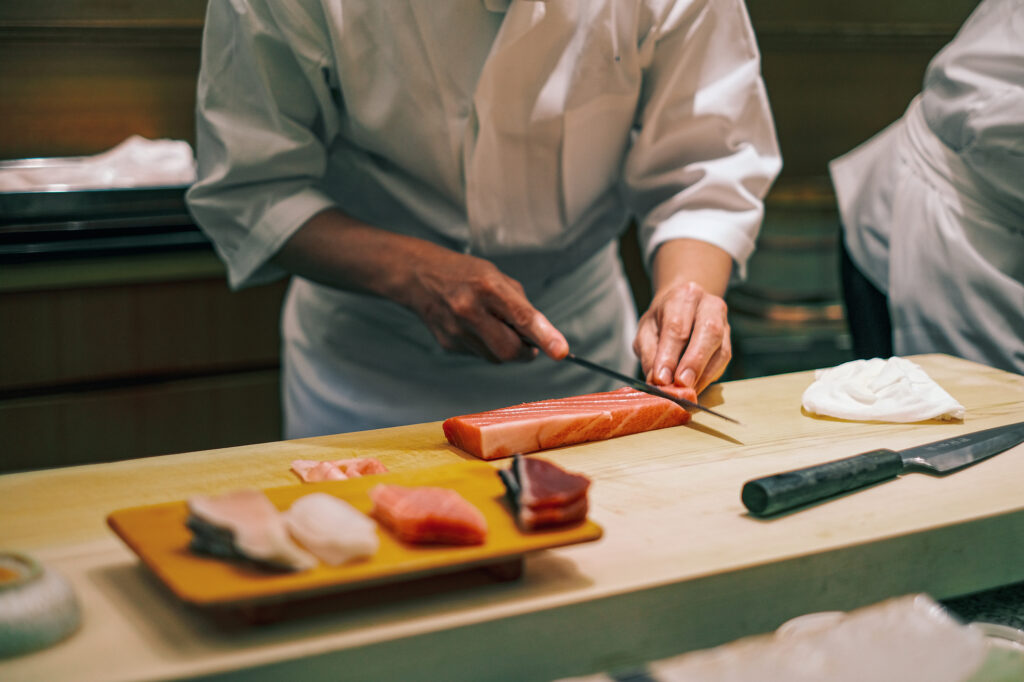
That very distinction came up in an interview with 寿司リーマン (Sushi Salaryman), a sushi enthusiast who has eaten at more than 600 restaurants. He told MonoMax that strong perfume is among the worst things a customer can bring to the counter. Sushi is delicate enough, he explained, that a strong nearby fragrance can make it difficult to perceive its flavor. He even recalled a heavily perfumed person entering a restaurant for only about ten seconds and leaving their scent behind.
Asked where the line falls with scented products, he said the faint smell of fabric softener or soap that someone only notices when they come very close isn’t something to worry about. Your fragrance should stay in your personal space rather than becoming part of everyone else’s.
That matters particularly in Japan because so many everyday situations put strangers in close quarters. A packed commuter train leaves little room to move away from someone wearing a strong fragrance. Small restaurants may seat diners shoulder-to-shoulder. At a counter, you may be sitting only a short distance from both the chef and the food being prepared.
When scent is part of the experience
However, there are some places where “wear less” becomes “wear none.”
The common thread is simple: if smell is part of what you’re there to experience, your perfume can interfere with everyone else’s experience too.
Counter sushi is one of the clearest everyday examples, but the same principle applies when tasting sake. Aroma is an integral part of kikizake (利き酒), the structured evaluation of sake by appearance, aroma, and taste. Kobe brewer Sawanotsuru advises brewery visitors to keep perfume and scented hair products to a minimum so they don’t drown out the aroma of the sake.
Breweries have another unusual reason to care about what visitors bring in with them. Some warn guests against eating foods such as nattō, yogurt, or kimchi before a visit. The concern there isn’t the smell: microorganisms carried on your body or clothing can potentially interfere with the kōji and yeast used in fermentation. In other words, what you bring into a brewery on your body doesn’t necessarily stay yours.
Meanwhile, at a tea ceremony, the room already has its own carefully controlled scent. Traditional guidance tells participants not to wear perfume, as subtle incense may be warmed in the tea room, with fragrances chosen according to the season. Adding your own perfume introduces an aroma that was never supposed to be there.
And if you’re attending kōdō (香道), the Japanese incense ceremony, perfume is an absolute no. Kōdō practitioners don’t say they “smell” the incense. They “listen” to it (聞く). During monkō (聞香), guests carefully appreciate an incense’s qualities, traditionally taking three breaths before passing it to the next person. Guidance from the Oiegaryū school’s Keisetsukai explicitly tells participants not to wear perfume or cologne when entering an incense gathering, and even asks them to remove rings and watches.
In that setting, outside fragrance isn’t merely rude. It can overwhelm the very thing everyone has gathered there to experience.
Whether it’s the aroma of fresh sushi, sake, tea, or incense, the easiest rule is also the safest one: if your nose is an important part of the experience, leave the perfume off.
Questions about manners in Japan sometimes don’t have an obvious answer. This is where having a tour guide can come in handy. If you want greater peace of mind on your Japan trip, ask us to design a custom tour for you and show you around.
Less is more
While there’s no objectively correct amount of perfume to wear, kōgai is not simply a complaint about foreign tourists. Japan’s fragrance debate predates the current tourism boom. Foreign visitors are entering a conversation that was already happening.
But when you’re traveling to Japan, as a general rule? Wear less, especially in crowded spaces. And when you’re somewhere specifically to appreciate an aroma such as sushi, sake, tea, or incense, consider wearing none at all. Perhaps that’s the simplest way to understand kōgai: instead of asking only “How do I want to smell?”, ask “How much of what I smell like should everyone around me have to experience?”
In Japan, the safest answer is usually: a little less than you think.
Keep reading


Sources
「その香り困っている人もいます」ポスターを掲載しました。 消費者庁
Vol.679 知ってください!その香り困っている人もいます 消費者庁
柔軟仕上げ剤のにおいに関する情報提供(2020年) 国民生活センター
「香害」や「化学物質過敏症」に苦しんでいる人がいます 名古屋市
【意見書】消費者庁に香害への対応を促すための内閣府消費者委員会への意見書(2025年5月19日) 日本消費者連盟
【プレスリリース】香害110番開設結果のご報告(2017年8月4日) 日本消費者連盟
Prevalence and Characteristics of Chemical Intolerance: A Japanese Population-Based Study Archives of Environmental & Occupational Health
日本酒の酒蔵見学での注意点を紹介。直前に納豆を食べてはいけないって本当?! 酒みづき(沢の鶴)
ワインの試飲会でのマナー&注意点 LoveWine
初めての香遊び 御家流香道 桂雪会
茶道のお稽古→初心者が茶道教室で稽古するときの基本作法・所作・マナー 茶の湯スタイル
「香水をつけるのは絶対NG?」大人なら知っておきたい“カウンター寿司のマナー・NG行為”を600店以上巡った寿司リーマンに聞いた MonoMax
声を上げづらい“訪日外国人客のにおい問題”「香水がきつくて電車内で気分が悪くなった」「いつものカレーの味がわからなくなった」 マネーポストWEB
「『人工的香料の強い方』の入店はお断りします」とあるうどん屋の注意書きにXからは様々な反応… 店からは出汁やてんぷらなどの香りも楽しんで食事してもらうためとの説明 Togetter
日本では「香害」とすることもあるが「ヨーロッパでは香水のにおいの指摘は喧嘩のもと」である話…インド人にとって和食は醤油ばかりに感じる話も Togetter