Japan is often praised for its bullet trains. More than a bucket-list experience for tourists, the Shinkansen carries millions of passengers across the country each year while maintaining an astonishing average delay of just 24 seconds.
Yet even one of the world’s most celebrated rail systems has its inconveniences.
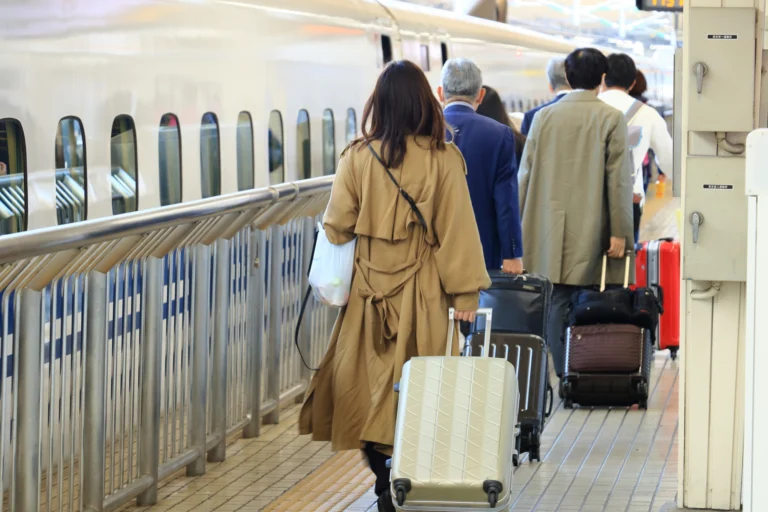
Just ask the 27-year-old Tokyo office worker who recently endured a 2 1⁄2-hour journey from Osaka to Tokyo wedged between two foul-smelling middle-aged men. After the ordeal, she took to X (formerly Twitter) with a simple plea: Give the Shinkansen women-only seats. The reason she asked for the change, however, added a new twist to the debate.
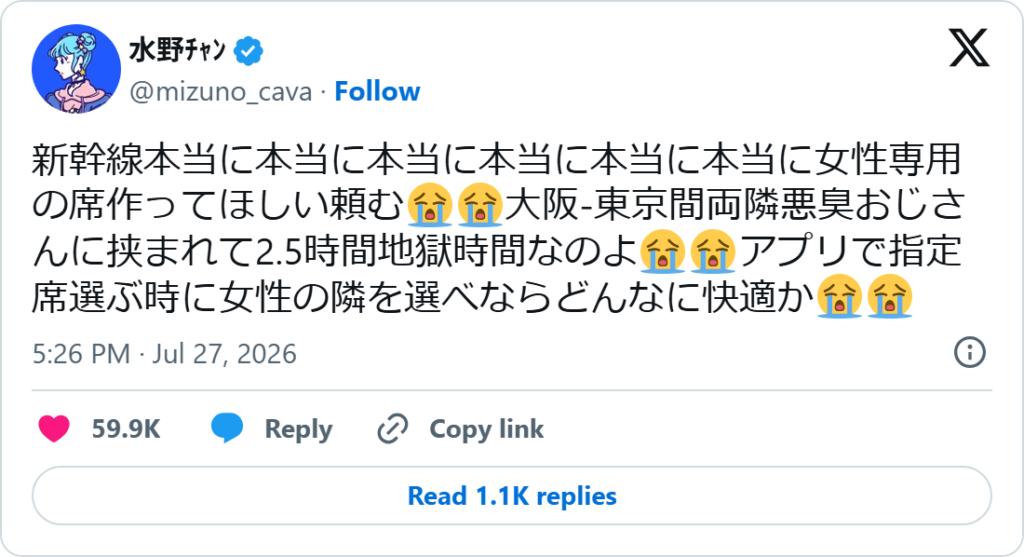
“I really, really, really, really, really, really want the Shinkansen to create women-only seats. On the Osaka-Tokyo route, I spent 2.5 hours sandwiched between two foul-smelling middle-aged men. It was hell. If only, when choosing a reserved seat in the app, I could choose to sit next to a woman.”
The viral July 27, 2026 post by @mizuno_cava (水野チャン) that reignited the debate.
The post quickly exploded online, attracting nearly 60,000 likes and almost 10 million views within days. Thousands of users flooded the replies and quote posts, turning one woman’s uncomfortable train ride into a nationwide discussion about comfort, fairness, and gender on public transportation.
Much of the conversation centered on her description of being trapped between two “悪臭おじさん” (akushū ojisan), literally, “foul-smelling middle-aged men.” While many women shared similar experiences and sympathized, others argued that unpleasant body odor is hardly exclusive to men. Some dismissed the proposal as discriminatory, while others suggested simply paying for a Green Car seat or another premium seating option instead.
Yet one detail surprised many readers.
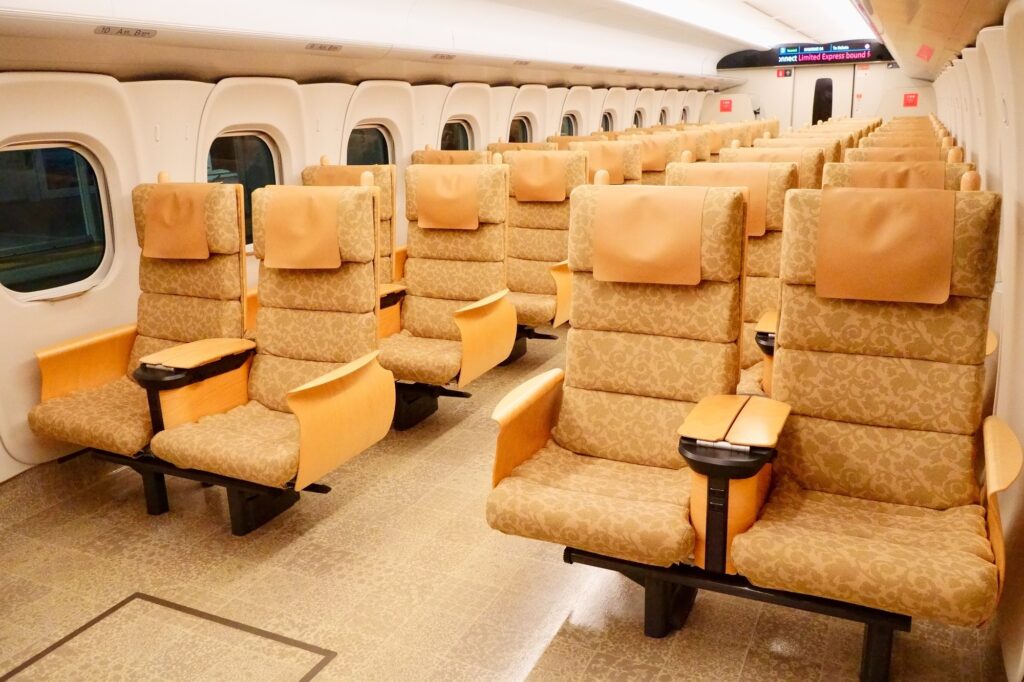
Does the shinkansen have women-only seats?
Picture: ARIAKE787 / PIXTA(ピクスタ)
Despite the viral attention, the answer is simple: no.
JR operates plenty of trains with women-only cars: they’re just not on the Shinkansen. Since 2007, JR West has offered women-only seating on several of its limited express services, including the Thunderbird and Kuroshio. These seats are available to women, as well as boys up to sixth grade traveling with them, at no additional charge beyond the standard reserved-seat fare.
But Japan’s most famous high-speed rail network does not offer women-only train cars, women-only seats, or any other seating area reserved exclusively for female passengers. Instead, passengers hoping to avoid sitting next to someone they find uncomfortable are encouraged to use non-reserved cars, where they may have more freedom to choose their seats, or to upgrade to the first-class Green Car.
So why would JR provide women-only seating on some trains but not on Japan’s flagship bullet trains? The answer lies in the history of why these accommodations were introduced in the first place.
Why did Japan introduce women-only train cars?
The first women-only carriage dates back to 1912, when Tokyo’s Chūō Line introduced one to help protect female students from harassment during their commute.
Fast forward almost a century, and the rising number of high-profile sexual assault cases created a demand that needed to be filled. Keiō Railway launched a trial in late 2000 before permanently implementing women-only cars in 2001, and other operators gradually followed suit. Passenger surveys conducted during the trial period found that the overwhelming majority of women, along with a majority of men, supported the move.
Today, women-only cars operate on roughly 90 railway lines run by around 30 railway companies across Japan. Despite their name, they are not legally enforced. Rather, passengers are asked to cooperate voluntarily by respecting the designated cars during the hours they are in effect.
JR West adopted a similar approach for some of its limited express trains in 2007, introducing women-only reserved seats after another widely reported sexual assault case. This time, however, JR West cited passenger comfort and demand, not safety, as the driving factor.
That history is precisely why Mizuno’s viral post sparked such a different conversation. Unlike the debates that originally led to women-only train cars, her complaint wasn’t about chikan, the Japanese term for groping or sexual molestation on public transportation. It was about something else entirely: body odor.
Question: do you like UJ's independent coverage of Japan? Our writers are supported by our members. Join Unseen Japan Insider to get bonus content every week, an ad-free website, and access to our large and growing Insider archive.If you love what we do, help us pay our writers to do more of it by joining Insider. You'll get bonus content every week, an ad-free website, and access to our large and growing Insider archive.
From chikan to sumehara
Picture: :maroke / PIXTA(ピクスタ)
For decades, the justification for women-only train cars in Japan has been straightforward: protecting women from chikan (痴漢), a type of groping and sexual harassment that has long plagued crowded public transportation. The goal was to reduce the risk of assault, especially during rush hour, when packed trains made offenders difficult to identify or stop.
Mizuno’s complaint, however, had nothing to do with sexual harassment. Instead, it centered on スメハラ (sumehara), short for “smell harassment.” The term refers to subjecting others to unpleasant odors in shared spaces, whether from body odor, cigarette smoke, strong perfume, or even heavily scented fabric softeners.
In recent years, sumehara has become part of Japan’s broader conversation about everyday etiquette and consideration for others in public. High-end restaurants and other businesses with intimate counter seating such as sake tasting experiences can refuse customers if their perfume is too strong.
That distinction helps explain why reactions to the viral post were so divided. Many supporters argued that being unable to escape an unpleasant seatmate for a two-and-a-half-hour journey is a legitimate comfort issue. Several pointed out that long-distance buses already offer women-only seating or same-gender seating options, making the absence of a similar option on the Shinkansen seem inconsistent.
Critics, however, questioned whether gender was the right solution to an odor problem. Women, they noted, can also have strong body odor, wear overpowering perfume, or remove their shoes during a journey. If the issue is unpleasant smells rather than personal safety, they argued, then creating women-only seating does little to address the underlying problem. Others went further, calling the proposal discriminatory toward men.
In other words, the debate quickly grew far beyond one uncomfortable train ride. It became a broader discussion about where the line should be drawn between passenger safety, personal comfort, and equal treatment in public spaces.
Could women-only shinkansen seats actually work?
Picture: denkei / PIXTA(ピクスタ)
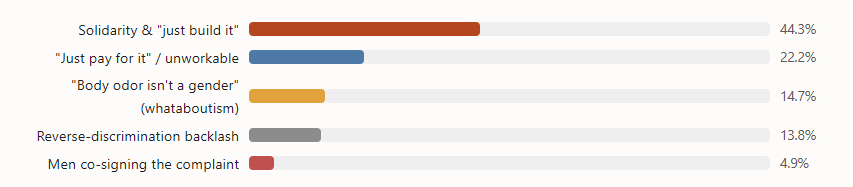
A plurality of commenters (44.3% by engagement/likes) supported Mizuno’s proposal. But others questioned how practical it would be to implement.
An analysis of approval/disapproval, weighted by engagement.
One common suggestion was to allow passengers booking reserved seats to choose whether they wished to sit next to a man or a woman. However, critics argued that such a system could easily be abused. Several male commenters openly admitted they, too, would choose to sit beside a woman if given the option, potentially defeating the very purpose of the feature.
Others pointed to the demographics of the Shinkansen itself. On weekdays, many services are heavily used by business travelers, who are still disproportionately male. Reserving seats or entire cars exclusively for women could complicate capacity management, particularly during busy travel periods.
Some also argued that alternatives already exist. Travelers willing to pay more can reserve seats in the Green Car, while JR Central’s premium S Work P Seat guarantees an empty adjacent seat separated by a partition. Others suggested choosing a non-reserved car, where passengers have greater freedom to select where they sit if seats are available.
Yet supporters countered that these solutions come at an additional cost, or depend on luck. They noted that long-distance buses in Japan routinely offer women-only seating areas or guarantee female passengers sit beside other women, making the absence of a similar option on one of the country’s flagship transportation services feel inconsistent.
Whether JR will ever revisit the idea remains to be seen. But the discussion sparked by one uncomfortable train ride demonstrates that the conversation around women-only spaces in Japan continues to evolve.