
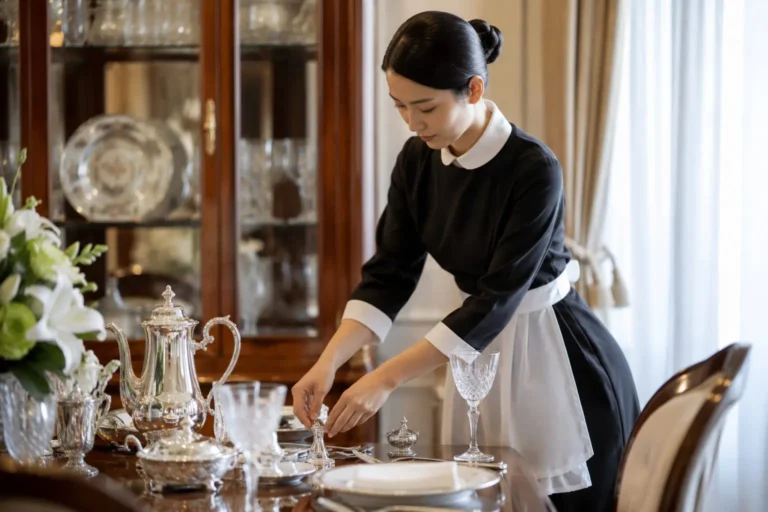
For most people in Japan, the word “maid” immediately brings one image to mind: frilly dresses, cute greetings, and themed cafés in Tokyo’s Akihabara district. So, naturally, when the Japan Butler Association announced it was opening what it calls Japan’s first systematic “maid school,” many people assumed it was connected to anime or cosplay culture.
Spoiler alert: it was not.
A straightforward school with a clear purpose

The new Japan Maid School specializes in training students for careers in private service for wealthy households. It focuses on a variety of different areas, like professional housekeeping, hospitality, discretion, and working alongside butlers. Entertaining customers in a café simply isn’t on the list.
The Japan Butler Association, an organization already known for training professional butlers serving affluent clients, is operating the school. The first class will begin on July 28 and run until September 3, with classes held every Tuesday and Thursday evening (9:00 to 10:30 pm JST). In total, there will be 12 online sessions, all conducted via Zoom. The school has also said it’s capping enrollment at just 20 students on a first-come, first-served basis.
Before you rush to apply, though, just note: the tuition isn’t cheap. The full course costs ¥290,000 (USD $1,790) before tax, averaging roughly USD $150 per class. They are egalitarian, though; anyone aged 20 or older can apply regardless of gender or previous experience.
Although most of the instruction is online, the program combines lectures with in-person role-playing exercises and individual mentoring. The curriculum covers seven major areas: advanced housekeeping for luxury homes, wardrobe and textile care, table-service coordination, confidentiality and professional ethics, serving VIP and high-net-worth clients, coordinating with butlers and concierges, and responding to emergencies.
Students can eventually earn one of three certification levels: Associate Maid, Certified Maid, or Senior Maid.
The organization has gone out of its way to explain that this is not a “moe maid” training course. Instead, it promotes the idea of the “authentic maid”; i.e., someone employed in a private residence whose job is to maintain the household and provide high-quality hospitality behind the scenes.
The history of the maid in Japan
Before World War II and even a few decades after it ended, live-in domestic workers were relatively common in wealthy Japanese households. Women originally known as jochū (女中), and later as otetsudai-san (お手伝いさん), handled cleaning, cooking, laundry, and other household responsibilities.
However, Japan began to change as the 20th century wore on, and employing full-time domestic staff became increasingly rare, except for the super-wealthy.
Meanwhile, “maid” (メイド) took on a completely different meaning thanks to pop culture. For this, you can mainly thank Akihabara’s maid cafés from the late 1990s to the early 2000s. People just really enjoyed the fantasy of domestic service built around cosplay and customer entertainment. For many younger Japanese people, that became their only real model (or at least the only one that stuck in their minds) of what maids and domestic servants are.
The Japan Maid School is effectively trying to revive domestic service professions while separating them from the pop-culture image built up over the past three decades.
Question: do you like UJ's independent coverage of Japan? Our writers are supported by our members. Join Unseen Japan Insider to get bonus content every week, an ad-free website, and access to our large and growing Insider archive.If you love what we do, help us pay our writers to do more of it by joining Insider. You'll get bonus content every week, an ad-free website, and access to our large and growing Insider archive.
The reaction online: from “Haha, seriously?” to “Wait… are you serious?”

After a news article posted about the school on X, the most common reaction was some variant of “Wait, it’s not talking about Akihabara maids?”
Not everyone in the comment section was just there to joke, though. Some users had serious questions, like asking whether a largely online course can really teach practical household service skills.
Frankly, that’s a fair point. Some aspects can be taught remotely, like etiquette, communication, and what type of cleaners to use for different surfaces. However, getting cleaning techniques, table service, and client interactions to a professional level needs extensive hands-on practice.
Skepticism ran high for other reasons, as well. Quite a few wondered how much demand actually exists for professional maids in modern Japan. Still more asked how, exactly, the maids trained by this school will be any different from already-existing domestic-help or housekeeping jobs available through agencies.
Niche luxury domestic work
These sorts of high-class maid services aim to take a slice out of the luxury-service market, which has been on the rise in Japan.
The association behind it says that it has served VIP clients and celebrities both inside and outside Japan, and that networking will be part of what’s offered to students of the Japan Maid School. This is arguably the most important aspect. After all, you can have all the skills in the world, but it won’t mean anything if you can’t find the right employer.
And since the association already has first-hand experience connecting with ultra-high-net-worth individuals (think ¥5 billion or USD $31 million in assets and annual incomes of ¥500 million [USD $3 million] or more), getting hired is almost a done deal.
So, while many may still be stuck on this “new” usage of the word maid, that’s not going to stop this school from trying to rebrand it as a high-class service worker.
Keep reading


Sources
「日本メイド学校」設立および「メイド資格制度」創設のお知らせ 一般社団法人 日本執事協会
日本メイド学校 第1期生募集開始のお知らせ ValuePress (日本執事協会)
日本メイド学校 (スクール詳細ページ) 一般社団法人 日本執事協会
日本執事協会が「メイド学校」開校へ 学ぶのは“萌え”ではなく邸宅で働く技術と人格 ライブドアニュース
日本執事協会が「メイド学校」開校へ 学ぶのは“萌え”ではなく邸宅で働く技術と人格 (announcement post) LiveDoor News (@livedoornews on X)
「秋葉原のアレじゃなかった」日本執事協会の“本格メイド学校“がXで話題 MEDIA DOGS
新井直之 (執事) Wikipedia
Now Is The Right Time To Invest In Japanese Luxury Oliver Wyman