
Icks, red flags, and deal breakers: everyone has them. Social media is flooded with people sharing their turn-offs, from bad posture to saying “hashtag” out loud (as in, “Hashtag tired” after a long day at work).
Usually, the posts are funny and harmless. Nobody gets called sexist. Everyone laughs and scrolls on.
But that wasn’t the case for one man, who almost dumped his girlfriend because she bit yakitori straight off the skewer instead of using chopsticks.
No gendered etiquette rule around yakitori
The girlfriend was so shocked that she sent an anonymous letter to an advice account on X, which published it Sept. 18 under the title “Yakitori breakup 🥹.”
Reader caution: The letter is anonymous and cannot be independently verified. It was shared by a third-party account, and the boyfriend’s remarks are reported through the girlfriend rather than quoted directly.
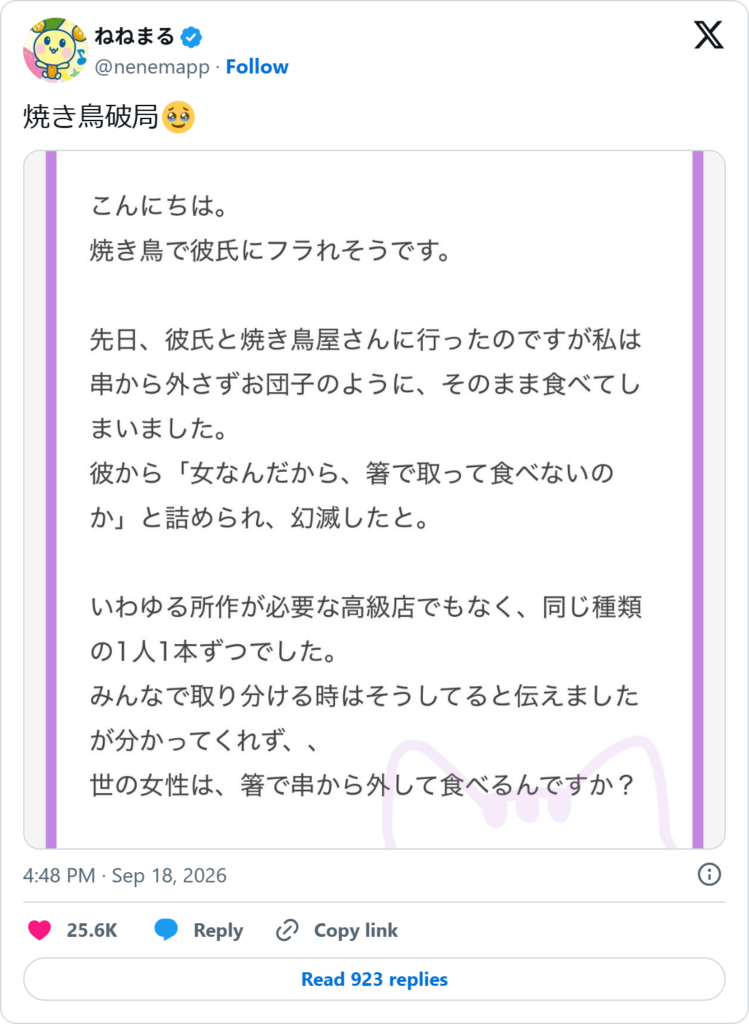
The letter read:
“Hello. I think I’m about to get dumped over yakitori. The other day, I went to a yakitori place with my boyfriend and ate my yakitori straight off the skewer, like dango, without taking the pieces off first. He called me out: ‘You’re a woman, so why aren’t you taking it off with your chopsticks?’ He said he was disillusioned with me.
“It wasn’t some fancy restaurant where table manners were a big deal, and we each had our own skewer of the same thing. I told him I do take it off when we’re sharing, but he wouldn’t let it go. Do women really take their yakitori off the skewer with chopsticks?”
The post received 25,654 likes and 3.71 million views within two days. In a sample of 566 replies and quote-posts, which drew 37,988 likes between them, not a single one sided with the boyfriend.
As for debunking the boyfriend’s claim, there’s no etiquette rule requiring women to remove yakitori from the skewer before eating it. In fact, common practice points in the opposite direction: two surveys found that most Japanese people eat it straight from the skewer.
But the boyfriend’s ick that almost caused this “yakitori breakup” is rooted in broader Japanese expectations for women at the table. Pouring drinks and portioning food have traditionally been seen as women’s responsibilities, while women are also more harshly judged for how they eat.
Reactions to the yakitori breakup
One of the most-liked responses, a quote-post from a former yakitori shop worker, argues that yakitori is made to be bitten off the skewer.
“I used to work at a yakitori shop,” wrote X user @satoimo23854084. “Whoever skewers the meat preps it so it tastes best the moment it comes off the skewer.” Their manager at the time, they added, said it was a real letdown to watch customers pick the pieces off bit by bit “when we skewer it for that exact moment.” The post drew 4,297 likes.
Engagement with the original post lay in the replies. An engagement-weighted pull on September 20 found 464 replies holding 31,046 likes against 102 quote-posts holding 6,942, so 82% of the conversation sits on the reply side. Two replies alone, at 10,430 and 6,183 likes, out-earn every quote-post in the thread.
What the trade says about biting
To bite off or not to bite off: the dispute is real, with professional opinions on both sides. Neither side, however, made it about gender.
Mainichi Shimbun reported in December 2024 on Japanese yakitori chefs who object to customers eating yakitori the “wrong” way. The newspaper featured Shusse Sakaba Daitōryō (出世酒場 大統領) in Minato City, which warns customers that the price goes up every time they pull meat off a skewer.
Owner Sawazaki Makoto, 52, expressed frustration over skewer etiquette to one of the newspaper’s reporters. “We put all this work into the prep, so yes, I get angry at customers who pull the meat off without asking,” Sawazaki said.
Two people who have worked in yakitori restaurants also weighed in on the original X post, and both said they prefer customers to bite the meat straight off the skewer. A former yakitori shop worker, whose quote-post drew 4,297 likes, explained that the way the meat is threaded is designed around that first bite. A current shop worker, whose reply received 2,783 likes, wrote: “We cut into our sleep to thread these, so it’s sad when someone strips a skewer in seconds.”
However, two etiquette professionals asked directly by Netorabo in 2015 declined to call removing yakitori from the skewer with chopsticks a violation.
Tanaka Junko of Global Knowledge Network said there’s no fixed correct answer and that what matters is reaching agreement among everyone at the table when sharing. Harada Yumiko of Six Stars Consulting said yakitori is designed to be eaten on the skewer, and that removing it can cause it to lose juice and heat.
Neither expert mentioned gender.
Comment section sides with girlfriend
Nobody took the boyfriend’s side. In that sample of 566 replies and quote-posts, not one endorsed the rule that women shouldn’t bite yakitori straight off the skewer.
The closest thing to a defense was a nine-like post whose author said they privately find the unskewered version cuter, but would never say so out loud.
The dominant response was to tell the girlfriend to dump him. Breakup advice appeared in 34.5% of posts and accounted for 73.4% of engagement, including both of the thread’s two most-liked posts. The most-liked item, at 10,430 likes, reads: “This is no time to be saying you’re about to get dumped. Hurry up and dump him. Marry him and he’s guaranteed to turn into a moral harasser.”
The most-liked comeback advice, however, made the argument about gender. At 3,717 likes, one user suggested telling the boyfriend that normal men don’t fuss over details like this, and that doing so is effeminate. It was a gendered insult answering a gendered insult.
The only other evidence of a gendered version of the yakitori rule came from one reply claiming that women’s magazines promoted the idea about 30 years ago that removing yakitori from the skewer was more refined.
Most people eat it on the stick

A 2024 survey of 500 Japanese adults found that 381 eat a skewer to themselves.
Shogakukan’s kufura asked men and women aged 20 and over what they do with yakitori at a drinking party: 381 said they eat one skewer per person, 104 said they remove the meat and share it, and 15 answered otherwise. That puts 76% in the eat-it-on-the-stick camp.
A reader poll nine years earlier landed in the same place. J-Town Research ran an open vote from July 7 to Sept. 1, 2015, drawing 780 responses; 71.4% said they do not remove the meat from the skewer, with regional results ranging from 82.6% in Hokkaido to 66.7% in Osaka. It was an opt-in web poll on a news site, not a representative sample, so the kufura figure carries more weight.
Neither survey publishes a gender breakdown, so neither answers the question at the heart of the letter: Do women actually take their yakitori off the skewer with chopsticks?
A 2024 dating survey found that table manners can cool romantic interest. But nothing skewer-shaped made the list. Next Level Inc. asked 420 unmarried adults aged 18 to 40 in spring 2024 whether a partner’s table manners had ever made them lose interest; 53.1% said yes, including 59.6% of women and 42.5% of men.
For both sexes, the top 10 were mostly hygiene and courtesy issues: chewing with the mouth open, being rude to restaurant staff, leaving a mess, poor chopstick handling, and talking with a full mouth.
Gendered food customs in Japan
Yakitori counters are male-dominated, with few women manning the grill as successors in their family-owned restaurants.
Pouring drinks and portioning out shared dishes are still treated as women’s jobs, sometimes in almost exactly the boyfriend’s words. Money Post WEB reported in August 2020 on oshaku (お酌; pouring drinks for others at the table) and toriwake (取り分け; portioning shared dishes onto individual plates) as women’s work at Japanese workplace drinking parties.
A woman in her 30s told the publication that a supervisor once told her, “You’re a woman, so go pour.” She also said that if she skipped portioning the salad or pouring drinks, someone would mutter that she was not very thoughtful.
Ramen offers another example of how gender can shape who feels comfortable in a food setting. Ichiran says one of the founding aims of its “flavor concentration counter” (味集中カウンター; aji shūchū counter) was to create a shop women could enter without a second thought.
Sendenkaigi reported in 2017 that during Ichiran’s early years, president Yoshitomi Manabu surveyed customers and heard from many women that they found it difficult to enter a ramen shop alone. A curtain prototype was installed at a Fukuoka shop in 1993; the patented counter followed at Hakata in 1997.
Ichiran representative Katsuragi told Mesitsu in February 2020 that some women said they were uncomfortable entering ramen shops alone and did not want to be seen ordering kaedama (替玉; an extra portion of noodles added after starting a bowl).
So how should you eat yakitori?
Most people eat it on the skewer, and the shops that make it generally prefer that you do. Taking it off to share is also a normal courtesy when there are not enough skewers to go around. That is roughly where the etiquette professionals land: read the table, rather than follow a rigid rule.
The girlfriend’s own account describes exactly that distinction. She takes the meat off when a group is sharing and eats it straight from the skewer when she has one of her own, essentially the same situational approach recommended by the etiquette consultants.
Keep reading



Sources
「串から抜かないで」 焼き鳥店主が本気で怒るその理由 毎日新聞 (archived)
焼き鳥を串から外して食べるのはダメ? マナーに詳しい人に教えてもらおう ねとらぼ
飲み会で注文した「焼き鳥」1人で串ごと食べるor串から外してシェアする?その理由は kufura (archived)
長年の議論ついに決着?「焼き鳥を串から外して食べる」は少数派だった! at home VOX
男女420人に大調査!恋が冷める「異性の食事マナー」ワースト10発表 PR TIMES
サラダ取り分け、お酌はいまだに女の役割? 女性レッテルに辟易する人たち マネーポストWEB
味集中カウンター 天然とんこつラーメン 一蘭
ラーメン店・一蘭、「味集中カウンター」の裏側に迫る 販促会議
一蘭の「味集中カウンター」はどうやって生まれたのか【最大で28.8m、厨房から席までの距離】 メシ通